| |
|
 |
|
I first visited
Acton church on the first day of January
2001, which seemed an appropriate day as
any to visit the parish that is the first
in Suffolk, alphabetically speaking. Back
in those days there was no keyholder
notice, so I had to gain access by
nefarious means. These days the church is
still locked, most unusually for
this part of Suffolk, but at least
today there is a keyholder notice, and
what is more what turned out to be a very
friendly keyholder when I returned on a
day of high summer in 2014.
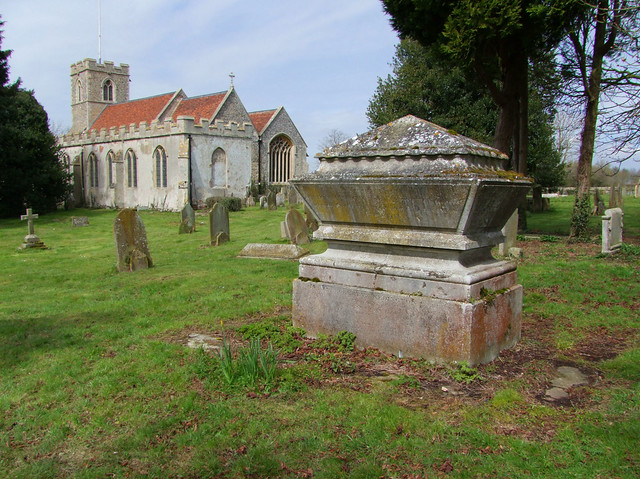
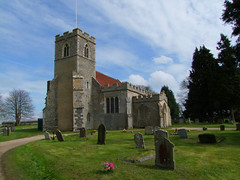
The tower is a 1920s creation, replacing
one demolished as dangerous in the 1880s.
An old avenue of yews stretches towards
the recreation ground, no longer the main
entrance to the churchyard. To the north
west, you can just see the tower of Long
Melford's Holy Trinity, three miles away.
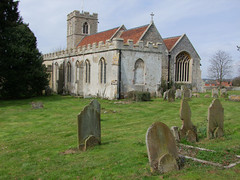
The setting is pleasant enough, the
church fine and grand, but the key is
well worth seeking out for a number of
reasons, not least because All Saints
contains the oldest brass in Suffolk, and
it is generally considered to be the
finest medieval military brass in
existence. Also, there is the remarkable
Jennans memorial, of which more in a
moment. And, in any case, Acton is such a
fascinating place, it would have been a
great shame not to enter the historic
heart of its community.
|
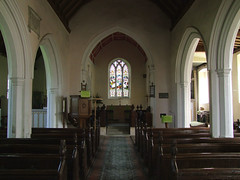
The church has undergone a considerable
restoration inside since my first visit, and now
feels extremely well looked after and loved. The
feel is that of large, square, Victorianised
interior, the aisles and nave all of a piece.
Looking to the east as you enter the south aisle
you can see the entrance to the extraordinary
Jennans memorial chapel. It is partitioned off
from the rest of the church by a grill, set in a
classical arcade, quite out of keeping amongst
the Victorian Gothic but splendidly aloof, like a
duke who has accidentally washed up among a party
of bank managers. Work of this period and quality
is rare in Suffolk; one thinks of Shotley and
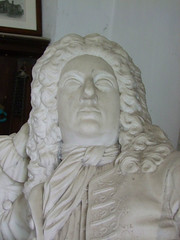
Boxted. Inside the chapel, the Jennens memorial
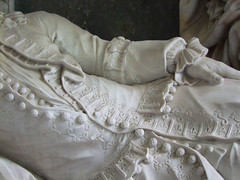
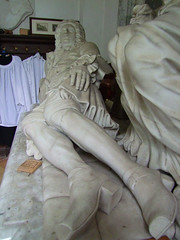
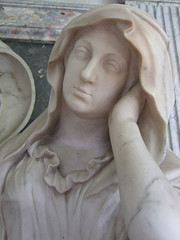
is big. Robert Jennans lies swooning in the
high camp fashion of the 1720s, wearing his own
clothes. He's not dead, but he doesn't look very
well. The allegorical figure of Grief weeps at
his feet, and you can tell she's not very happy
about his demise. The memorial records
Jennan's details, and those of his son, William -
but there is more to this than meets the eye.The
story of the Jennans family is an intriguing one.
They were a vastly wealthy family; they had made
their money in the Birmingham iron foundries of
the early 17th century. In the Civil War, the
family was split between the two sides, as so
many were. Fascinatingly, this resulted in at
least two separate sets of family records being
kept, some of which were contradictory. This
would have alarming consequences.
In 1708, Robert Jennans
purchased Acton Place from the recusant Daniels
family. He began to rebuild it into a Palladian
mansion, but the work was cut short when he died
in 1725. His son William inherited. William
stopped all work on the mansion, and lived in the
unfinished shell - to be exact, he lived in the
basement, in an unfurnished room, never going
into the rich tapestried wing his father had
completed. He lived entirely alone with his
servants and dogs, never having guests, and never
visiting anybody else. Some of the year he spent
in London, where he lent money to those gambling
in the casinos of the day. It is said that he
always carried an inventory of the other house
when he was away from it. He became nationally
famous as 'the Acton Miser', a role he played so
successfully that, at his death, he was the
richest man in England, and found to be worth
well over two million pounds, the equivalent of
about half a billion in today's money.
A chest in his shabby basement contained more
than £20,000 in notes, the equivalent of about
five million pounds today. He gave orders that
Acton Place was to be destroyed, and the story is
that he hoped to destroy any evidence of his
ancestors. He died intestate, and here the fun
begins. It turned out that his grandfather had
been married twice, and that he had two sons
called Robert. Because of the conflicting
evidence of the different family records, it was
never clear which Robert the Acton Miser was
descended from. From all over the country,
distant relatives appeared, chancing their arms
on a share of the fortune, forging birth
certificates, parish registers and so on. The
case of Jennans v Jennans ran on in the London
courts for more than eighty years, providing
generations of lawyers with an income, and
Charles Dickens with the basis of Jarndyce v
Jarndyce, the pivotal case in Bleak House. By the
time the legal case was resolved, it had absorbed
most of the estate.
One great mystery connected with the case
concerns the Jennans memorial itself. At some
point between the addition of William's name to
it in 1805, and James Coleman's survey of it in
1859, an unrecorded inscription 182 letters long
had been removed. Could it be that someone with
an interest in the case was trying to tip the
balance in their favour?
I wandered back down the south aisle, past the
funeral bier and remains of the medieval font,
which was dug up in the Rectory garden. Many
fonts were removed from Suffolk churches during
the Commonwealth of the mid-17th century, mainly
because of the disapproval of infant baptism by
local puritans. From the other end of the
theological spectrum, Arthur Daniels was born
into a devoutly Catholic family at Acton Place in
the 1620s. Catholics had suffered ferocious
persecution under Elizabeth I, and for a time
after her death there were hopes that such
troubled times were past. But, it was not to be.
Arthur left Acton in the early 1640s, to train as
a Jesuit Priest in Spain. He returned to England
to follow his ministry, but was quickly captured.
On the 11th November, 1642, he was cruelly
slaughtered before a large crowd at Tyburn Hill
in London. Naked, and suspended by the neck until
he started to lose consciousness, he was cut
down. He was slit open, and his bowels were wound
out in front of him on a windlass, being burned
before his eyes. His arms, legs and genitals were
removed, and thrown into the fire; finally, in an
act of mercy, he was beheaded. Some 300 Catholic
priests suffered the same fate between the 1550s
and the 1660s, and in the 1930s he was beatified
as the Blessed Arthur Daniels. Although he was
not among the representative sample of 40
Catholic martyrs canonised into sainthood in 1970
by Pope Paul VI as the Holy Martyrs of England
and Wales, he is, nevertheless, the nearest thing
that Suffolk has to a modern Saint.
I stepped into the nave, which is almost wholly
Victorian. 19th century restorations can be good,
bad or indifferent, and this is mostly a good
one. It was probably also very necessary, if the
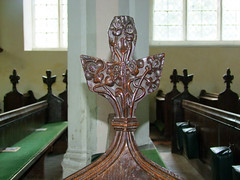
state of the tower was anything to go by. Some of
the benches are medieval, understated and
pleasing. But the mediocrity of the 19th century
font and east window should not be
underestimated.
It is the north aisle that brings us to the great
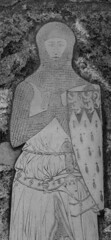
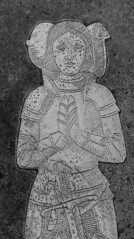
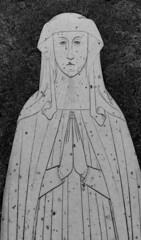
treasure of the church. The brasses are of Robert
de Bures, Henry de Bures and Lady Alice Bryan,
and some later, little Bryans. Robert de Bures is
the famous one. It dates from early in the 14th
century - Sir Roger himself died in 1331, but it
was certainly crafted before his death, and shows
the fashionable armour of three decades earlier.
The shield is actually cut out of a separate
piece of latten, so it may originally have been
designed for someone else. Whatever, it is the
oldest brass in Suffolk, the third oldest in all
England. It is about seven feet long,
meticulously crafted, and in superb condition -
so much so, I couldn't help wondering if it had
been secretly replaced by a replica. Mortlock
tells me that the church used to have a replica
on display for the benefit of brass rubbers, and
it would be the logical thing to do, but this
turned out not to be the case. To the south east
of it lies Lady Alice, another outstanding brass
that would be the pride and treasure of anywhere
else. There are also two smaller brasses of later
Bryans.
Between the north aisle
chapel and the chancel is a huge open tomb
recess, described as a founders tomb, and
certainly an Easter sepulchre. Stepping into the
chancel, you see that the detailing on it is
quite superb, one of the best in the county.
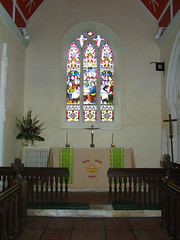
During the reordering of the sanctuary the old
carpets were removed to reveal high quality
Victorian tiling, as good as anything a few miles
off at Stanstead. A generation later, a
Zeppelin bomb which fell on the parish in 1916
was placed in an alcove under the tower, probably
the splay of a west window; there's another one
at Somersham. Beneath it, a sign remembers that
the bells were rehung as an act of thanksgiving
for surviving the Tokyo earthquake of 1923.
This is a clean,
bright, welcoming place, if lacking a
little of the atmosphere many people love
in a country church. But Acton has its
stories still. I thought of the
Rector's brother-in-law, a murderer (back
in 1740, I hasten to add) who was hung at
Bury St Edmunds, and then buried in the
crypt here under cover of darkness. I
thought of the so-called Acton ghost, a
coach and four that sets out on dark
nights from the former gatehouse of Acton
Place; it features in many a compendium
of East Anglian hauntings, except that no
one seems to be on record as having seen
it.
Mostly, I thought about Catherine Foster,
who lived in a cottage not far from the
church. She was a simple-minded woman who
poisoned her husband in November 1846,
just three weeks after their marriage at
All Saints. She made no attempt to
conceal the crime; she had married him to
please her mother, and decided that she
preferred her former life in service. In
an attempt to get back there, she cooked
his potatoes in arsenic. She was hanged
before a crowd of 10,000 people on the
Market Hill at Bury, the last woman to be
executed in Suffolk. She was just 17
years old.
On this bright sunny day in 2014 it was
easy to shake off any gloomy thoughts.
But back in 2001 I had set off in the
dusk towards Sudbury, across bleak, open,
winter fields. This was the old USAAF
base; between May 1944 and the end of the
War, more than four hundred American
airmen lost their lives in missions flown
from this field. If any ghosts haunt this
parish now, they are here. |
|
 |
|
|
|