| |
|
|
|
|
East Anglia has
plenty of churches which are more remote than St Mary,
Akenham, but can any of them be so lonely? Here we are,
just four miles from the Cornhill in the centre of
Ipswich, with the Whitton housing estate and the little
spire of Whitton parish church punctuating the landscape
beyond the fields and trees to the south. But we are
almost a mile from the nearest proper road, and there are
just two old farmhouses for company. Akenham church has
been redundant for decades, falling out of use in the
years after the Second World War, and not just because of
its remoteness.There is no village and the parish is now
almost entirely given over to intensive agriculture.
Hardly anyone lives in Akenham anymore.
Standing here on a narrow, muddy track through the fields
you can easily find yourself transported back through the
centuries. All there is to hear is the skylark spiralling
invisibly above you, the gentle rush of the wind in the
hedgerow, the sound of a dog from nearby Rise Hall. But
if Akenham church is remote, its story is less obscure,
for along with Rise Hall this little lost church was the
scene of one of the great ecclesiastical scandals of the
19th Century, a scandal which occupied the national press
for a year or more, a scandal which reached the highest
courts in the land, and which ultimately led to a change
in English law. It is the story of a conspiracy, a tale
of manipulation and persecution. Even more than this, it
was a watershed in the controversy surrounding the Oxford
Movement, and the irresistible rise of Anglo-Catholicism
within the Church of England.
To find out what happened here you need to go back to the
1850s. The minister in charge of this parish was the
rector of nearby Claydon, one Father George Drury, one of
the new breed of ultra-ritualists. His introduction of
candles and a cross on to the altar at Claydon, as well
as vestments, daily communion and even incense,
scandalised the local protestants, and led to his
admonishment by the Bishop of Norwich. For all these
things were quite illegal of course, and several priests
had been prosecuted, and a few of them imprisoned, one
for more than a year. Others were persecuted into
breakdown, early death and even attempted suicide.
Incumbents like Drury were notorious at this time not
least for calling themselves priests, which was
considered by some to be a suspiciously papist word. As
the 19th Century reached its middle years it was not
enough for a Church of England minister to be a
protestant, he had to behave like one too. And Drury's
greatest crime in the eyes of his opponents was the
establishment at Claydon of two religious communities,
firstly of men, and then a convent of sisters. We may
well imagine the effect on a Suffolk village of Father
Ignatius, the exotic monk who had led the men's community
here, later moving it to Norwich and then on to Wales
where it still survives as a Catholic community on the
island of Caldy. What enraged popular opinion most though
was the convent. Father Drury was accused of keeping a
harem, which was an outrageously offensive slur in the
19th Century. On one occasion a local mob broke into the
convent and 'rescued' a nun. She was conveyed to a
lunatic asylum on the orders of her father, and had to
remain there until his death. Anti-Catholic slogans were
painted on the side of Drury's rectory, and he built a
nine foot wall around it to protect it, which still
survives to this day.
But Claydon is a big village, and we may presume that he
found enthusiasts as well as enemies there. Supplemented
by adherents from the wider area, his Anglo-Catholic
services at Claydon were increasingly popular, despite
constant interference from the Bishop of Norwich, who on
one occasion threatened him with suspension for saying
services in an unlicensed preaching house - that is to
say, he celebrated communion in the convent. He was also
accused of calling communion 'Mass'. This all seems very
amusing today, but we need to remember that burning
passions were inflamed. Wider popular opinion, and at
times the Law, were on the side of the Bishop, not George
Drury. And yet Drury appears to have been a determined
character, fully equal to the Bishop's interference.
There was perhaps a grudging admiration in the nickname
he acquired of 'Firm Father George'.
If Claydon was a busy church, then Akenham was quite the
opposite. As I say, Claydon was, and is, a large village.
Now combined with Barham, it is virtually a small town of
ten thousand people. But Akenham, in the 19th Century,
could muster barely seventy souls (and a fraction that
number today). More than this, virtually all its
inhabitants were non-conformists, largely because the two
major landowners, Mr Gooding of Akenham Hall and Mr Smith
of Rise Hall beside the church, were both members of
Tacket Street Congregational Church in Ipswich. Each
Sunday, they would load up their carts, and take their
employees off to chapel. Akenham sexton Henry Waterman
could rightly claim in 1878 that he was the only Anglican
left in the parish.
Then, as now, it was left to the people of the parish to
elect one of the churchwardens. Unsurprisingly it was
usually a local landowner, and the people here elected Mr
Smith of Rise Hall, despite the fact that he wasn't a
practising Anglican. Equally unsurprisingly, Firm Father
George refused to recognise the appointment (although of
course it was recognised by the Bishop of Norwich) and he
also refused to allow Smith to hold copies of the keys to
Akenham church.
Every Sunday, Father
Drury set off across the fields from his rectory beside
Claydon church to hold a service at Akenham church. You
can still make this journey on foot today along a
bridleway. It is less than a mile. He would wait by the
gate, and if anyone turned up he would unlock the church,
go in with them, and a service would be held. Otherwise,
he turned back across the fields to his rectory at
Claydon. Estimates varied as to how often there was a
service here. Drury guessed once or twice a month, but
locals claimed no more than four times a year. It is
important to remember that, in canon law, Drury was not
allowed to hold a service without a congregation. The
Sexton did not count. Ironically, this legislation was
often used against Anglo-Catholics like Drury to stop
them saying private Masses.
It was, and is, the responsibility of the churchwarden to
ensure the upkeep of the church. But, since Drury refused
to recognise Smith as warden and denied him access, the
inside of Akenham church was reported to be in a dreadful
state, with dirt, decay and dead birds. This state of
affairs suited both parties, for from Drury's point of
view it reinforced the impression that there was no
warden. From Smith's point of view, it showed the results
of Drury's stubbornness and High Church fundamentalism.
On top of all this, a further pointed inflamed Akenham
feeling against Drury. Although Claydon had by ten times
or more the larger population out of the two parishes,
Drury received a stipend of just £240 a year for his
incumbency as rector there. By contrast, he received
£266 a year for fulfilling the role of perpetual curate
at Akenham. This total of about £500 a year is
equivalent to more than £100,000 today. This anomaly was
not unusual in the 19th Century, and it was the
responsibility of the patron who presented to the living.
In the case of Claydon and Akenham, the patron of the two
parishes was the Drury family themselves.
The whole thing then was a powder keg waiting to explode.
The fuse was lit in a quite unexpected manner.
Shortly before five o'clock in the afternoon on Friday
the 23rd of August 1878, Drury set off along the
bridleway towards Akenham church to bury a two year old
boy, Joseph Ramsey, the son of one of the farmworkers
employed by the non-conformist Mr Gooding of Akenham
Hall. Drury had been told during the week that the boy's
parents were Baptists, and the child had therefore not
been baptised. Adherents to the Baptist tradition
practise adult rather than infant baptism. The only
difference this would make to Drury would be that, in
canon law, he was not allowed to read the Book of Common
Prayer burial service over the coffin of an unbaptised
person. It is important to note that it would actually
have been an offence for Drury to read the service even
if he had wanted to, and he was already in enough trouble
with the Bishop of Norwich. However, Drury would still be
expected to accompany the coffin from the church gate to
the burial site, and to be present at the interment,
perhaps saying a short prayer.
At Akenham it appears that unbaptised infants were
usually buried on the north side of the churchyard,
although there was no particular reason in canon law for
this to happen. The tradition was maintained at Akenham
by Henry Waterman the sexton, who had dug the grave
earlier in the day and seems to have taken a dark
pleasure in informing the Ramseys of this arrangement,
allegedly telling them that their son would be buried
'like a dog'. In most churchyards, the north side of the
church is not as severely cut off as it is here. However,
contrary to popular belief this was not unconsecrated
ground. That many people believed the ground to be
unconsecrated emerged at the later trial.
What happened when Drury arrived at the church is
unclear, and depends on whose evidence you believe. What
all agreed on, however, was that the little coffin
arrived accompanied by an Ipswich Congregationalist
minister, the Reverend Wickham Tozer of St Nicholas
Street Chapel. Also present were the two main landowners
of the parish, Mr Smith and Mr Gooding, along with a
crowd of twenty or thirty farmhands, mostly members of
one or other of the Ipswich non-conformist chapels. Drury
arrived to find the Reverend Tozer beginning to hold a
service at the edge of the field across the track from
the churchyard gate, a field owned by Mr Smith of Rise
Hall.
Drury approached the group impatiently. He later claimed
that this had been to take charge of the coffin and to
accompany it to the grave. However, Tozer claimed that
Drury had attempted to break up the service. Whatever,
both sides agreed that firm words were spoken, Tozer
waving his fist in Drury's face. Both sides agreed that
Drury gestured towards the coffin with his umbrella, and
that the parents implored Tozer to ignore Drury and
continue with the service. Both sides agreed that Drury
eventually stormed off without burying poor Joseph
Ramsey, unwisely locking the churchyard gate before he
left.
The others then conveyed the coffin through the hedge and
buried it in the grave that Waterman had prepared, later
making it clear that they had not held any form of
service in the churchyard itself. For the part of canon
law that had prevented Drury reading the burial service
over an unbaptised infant contained another, even harsher
clause. This was that it was an offence in the eyes of
the law for a clergyman from another denomination to read
a burial service of any kind in a Church of England
parish churchyard. Now, given that 95% of burials at this
time, and almost all outside the great cities, took place
in Church of England churchyards, this was an
increasingly harsh piece of legislation. There had been a
recent lobbying of parliament for a change in the law.
After all, if an Englishman abroad could be buried in a
Catholic or Orthodox graveyard with the service of the
Church of England, why could not a Catholic, Orthodox or
non-conformist corpse receive the rites of its own
tradition in this country? A Burials Reform Bill was
talked up in all parts of the land, as a way of putting
right this injustice.
Some non-conformist chapels had their own burial grounds
(as at Tacket Street in Ipswich, for instance), but there
was none in Akenham, and surprisingly none in Claydon,
where despite the size of the village there wasn't even a
resident non-conformist minister. In normal
circumstances, the non-conformist dead would receive a
service in their own chapel before being conveyed to
their grave in the parish churchyard. In a place like
Akenham, where there was no chapel, that service might
take place in a cottage. But the service over the corpse
of the young Joseph Ramsey in the field beside the parish
church was quite unprecedented. Although there seems to
have been no law against it, it was a wholly unusual
situation, as unusual as such a great crowd being at the
funeral of an infant from a working class family.
Presumably Drury went back to his comfortable rectory,
seethed for a while, and then forgot about what had
happened. However, on the Monday morning he received a
nasty surprise. A detailed account of the incident
appeared in the East Anglian Daily Times, the
local newspaper with the largest circulation. This
purported to have been written by a witness. Had one of
the crowd been a reporter? How had he come to be there?
The report accused Drury, amongst much else, of trying to
prevent a Christian burial, and of saying in response to
Tozer's entreaties that "religious convictions...
and feelings have nothing to do with it - your
proceedings are altogether wrong and I must teach my
parishioners that I cannot sanction them". It
accused him of saying that the child was not a Christian,
and of storming off and locking the churchyard gate when
Tozer refused to cut short his service. Tozer had told
Drury to go to Heaven, the report continued, but instead
he had gone to Claydon, which "as far as the rectory
and adjoining nunnery are concerned, is a very different
place". The piece concluded with the editorial
comment: "We leave the facts to tell their own tale,
reminding our readers that this staunch upholder of
ecclesiastical law is already under admonition from his
own bishop for lawless proceedings in his own
church." Newspaper readers in the 19th Century would
have immediately understood this to mean that Drury was
guilty of High Church practices.
The report in the East Anglian Daily Times brought down
an avalanche of brickbats upon Drury's head. Letters
poured into the newspapers, both locally and nationally.
He was accused of being an unfeeling monster, the
embodiment of unfair and unjust laws. It was not long
before lurid accounts were being published of his
liturgical practices and lifestyle, as well as innuendo
about the convent, and his run-ins with the law. And then
it emerged that the original report in the East Anglian
Daily Times had been written by none other than the
Reverend Wickham Tozer himself. Several of the letters
attacking Drury and increasing the ferment had been
written by people directly involved in the case. For
instance, letters signed 'A Protestant Churchwarden' had
come from Mr Smith of Rise Hall
The report seemed carefully calculated to provoke some
sort of response from Drury. Whatever, Frederick Wilson,
the editor of the East Anglian Daily Times,
seems to have thought legal action likely. Wilson wrote
letters to several people concerned with burial law
reform, suggesting that they might finance his costs in
any court case. "Such an action would do more to
further the burials bill than any step I can
imagine", he wrote to Tozer. "I trust the
friends of religious liberty, now so thick around you,
will come forward to help us. I want to form a guarantee
fund of £500 to defend this action, and if he brings it,
to attack him simultaneously under the Public Worship
Act." This was the legislation that prevented
Anglo-Catholic priests from introducing ritual into their
churches, on penalty of imprisonment. "If there is
any bottom in this talk about the Burials Bill, there
should be no difficulty in getting plenty of money to
fight such a cause."
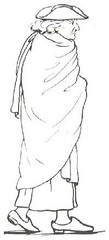  
Well, Drury had the
courage to sue, and sue successfully, Frederick Wilson
for libel. (In English law, it is the publisher rather
than the author of a piece who is liable). However, the
jury only awarded Drury damages of 40 shillings plus
costs, thus presenting a moral victory to Wilson, and, by
extension, to Reverend Tozer, Smith and Gooding.
During the trial, a number of curious facts emerged.
Firstly, Tozer had not been the Ramseys' minister. In
point of fact, he had never met them before that day. He
had been asked to conduct the 'impromptu' service by
Smith and Gooding, who had known that Tozer was an
experienced journalist. Furthermore, Smith and Gooding
were both related to the editor of the protestant Christian
World magazine, which would quickly pick up the
story as though from an authoritative source, and
gleefully run with it.
Tozer would surely have thought it odd when he arrived to
find a group of twenty to thirty farmworkers present, as
well as the two leading landowners of the parish. An
infant burial, after all, was a wearily common occurence.
Tozer himself stated that he had buried ten of his own
children. But it also emerged that the two landowners,
Smith and Gooding, had asked Tozer to compile a written
account of the proceedings, a request with which he
complied. He had incorporated their contributions, and
had even allowed them to correct the final draft before
it was passed on to Frederick Wilson at the East
Anglian Daily Times.
Was this a conspiracy, intended to discredit Drury's High
Church practices? Or was it simply designed to provoke a
change in the burial law? Whichever, popular opinion
remained against Drury. A national fund was set up to pay
Wilson's costs, raising over £1000, almost a quarter of
a million in today's money. A small amount of this went
to provide a proper headstone for the little boy.
Drury soldiered on at Claydon until his death in 1895,
and the events were increasingly forgotten as the years
went by. And then in the 1970s the writer Ronald Fletcher
discovered a scrapbook of press-cuttings about the
incident in a Southwold junkshop, and put together an
excellent account of the scandal in his book The
Akenham Burial Case, a reworking of a chapter in his
book In A Country Churchyard. His books showed
that the incident had led directly to the passing of the
Burial Law Reform Act of 1880. There's no question that
this popular change in the law was bought at the expense
of George Drury's reputation. As recently as the 1980s,
the Churches Conservation Trust guidebook to Akenham
church stated that this churchyard was the site of a
famous incident in which the rector, George Drury,
refused to allow the burial of a child of non-conformist
parents. I've seen this claimed elsewhere as well,
but Drury was not at the time accused by Tozer of this,
and certainly strongly refuted any suggestion at the
trial that he might have considered such a course of
action. Perhaps the confusion arises from a misreading of
Fletcher's books.
And so, you stand outside the gate, at the very spot
where Joseph Ramsey's coffin rested. On the other side of
the track is a gate into the field where the incident
took place. Beyond, Rise Hall sits in a dip.
 
The gate has been
renewed since the unfortunate afternoon that Drury, in
his anger, locked it against the burial party, but the
gateposts that you step through are the very same ones.
The church, on rising ground, presents a slightly curious
aspect. The 14th Century tower is a south one, common
enough in the Ipswich area, but a 17th Century brick
mausoleum has been built to the east of it, today forming
a south aisle. From the east end of the aisle, two modern
steel joists protrude, a reminder of another unhappy day
in the life of this church.
In 1940, a German bomber returning from a foray over a
Midlands city dumped the rest of its load here before the
hazardous recrossing of the North Sea. A mine hit St Mary
directly, wrecking the building. It remained derelict
until the 1960s, when the energy and enthusiasm of the
local people, and the resources of the Friends of
Friendless Churches, rescued the little building and
restored to use, as part of the benefice of Whitton and
Thurleston. In 1976, the Anglican Diocese declared it
redundant; not, perhaps, unreasonably. It was vested in
the care of the Redundant Churches Fund, now the Churches
Conservation Trust.
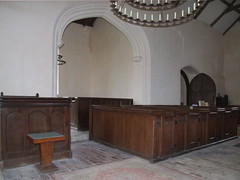
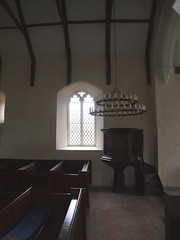
The Tower is stark, but the whole thing together is so
pretty that one can forgive this. The interior is bare
and tidy in the CCT manner, no doubt neater than in
Drury's day. As at Claydon he probably designed and made
some of the furnishings with his own hands. As if a sense
of melancholy has infected the building, there are two
other moving features not associated with the burial
case. One is the war memorial. It bears just three names,
but they are all members of the same family, Purkiss. The
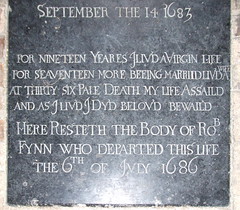
other is a ledger stone for Elizabeth Fynn, who died in
1683. The inscription reads:
For nineteen Yeares I liv'd a Virgin life
For seaventeen more beeing marriid liv'd a wife.
At thirty six Pale Death my life Assaild,
And as I liv'd I dy'd belov'd bewail'd.
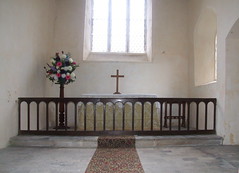
There are a couple of curiosities. In the chapel, which
is clearly post-Reformation, there is a medieval piscina.
Was it placed there, as seems likely, by Firm Father
George? Or was it there already, the aisle built on the
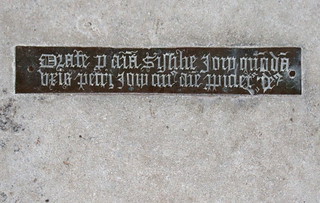
site of an earlier one? Just inside the door, there is a
medieval brass inscription, asking in Latin for prayers
for the soul of Sissilie Joly. It seems an unlikely
survival in puritan Ipswich and can't be in its original
position.
Like all CCT churches, Akenham is admirably cared for.
The great irony is that for many years the main custodian
and keyholder was at Rise Hall, the farm where Drury's
'protestant churchwarden' Mr Smith lived, whom Drury had
not allowed a key. The narrow path between the Hall and
the church cannot have changed at all in the years since.
But coming back here in the summer of 2019 I was
disappointed to discover that there was no longer a
keyholder notice. Wandering down to Rise Hall I found it
empty, the rooms visibly bare through the windows.
Before leaving, there is one last thing to do. You walk
round to the north side of the church to find a
disconcerting corrugated iron fence separating the
churchyard from a neighbouring farm. Here in the gloomy
shadows of the church there is just one headstone of the
dozen or so that were here in the 1870s. It is small, and
it is Joseph Ramsey's, of course.
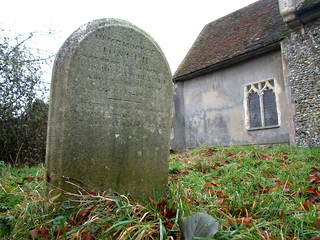
The inscription reads
In memory of JOSEPH, son of Edward and Jane Ramsey, who
died at Akenham on his second birthday August 19th 1878.
'Suffer little children, forbid them not to come unto me,
for of such is the Kingdom of Heaven'. In 1978,
Ronald Fletcher found this headstone leaning against the
church wall, so it has been reset since then, perhaps not
quite in its original place. On a cold winters day, with
the wind furrowing the grass, it would be easily
overlooked.
And there are other
graves elsewhere, now equally overlooked and forgotten.
Wickham Tozer lies under his sinking headstone in a quiet
corner of Ipswich Old Cemetery, his inscription telling
us that he was pastor of the Congregational church,
St Nicholas, Ipswich, chairman of the Board of Guardians,
the labour bureau and the free library. Died September
9th 1908 aged 76. "After he had served his own
generation... fell on sleep." The headstone
also remembers his wife Emily who died in 1904 and,
poignantly, also of 9 children of the above, interred
elsewhere. Closer to Akenham, George Drury lies
under a tree against the wall separating Claydon
churchyard from his rectory, now a private house. His
memorial is a cross-shaped tombchest surrounded by rails.
 
I thought back to the
1990s when I first stood outside this gate where the
whole thing began, looking out towards Ipswich's Whitton
estate to the south. The tower block of Thurleston High
School was prominent on the horizon. This school, which
served the estate, was named after the vanished village
of Thurleston, which was once in the valley below. The
ruined church of Thurleston was demolished under Drury's
direction in the 1860s to provide materials for the
rebuilding of Whitton church. It is said that Drury used
some of the medieval masonry from here to construct the
grotto which you can still see over Claydon churchyard
wall in the garden of the former rectory.
The fields of Akenham
are rugged in winter. Frantic, relentless gulls clamour
behind the plough as a tractor drags it up the flinty
soil of the rise. Electricity pylons criss-cross all the
land around about, and perhaps if Joseph Ramsey had lived
he might, as an old man, have seen them going up. I
thought about how all of this happened a century and a
half ago, but that a century and a half was not such a
very long time. When you are exploring medieval churches,
it's a very short time indeed.
|
|
|
|
|