| |
|
 |
|
Alderton is a busy
little village where the roads come
together out on the Bawdsey Peninsula. St
Andrew is almost entirely the work of
Arthur Blomfield, the 19th century
architect. He seems to have spent an
uncommonly large amount of time in the
county of Suffolk, and his work extends
from the vast, urban St John the Baptist,
Felixstowe, to the tiny chapel in the
woods on Culford Heath. Much of his work
in the county was restoration stuff, and
his hallmark is the mystical, rural
archaism of Early English/Decorated
Transitional.
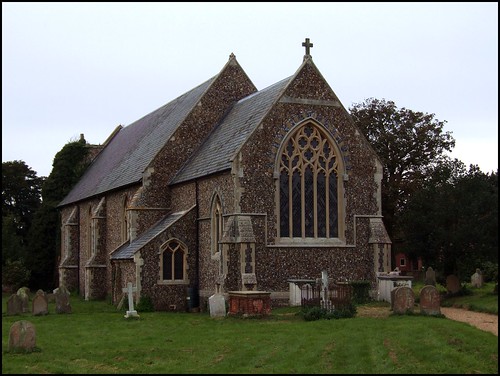
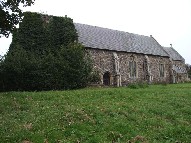
My first sight of St Andrew was
accompanied by a shock of recognition,
for here is Blomfield's work in all its
glory, a crisp exterior in a pleasant
setting, with a pub garden that cuts
directly into the churchyard. The oddest
thing about the church is its tower - or,
rather, the absence of one. As with much
of this area, the wealth and activity of
the early medieval period were replaced
by later depopulation and poverty, so
that, as with Bawdsey a mile away, this
church was soon crumbling. |
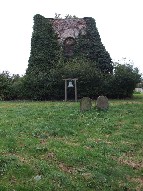
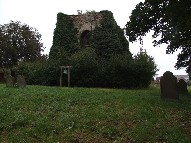
The tower fell
progressively during the 17th and 18th centuries,
then achieving its present state one Sunday
morning in 1821, when it collapsed during morning
service, killing a cow. I understand that the cow
was outside the church at the time. The ruined
tower is most splendidly overgrown, full of ivy,
angelica and elder, and there's no other Suffolk
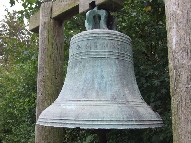
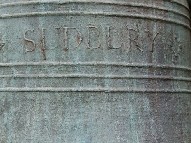
church like it. The Millennium project was a
little turret for the bell, which now stands just
to the west of the tower. For many years, this
bell sat on the floor of the nave. A more
ambitious, and slightly tongue-in-cheek, project
suggested for the Millennium here was to rebuild
the tower - perhaps inspired, or even provoked,
by the vast amount of money about to be spent on
building a tower at the Anglican Cathedral in
Bury.
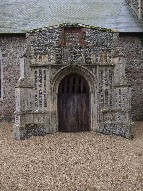
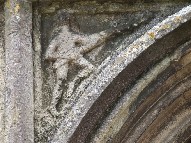
The great survival of the
church is the late medieval north porch, which,
although battered and truncated, retains a
Suffolk Wild Man stalking a Dragon in the
spandrels, and Marian monograms around the base.
The porch must have been huge before it lost its
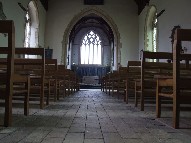
upper storey. I stepped inside to the a
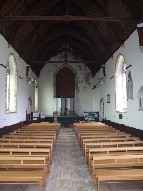
substantial, light, open nave. As with Bawdsey
and Hollesley, this church must have been a big
one before the rot of poverty set in. The
interior is thoroughly Victorianised, if not
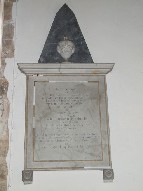
urban and anonymous; but Blomfield retained some
of the memorials from the pre-Restoration church,
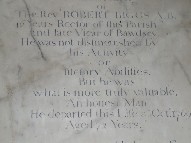
and there is an interesting one to Robert Biggs,
a Rector of Alderton and Bawdsey who died in
1769: He was not distinguished by his
Activity or literary Abilities, But he was what
is more truly valuable, An honest Man. Amen
to that.
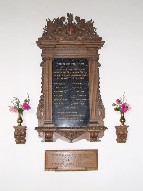
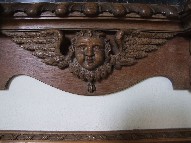
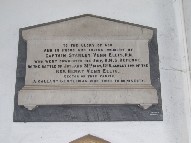
The War Memorial is a
marble slab set in an 18th Century-style wooden
frame - I don't think I have seen another one
like it. It is large, as you'd expect in a
coastal parish which sent many young men off to
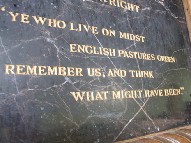
the Navy as well as the Army. Poignantly, it
slightly misquotes the famous line from Kipling: Ye
who live on midst English pastures green,
Remember us, and think what might have been,
suggesting that it was recalled from memory.
| Blomfield also
left in place the piscina in the south
wall, but the chancel is all his typical
ritualist ordering, designed for for a
style of worship now rather out of date,
although when I was here about eight
years ago, the lady cleaning the church
assured me that it flourished at
Alderton, and that there was a strong
musical tradition here. Most curiously, Blomfield
installed what appears to be a mock
Easter sepulchre in the north wall,
possibly for use as a credence, but
probably just because it looked
harmonious. When I was here before, the
west end was anything but harmonious,
with a partition screen cutting the
church off from the ruins of the tower,
and the tower arch looming in an alarming
manner above it. Today, this end is home
to a raised stage, giving the church a
dual purpose, depending on which way you
are facing. What a splendid idea!
Splendid, too, to sit outside the Swan,
gazing over the top of a pint at the
depredations of time, and Blomfield's
masterly restoration.
|
|
 |
|
|
|