St Mary, Aldham

www.suffolkchurches.co.uk - a journey through the churches of Suffolk
|
St Mary, Aldham |
|
|
||
www.suffolkchurches.co.uk - a journey through the churches of Suffolk |
||
Follow these journeys as they happen at Last Of England Twitter.
| I cycle past this church often -
or, at least, the top of the lane that leads down to it.
Traffic rushes along the busy Ipswich to Sudbury road not
far off, but there is a quieter, parallel road which not
many people seem to know about. It leaves Ipswich through
Sproughton and will take you all the way to Sudbury,
visiting the likes of Burstall, Kersey and Little
Waldingfield on the way. Aldham as a village is little
more than a straggle of houses, but they lie along this
road, and just beyond a cluster of houses you take a
sudden turn to the left, on to a pretty track to Aldham
Hall. Down through fruit trees you descend, until the
walls become older, and there at the end are the farm
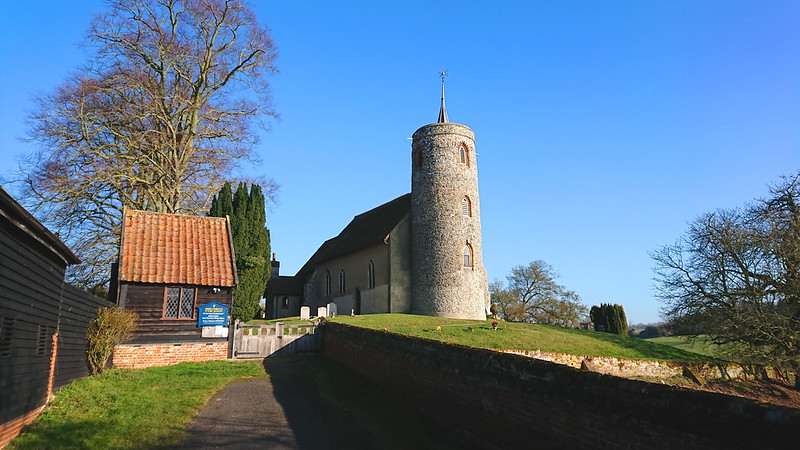
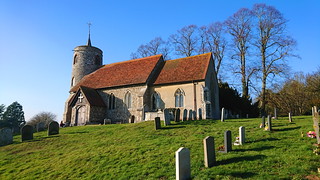
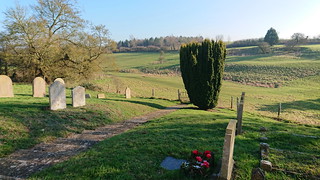
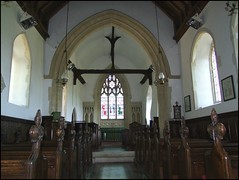
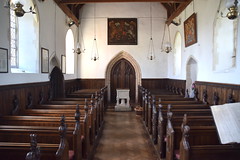
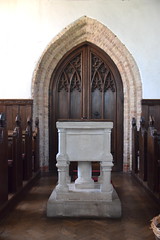
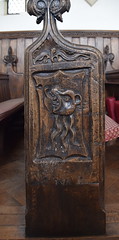
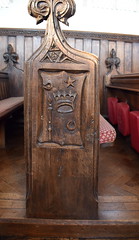
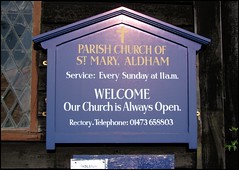
buildings. Beyond them, is this pretty church. If the church is pretty, the view from it is doubly so - to the south, the land drops away alarmingly, into a valley full of sheep. You may even think you recognise it, and you could well be right, for the second season of the popular TV series The Detectorists was filmed here, as a small display in the porch of the church reminds you. The church appeared in the opening credits of each programme, the two main characters searching for buried treasure in Aldham Vale below the churchyard. This is lovely, and splendidly English. Nothing could be more peaceful. But beyond, the land rises to a dark sea of trees, the mysteriously named Wolves Wood, now an RSPB reserve. Looking along to the right, the other hilltop is where the Protestant preacher Roland Taylor was burned at the stake in the 1550s, a site of pilgrimage for his many American descendants. Whatever your reading of the English Reformation, Taylor's burning was a terrible event. One imagines the villagers gathered outside this church, watching the flames and smoke rise. I remembered the first time I came here, back in the 1990s. We arrived on one of those humid, overcast summer days, on our way to the Bildeston Beer Festival. My young children scattered off to play hide and seek with their mother in the precipitous graveyard. An elderly man was pottering about, looking at 19th Century graves, so I apologised for my family (as you do). But he seemed genuinely pleased that they were running about like mad things. He was tracing his family, and had come down from Norfolk to look for a particular grave of an ancestor. And he'd found it. He was pretty pleased about that, too. He was also following up a theory that his ancestor had been a Rector of this parish. His address had been Aldham Rectory. Did I have any idea how he could find out? I suggested that the church might have a board of 'Rectors of this Parish'. Many do. These are a pleasant Victorianism, intended to overcome the 16th Century breach by claiming a history of the CofE that extended back before the Reformation. We could go inside, and take a look. And we did - the church was militantly open, the inner door wedged wide. We found the board - but the name wasn't there. So, the mystery remained unsolved. This church was pretty well derelict by the mid 19th Century, and underwent a fairly late restoration, in 1883. The tower was rebuilt, as was the south wall of the nave. The roofs were replaced, giving an overwhelmingly Victorian appearance, although Sam Mortlock detected the Norman, and possibly Saxon, ancestor. The hill itself suggests a very early foundation, perhaps on a site of pagan worship. The architect was WM Fawcett, and there was another restoration of the inside in the early 20th Century under the eyes of diocesan surveyor and renowned antiquarian H Munro Cautley. The resulting interior is one of those neat and shiny jobs that is certainly grand, and pleasant enough, but rather dated now. Our early 21st Century spirituality seems to respond more to dusty, ancient interiors than to these High Church ritualisations. But you get a sense of a church that is still much loved, well-cared for, and used regularly. Aldham parish have gone one further than a wedged-open door, and a big sign has been erected at the bottom of the lane proclaiming that Our Church is Always Open, and so it is easy to step inside. And it is not without survivals, some of them fascinating. The benches are mostly Cautleys from the 1920s, but he incorporated a couple of earlier ones. These are unlike anything else I've seen in Suffolk, and their primitive quality suggests a local origin. The one to the west apparently shows a bear, or possibly a lion. My first impulse was that it was some kind of heraldic device, but what is the shaved off object it holds in its mouth, and is the pattern emerging from beneath the head really fur? Back in 1999, my six year old took one look at it and decided that the creature isn't eating the bird, but the bird is flying out of its mouth. Could it be a dove? And could the three objects issuing from beneath the head actually be tongues of fire? In which case, could this be some strange composition representing Pentecost, and the descent of the Holy Spirit? In the spandrel above the bear, or whatever it is, there is a lily, the symbol of the Annunciation. But it is also a symbol of the crucifixion. It calls to mind the rare lily crucifixes, of which just two are known to survive in Suffolk, at Long Melford and Great Glemham. Could this be an unrecorded third? The other bench end is probably easier to read. The crown is obvious enough. The star and crescent are familiar from representations of the crucifixion. The pike is a familiar instrument of the Passion. And, if you look in the spandrel above, you'll see a crown of thorns, so this may well be a composition representing the Passion. A third bench end, to the east, shows just a simple spiked tool, that looks as if it might have been used in thatching. So, what's it all about? They are all a bit of a mystery, really. And what of the font? This is curious too. It appears to be Norman, but a second glance finds it too elegant, too finely detailed. The pillars are almost Classical in design, and the whole piece has a touch of the 18th Century about it. Was it brought here from somewhere else in the 1880s? Or is it a Victorian recutting of a Norman predecessor? Whatever, the revealed brickwork of the late medieval tower arch looks most fitting behind it. To see Cautley's work in its full
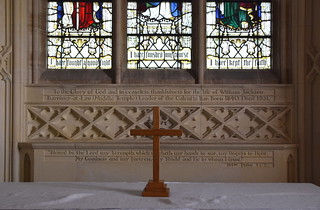
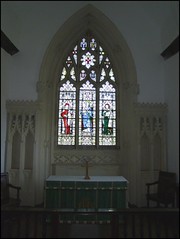
glory, step up into the chancel for the reredos and its
flanking niches, as grand as a side-chapel in a French
cathedral. Cautley was usually a safe pair of hands in
these churches he loved so well, but I wonder what he had
been thinking to impose this triumphalism on this pretty
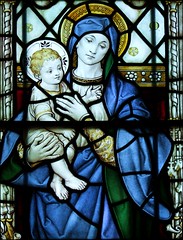
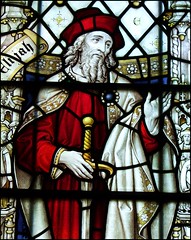
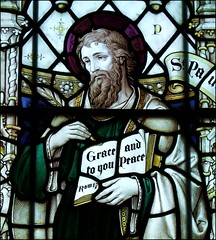
little country church. Alfred Wilkinson's contemporary
glass above it suits it well, but even so it is rather
hard to imagine the same thing happening today.
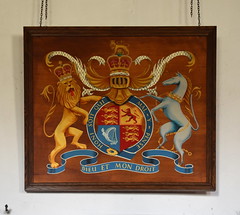
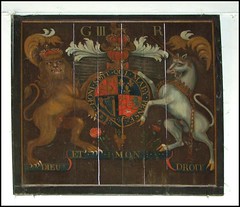
Postdating it by a few decades is a set of arms for
Elizabeth II above the south doorway. East Anglia has no
more than half a dozen sets, and these ones are rather
good. |
Simon Knott, March 2019
Follow these journeys as they happen at Last Of England Twitter.
|
||||||||||||||||||||||||||||||||||||||||||||||||||||||