| |
|
They
seem to have been a pragmatic lot in the two
villages of Ashfield and Thorpe over the
centuries. After, the Reformation, the two
parishes were consolidated into one. The church
of St Peter at Thorpe quickly fell into ruins,
and by 1602 it was quite unusable. So, the people
of both villages came here. In 1739, the Squire
at Thorpe rebuilt St Peter, retaining its late
Saxon round tower; the novelty of a new church
seems to have been a bit of an attraction,
because now it was St Mary at Ashfield which
entered a period of neglect. By the late 18th
Century, the church here had become ruinous, so
it was the turn of the Ashfield villagers to make
the trek across the fields to Thorpe, to attend
divine service there. In return, the dead of both
villages came here to be buried. In 1823, someone
stole the bell from the cage at Ashfield, so
presumably it had still been in use for funerals.
It must have been a curious place, because
cemeteries were virtually unknown at the time,
and the ruins of the old church must have cast a
haunting presence.
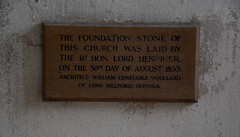
This went on until 1853, when Lord Henniker of
Thornham Magna paid the Long Melford architect
William Woollard to design a new church for
Ashefield. All that remained of the old building
by now was the stump of its square tower, and
this was completely removed, a wholly new St Mary
being built in its place. It is an unusual
building in some ways. Although Suffolk doesn't
have many newly built Victorian churches outside
the four main towns, there were lots of heavy
restorations. Generally, these are all in a
traditional Suffolk style, but St Mary is wholly
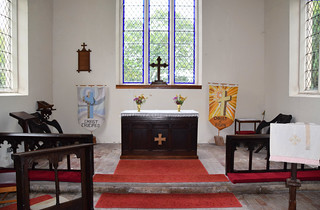
mid-19th century and was equipped for Tractarian
worship, which must have been quite a sensation.
The cost
of the church was £2000, about half a
million in today's money, and this
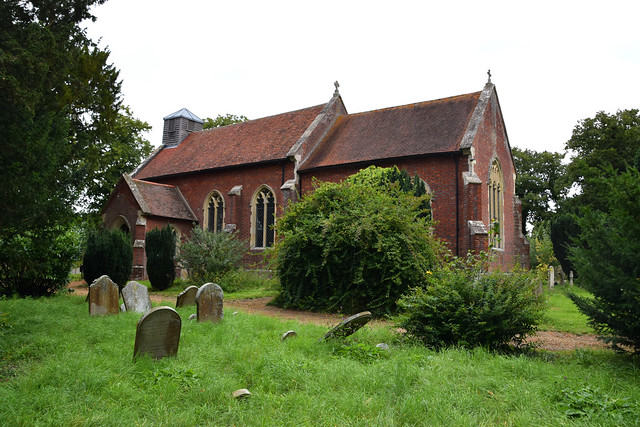
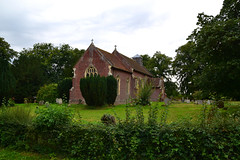
substantial building has faired well. Red
brick is usual in Suffolk buildings of
this period, but Woollard banded it here
with expensive blue bricks, which gives
it a strangely industrial feel,
especially when coupled with the
chimney-like bellcote at the west end.
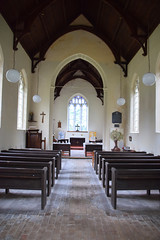
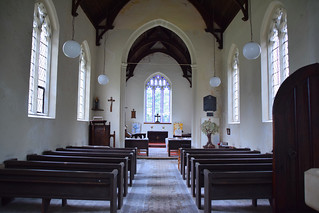
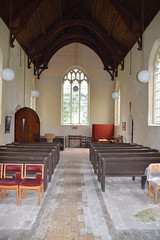
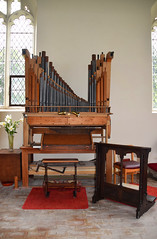
Inside is neat and crisp, thanks to a
recent restoration which has removed old
wood and exposed the fine brick floors.
Thanks to the lack of stained glass, the
church is shot full of light, a pleasant
place. Outside, it is interesting to find
several gravestones dating from the early
years of the 19th century, when this was
but a cemetery, before the great
philanthropist of Thornham restored it to
its former glory. |
|
 |
|
|
|