St Peter and St Paul, Bardwell

www.suffolkchurches.co.uk - a journey through the churches of Suffolk
|
St Peter and St Paul, Bardwell |
|
|
||
www.suffolkchurches.co.uk - a journey through the churches of Suffolk |
||
Follow these journeys as they happen at Last Of England Twitter.
| We are in that curiously remote
agricultural area of north Suffolk, south of the Little
Ouse, where the villages keep themselves to themselves
pretty much. Most of their churches are equally workaday,
but Bardwell's is a fine affair, the grandest church for
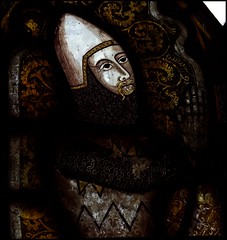
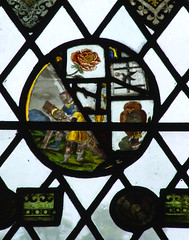
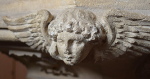
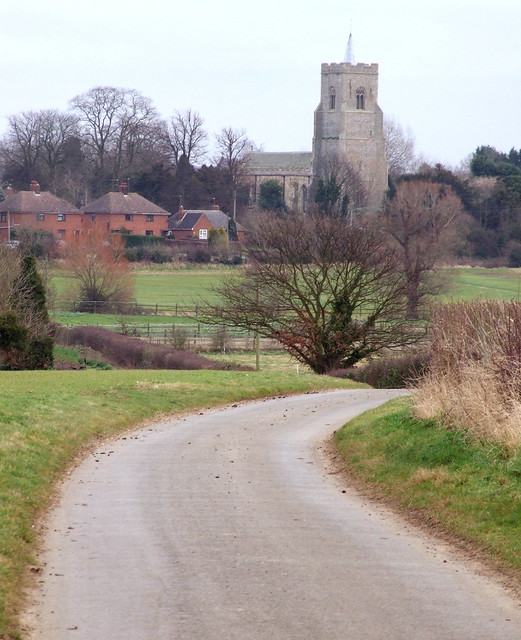
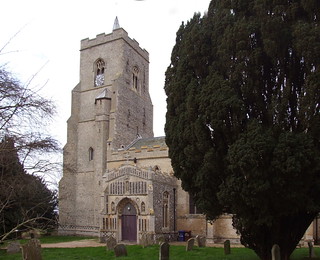
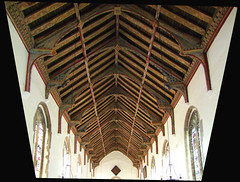
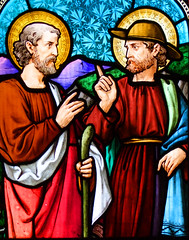
miles around. The church sits on the southern side of its compact village. The tower rises up from the hilltop site, and you can see it from a fair distance away across the rolling fields. But the building appears somewhat secluded when you reach it, the narrow churchyard making it appear as if the great structure has been shoehorned into its site. Simon Cotton unearthed a sequence of bequests that neatly show the building campaign unfolding. In 1409 Reginald Payne left 6s 8d to the fabric of the tower and in 1440 John North left 3s 4d and all the mass pence coming from the brothers and sisters of the gild of St Peter of the town to the new work of the church, by which time he rebuilding the nave was clearly well under way judging by the date 1421 on one of the nave roof angels. In 1454 William Atherene left 20s to buy lead, presumably for the roof so we may assume the nave was complete. In 1460 William Inglond left money for the completion of the south porch, which bears the arms of Sir William de Bardwell, holder of the manor. It is likely that Sir William was responsible for bankrolling this great building, and that the bequests were largely acts of goodwill aimed at ensuring the donors' souls were prayed for by the people of the parish. With the completion of the porch the structure was finished, and all subsequent bequests are for internal furnishings. As at Barningham not far off, this big church has neither aisles nor clerestories. Sir William's porch is one of Suffolk's typically grand affairs, with flushwork and tall perpendicular windows, although perhaps the lack of a clerestory makes the porch seem larger than it actually is. You step through it into a space which seems very tall and open. There was a vigorous restoration here in the 1850s, a date early enough for not too much care to be taken over the remnants of the past, and almost all the woodwork including much of the roof dates from this time. For all that, it is remarkable what has survived here, for this is a church with a little of everything. In most other counties it would be much better known. The most striking survival is the expanse of 15th Century glass, including Sir William de Bardwell's memorial glass. It has been reset in the easternmost window in the north side of the nave, but probably once sat below some grand scheme of devotional imagery in the east window. The image dates from the 1440s. Two more figures in the next window westwards are probably the donors Sir Roger Drury and his wife Margery. A rare survival for Suffolk is a panel of early 14th Century glass depicting a female saint holding a book. There is other later medieval glass, some of it English but also some collected continental work, including a beautiful 15th Century German pieta.
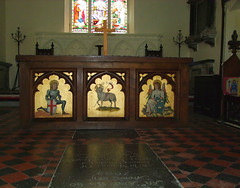
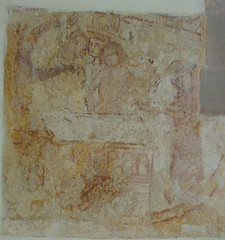
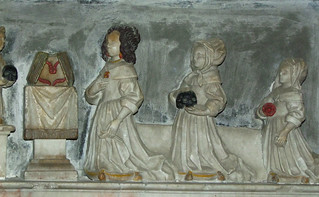
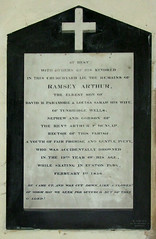
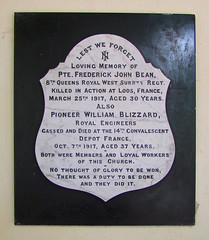
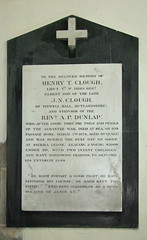
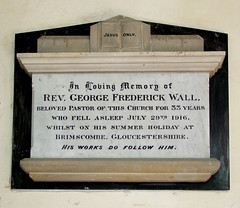
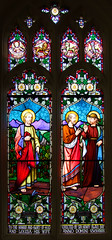
One fortunate outcome of the 19th Century restoration was the unearthing of a series of late medieval wall paintings, some of which were recorded and then plastered over, but a few can still be seen. Judging by the Deposition of Christ from the Cross and the Three Marys at the Empty Tomb, which must both be part of a Passion sequence, they are of a high quality. The sombre chancel is pretty much all the work of the 1850s, but a splendid late-17th Century memorial to Thomas and Bridget Reade survives. Their children kneel in different poses, some of them holding skulls to show that they pre-deceased their parents. The altar appears to be early 20th Century, although as one of the angels holds the shield of the Diocese of Ely it must predate the creation of the Diocese of St Edmundsbury and Ipswich in 1912. The nave is home to an interesting collection of memorials of the 19th and early 20th Centuries. Bardwell has one of East Anglia's few Crimean War memorials, naming seven men of the parish who fell in the service of their Country during the Crimean Campaign in the years 1854 and 1855. They sleep in a foreign land but their memories are not forgotten. Later activities of Empire are recalled in memorials to three stepsons of the rector Arthur Dunlap. Firstly, Henry Clough, who, after going through the toils and perils of the Ashantee War, died at sea on his passage home March 5th 1874 aged 30 years, and was buried the next day on shore at Sierra Leone leaving a young widow under 20 with two infant children. Henry's brothers Duncombe and Gerard are remembered on an adjacent memorial. Duncombe had died in Bardwell in 1860 at the age of 14, but Gerard died in 1867 on his first voyage to India and is buried at Colaba, Bombay. He was 17 years old. Closer to home, in 1856 Arthur Dunlap's nephew Ramsey was a youth of fair promise and gentle piety who was accidentally drowned in the 19th year of his age while skating in Euston Park. The east window depicting the Works of Mercy is by Arthur O'Connor, and I wonder if it was paid for by Arthur Dunlap's mother in memory of the rector's father and her second husband, for the inscription reads To the Glory of God and as a record of affection this window is devoted 1863 by MAM Hutchings in happy memory of William Lemon Dunlap, Bengal Medical Service, deceased in India 1820, and of her second husband George Hutchings, Bengal Army, deceased in India 1840. Some of the memorials were removed here from Bardwell Baptist Chapel when it closed in 2003. One tells us that George Wall, Beloved Pastor of this church for 33 years, fell asleep July 29th 1916 while on his summer holiday at Brimscombe, Gloucestershire. Another is the Chapel war memorial, listing two lads of the Chapel congregation, one who died at Loos in 1917 and the other gassed and died at the 14th Convalescent Depot in France. It continues that both were members and loyal workers of this church. Meanwhile, the parish war memorial is also in the church, and lists no fewer than twenty-three names. A terrible loss to such a small, close-knit rural community. |
Simon Knott, January 2021
Follow these journeys as they happen at Last Of England Twitter.












|
||||||||||||||||||||||||||||||||||||||||||||||||||||||