| |
|
 |
|
The grand Beccles
church of St Benedict vies with Bungay St
Edmund and Lowestoft Our Lady Star of the
Sea for the title of Suffolk's most
spectacular Catholic church. And yet,
they are all very different. St Edmund is
jewel-like, while Star of the Sea is a
palace of delights, an Arts and Crafts
movement treasure box. St Benedict is
something grander than both, more
austere; an articulate French Romanesque
revival that has been admired by many who
tend to be sniffy about the early 20th
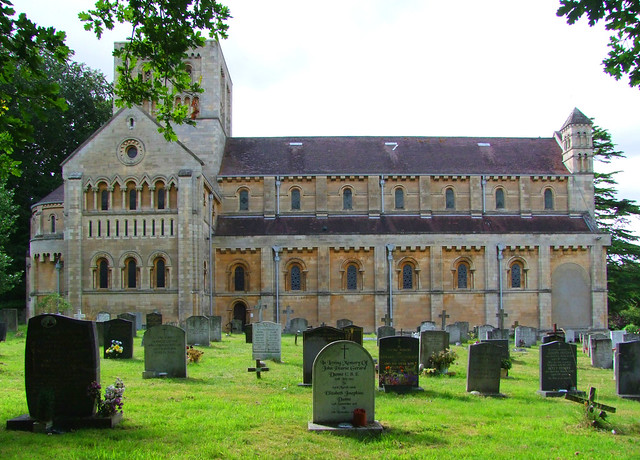
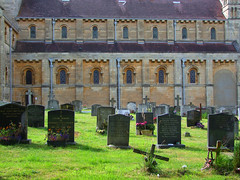
century. St
Benedict sits on a hill in the south of
the town, surrounded by its own
graveyard. Norman arches clamber and
interlock to form clerestories and
triforia; a bold apse extends beyond the
solid four-square tower. Topping it all
off is the grand west front facing the
main road.
The architect was
Frederick Banham, a local man, and the
project was bankrolled by the Kenyons of
nearby Gillingham Hall, across the border
in Norfolk. The building was erected
between 1900 and 1908, and was planned as
the minster church of a large priory. An
earlier church survives, now the parish
hall. Banham was himself a Catholic, and
is buried in the graveyard here beside
his young son, who died during the period
in which Banham was building the church.
|
Although the Benedictines
never came in force, the church was served until
the 1970s by the monks of Downside Abbey, and
links are still maintained. Perhaps because of
this, it doesn't feel like an East Anglian church
at all, and seems most exotic in one of the busy
little Waveney Valley market towns.
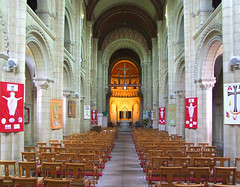
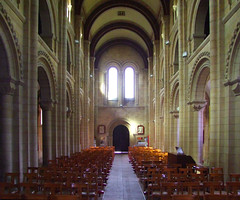
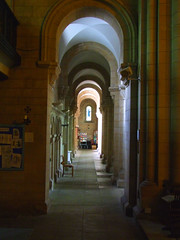
Inside, the ambulatory around the nave contains
the Stations of the Cross, and enhances the sense
of solidity. It is easy to imagine the monks
processing around the church. Above, the
triforium lifts the eye heavenwards, and light
infuses the building from the liturgical east
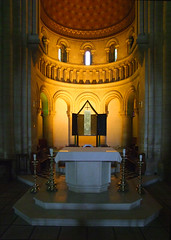
(actually south). Since Vatican II, the altar has
been moved forward from the apse to beneath the
crossing. Eric Stevenson's startlingly modernist
tabernacle of 1973 stands behind it.
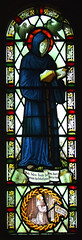
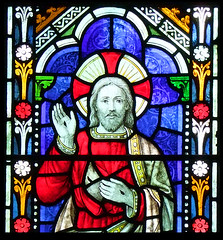
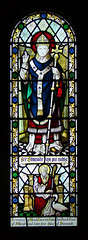
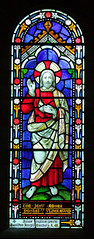
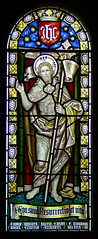
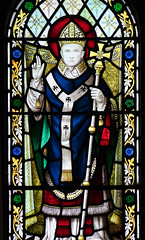
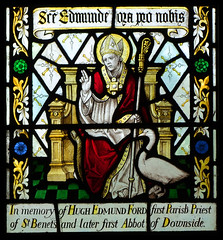
| In Banham's plan,
stained glass was used sparingly and
effectively, the work of Shrigley &
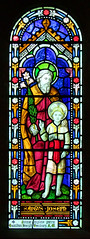
Hunt. One window shows Hugh Edmund Forde
who was first Parish Priest of St Bene'ts
and later first Abbot of Downside. It
depicts him with his real face, and St
Hugh of Lincoln sits with his swan
beneath him. Forde
may have been the first Catholic Priest
at St Benedict, but of course Catholic
priests ministered at St Michael in the
market square before the Reformation,
although very little of the church from
their time survives there. But St
Benedict harks back to an earlier age
than that of St Michael. The vaulted roof
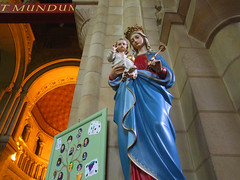
is far off in the gloom. The inscription
on the rood reads Sic Deus Dilexit
Mundum, 'God so Loved the World'.
All of Suffolk's churches would have had
a rood before the Reformation, so we are
in the presence of a continuity. The
Romanesque style, with its cruciform
shape and central tower, was virtually
eradicated in Suffolk by the wealth of
15th century Perpendicular rebuilding.
But it reaches across the void of
centuries, reconciling us to what the
English Church once was.
|
|
 |
|
|
|