| |
|
 |
|
It was a hit-and-miss
summer, and whenever the sun looked like
staying out for a while I jumped on my
bike and headed out of Ipswich. Despite,
or possibly because of, their proximity
to my home, it had been several years
since I'd explored the churches of the
Shotley peninsula and its hinterland.
Coming back, I was heartened to discover
that all the churches I'd found open ten
years before were all still open, and
several of those which I'd found locked
now listed keyholders. This was very
pleasing, and I wondered what I would
find at Bentley. Bentley
is a fairly suburban village roughly
halfway between Ipswich and Manningtree,
but its church is off down a long,
beautiful lane which heads in the general
direction of Belstead and Wherstead. Not
far off is Jimmy's Farm, made famous by
television, and the huge housing estates
of south-west Ipswich glower just over
the horizon, but here the setting is
intensely rural.
|
About
a mile from the village you reach a small
outlying hamlet, the raggedy hedges giving way to
the surprise of a neatly clipped churchyard and
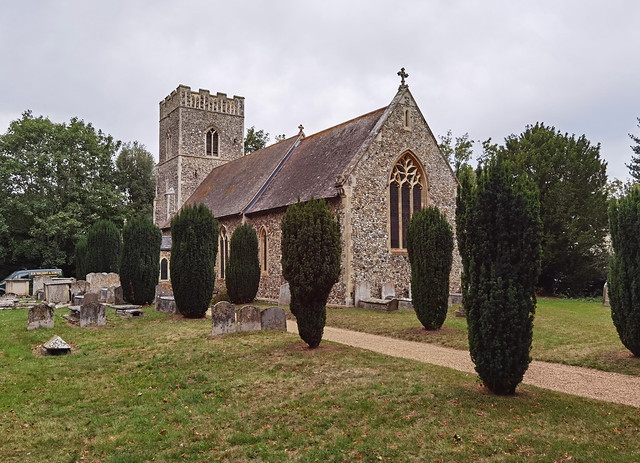
St Mary's crisp exterior. Despite the 14th century tower, this
is essentially a 19th century building, largely
the work of Richard Phipson, and very little
older survives. What does, suggests that this was
a Norman building, since some of the reset
lancets are genuine. Not genuine, of course, is
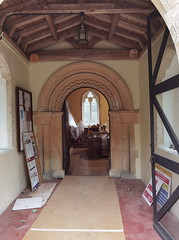
the grand mock-Norman south doorway, although it
is done rather well, the chevrons and peacock
eyes familiar from the surviving genuine articles
around the county. The niche reset in the porch
seems genuine too, or at least the canopy does.
There's a nice modern image of Our Lady inside
it.
Until the 1960s, the
Colchester to Hadleigh railway line ran along the
edge of this graveyard, and this tower must have
been a familiar landmark to travellers. Now, few
people see it; but if, like me, you are enticed
by such ghosts of the past, then you too will
feel a frisson as you locate the route of the old
line. And we know a little about the former life
of this church, since Bentley was the seat of the
Tollemaches before they established themselves at
Helmingham. One of the vast Tollemache memorials
there was originally in this church; when they
got it to its new home, they found that it
wouldn't fit, and had to build a little dormer
window in the roof above it. Here, the churchyard
feels ancient and peaceful, but I was impatient
to try the door, because on two previous
occasions I had found this church locked without
a keyholder. St Mary was my twelfth church of the
day, and the previous eleven had all been open,
which I took as a good omen.
I opened the porch door,
and the first thing I saw was a notice announcing
Welcome to St Mary's Church, Bentley.
This was encouraging. Another notice on the other
side read Welcome to St Mary's Church,
Bentley, where Jesus is Lord, People are Loved,
and Everyone is Welcome! It seemed that
there had been a considerable change of heart,
and so with mounting excitement I turned the door
handle.
Locked. I rattled it a few
times, and tried putting my weight against it,
but there was no doubt. I wasn't welcome after
all, and when I turned back to look for a
keyholder notice (there wasn't one), I saw that
someone had scrawled on the first notice, the one
that had bid me welcome, So why is the church
locked? Very sad.
Hmm. Well, it was
frustrating, but no worse than I had found on
previous visits. Since then, however, I had
gained a new interest in 19th century glass, and
the windows here appeared to be full of the
stuff. It would have been interesting to see
inside. However, the parish of Bentley appears
not to value the chance to welcome passing
strangers who might benefit from the sense of the
numinous within. It has to be said that most
medieval East Anglian churches are open every
day: the Church of England, in these parts at
least, appears to have come round to the idea
that it is there for the benefit of everyone,
including those who are not parishioners or even
Anglicans, and that its churches should be open
as places for peace, prayer and rest for all of
us, and not just be posh, subsidised venues for
weddings and the Sunday club.
I wandered back down the
graveyard path to my bike. I was just getting on,
and wondering which direction to head in first,
when I noticed another poster, on the board
beside the gate. I walked over to read it, and
what I read was so exasperating, so
jaw-droppingly ironic that I quote it in full. YOUR
CHURCH, YOUR HERITAGE, it began, in block
capitals. It continued St Mary's Church,
Bentley, needs the support of the community to
survive for future generations of this village BE
IT FOR Baptism, Marriage, Burial, Comfort,
Friendship or Just to Pray. This beautiful old
building dating back to Norman times needs your
support to preserve it for the benefit of the
community as a whole.
Well, what can I say? There
was no telephone number on the notice - if there
had been, I would certainly have rung it. If I
had come here for comfort, if I had come here to
pray, I would have been seriously disappointed.
Was the notice just lip-service? Or had I been
unfortunate? When I got home, I e-mailed a few
people who I knew had explored churches in this
part of Suffolk recently. All of them had the
same experience at Bentley.
I cycled on, and as I did
so I remembered what I had written about a church
in Norfolk a couple of years previously, and
which equally applied here. A locked church like
Bentley is bad for all sorts of reasons. For a
start, it means that the parish simply isn't
doing its job. Christ's injunction for us to
welcome the stranger within the gate is not
fulfilled by a locked door. I wonder how a
foreign visitor might feel, returning to the
parish of his ancestors, hoping at least to see
the War Memorial inside the church. I wondered if
the parish has received any public money for the
upkeep of their building? It should be a
condition of all grant aid that the church is
accessible to the public at reasonable times.
It may well be that, despite the pessimism of the
notice, Bentley is actually a thriving parish,
and this church is packed to the gunwales three
times every Sunday. Perhaps they actually don't
need to be open as an act of witness to
strangers, pilgrims and those with a thirst for a
sense of the spiritual. Indeed, perhaps they have
no room to welcome the tax collectors and sinners
who might respond to the peace they'd find by
wandering into this building on their own, on a
weekday.
But I suspect that this
isn't so. As I say, the great majority of
Suffolk's medieval churches are open to visitors
every day. The Church of England knows the power
of an open church, knows that it is its greatest
act of witness, and in any case works very hard
in this Diocese ministering to all its people,
Christians or not. But there are still pockets of
Suffolk where the buildings are kept locked from
one end of the week to the next, where the risk
of Faith that an open door represents is not
taken.
| Instead, such
parishes open their churches only for the
slightly smug activities of their club
members, while the graveyard is left to
the pagan cult of the dead, the bereaved
worshipping their recent ancestors with
propitiatory flowers, unable to combine
this with a prayer said inside a sacred
building, increasingly unaware even that
this might be an appropriate thing to do. As the years go by, the
congregation gets smaller, and older, and
less welcoming to strangers, hanging on
to the rituals that comfort them but
which otherwise serve no community
devotional purpose, and are no means for
sharing the faith and love and life of
the parish. The building is used less and
less often, eventually being abandoned
altogether by people who, no doubt,
bemoan the decline and fall of their
congregation and shake their heads
gravely at the immorality of the young of
today, their lack of respect and belief.
And yet, they have
not even once taken the risk of letting
themselves be found by us, the strangers
wondering at the God-shaped hole within
ourselves, surprising a hunger to be more
serious, and gravitating with it to this
ground.
|
|
 |
|
|
|