| |
|
 |
|
The hellish A134 hurtles
through from Sudbury to Bury, slicing
this otherwise rather pretty village in
two. But still, the church sits beside
the pub in happy juxtaposition, reminding
me rather of the same thing at Fornham St Martin. The name of the
village means exactly what it suggests;
there was a great fire here during the
1320s, when the Bury Abbey holdings here were
destroyed by a mob protesting at the
power of the Abbey over the burgesses of
the town.
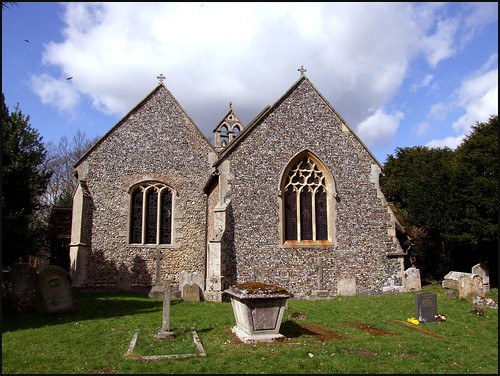
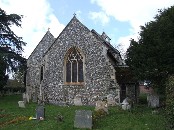
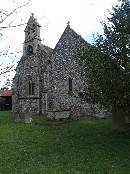
What a
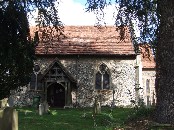
strange church this is! It seems to have
lost its west end at some time, but must
always have been tiny until the the great
square extension was built to the south.
I hesitate to call it an aisle, although that is
what it is; it seems to have been built
with the intention of increasing capacity
as much as a space for processions and altars. Indeed, although Mortlock dates it as 14th
century, it looks almost entirely
Victorian to me, with window tracery and
doors reused from the previous south
wall. Perhaps it was just over-restored.
|
There is a rusty
cage-like grill on the south door, but the church
is accessible, and it is worth getting the key.
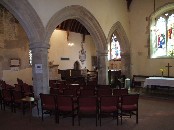
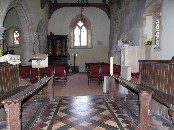
Stepping into the squareness of the nave aisle,
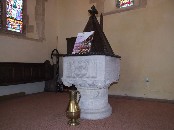
your first sight is of the very good Norman font, with its decoration added
a couple of centuries later when there was a
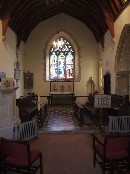
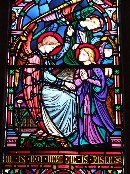
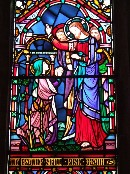
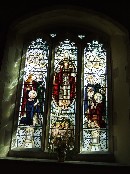
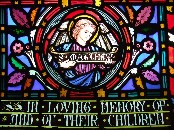
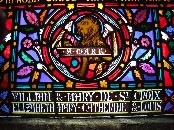
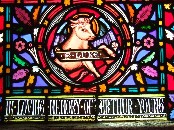
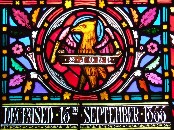
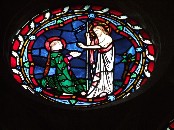
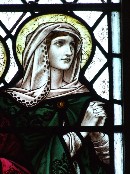
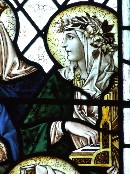
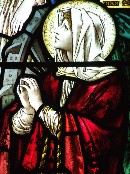
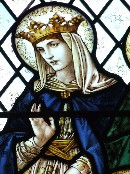
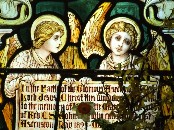
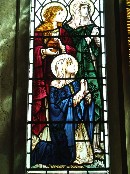
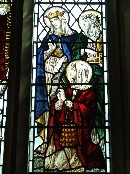
fashion for that kind of thing. Inside, the late
Victorian glass makes it a bit gloomy, but there
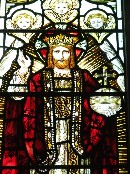
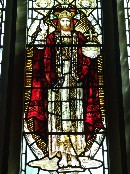
is an excellent early 20th century depiction of
Christ in Majesty, by Powell & Son I think,
in the east window of the aisle.
 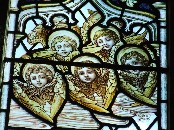
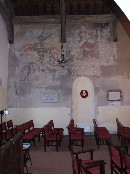
All Saints would
not be the least bit remarkable if it were not
for something discovered during the restoration
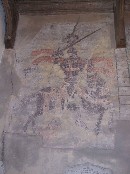
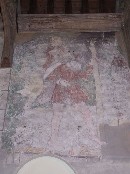
of the north wall in 1961. This was the pair of
wallpaintings, two of the finest in East Anglia,
of St George and St Christopher. St George is
dressed in the uniform of a crusader, which is
interesting, because the St Clare family of
Bradfield were noted as crusaders. This painting
probably dates from a good two centuries after
the crusades, but perhaps it is based on a family
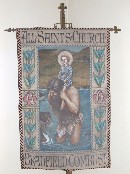
portrait. St Christopher stands in a river, fish
swirling about his feet, and his little house on
the bank below. The Christchild is quietly
majestic on his shoulder, but the Saint's face is
a riot of long hair, beard and moustache. As M.R.
James records of something more sinister in one
of his ghost stories, one feels in no doubt that
he is drawn from the life. The amount of red
pigment in the paintings is striking, and calls
to mind the Doom at adjacent Stanningfield. Like the Stanningfield
Doom, they would have been covered up with
whitewash by Protestant reformers in the late
1540s.
Rather
happily, the keyholder to this church is the
adjacent pub. Even better, one of the churchyard
gates leads directly into the pub garden. Of
course, this may mean that the church is not
accessible outside of pub hours, and in all
honesty I can't think of any reason why this
church shouldn't be safely kept open. Still, it's
a good excuse for a pint.
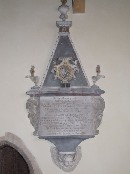
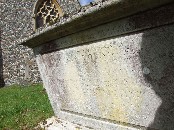
| On your
way over to the pub, don't forget to stop
at the rather impressive memorial to
Arthur Young. He was a member of William
Pitt's countryside taskforce, and one of
the great agricultural writers of the
18th century; he is credited with being a
major force behind the changeover from
medieval farming methods to modern ones.
His father had planted the great
woodlands of Bradfield Hall, which nestle
the village to the east. Arthur Young
junior was himself a useless farmer,
unfortunately; he not only bankrupted
Bradfield Hall, he did the same to
another farm he took over in
Hertfordshire. But he did write a
cracking book about his travels in
France. In later life, he
went blind, and suffered from intense
bouts of depression. Adding to these
sufferings, he had married badly at the
age of 24. His cousin, the writer Fanny
Burney, records in her journal that his
wife's language was violent, and she was
so red-faced that she looked like a
fiend. She lies beneath the memorial with
him. |
|
 |
|
|
|