| |
|
| |
|
Antiquarians and
ecclesiologists have not been very kind to our
parish church, begins Terence Smith's
guidebook to this church. Certainly, they have
been dismissive, but I think this is a lovely
little church, even if it is not full of
interest. You come to it from Bradfield Combust,
along high tree-lined lanes that recall the
memory of Arthur Young senior, of Bradfield Hall,
who first planted them more than 200 years ago.
The Youngs are one of two remarkable families in
this area, but probably they would admit to
second place behind the St Cleres, who were Lords
of the Manor here throughout most of the Medieval
period. They were great crusaders, and the image
of St George in crusading armour at Bradfield
Combust, despite post-dating the crusades by two
centuries, may be based on a St Clere family
portrait.
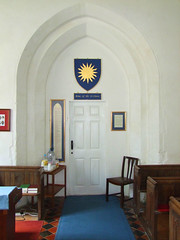
Much has been made of the fact that this church
bears a unique dedication in England for a
medieval church. St Clare was a companion of St
Francis, and lived in the 13th century, by which
time the Parish system and its churches in
England was already well-established (there
aren't many St Francis dedications, either).
Sadly, and as you may have already guessed, it
isn't actually the case. As you often find over
the border in Essex, the village here is named
not after a Saint at all, but after the St Clere
family. (Although less common in Suffolk, this
type of village naming does occur in several
places, notably Ashbocking and Stonham Aspal).
The medieval dedication here was to All Saints,
not to St Clare. The modern dedication was
adopted as recently as the 19th century, and
although it would be possible to blame 18th
century antiquarians for making the mistake that
led to it (as is often the case) it seems an
entirely reasonable mistake to make. After the
Puritan era, and before the Oxford Movement
revival, Parish churches were usually named after
their villages. It seems natural that 'Bradfield
St Clere Church' could easily become 'St Clare's
Church'. However, the modern Parish has happily
adopted its new dedication, and why not?
You cross a steep railway bridge over the
now-vanished Sudbury to Bury line, part of which
is a footpath to the south of here. You enter a
hamlet of pleasant cottages, and the church is
away in the fields, with an incongruously large
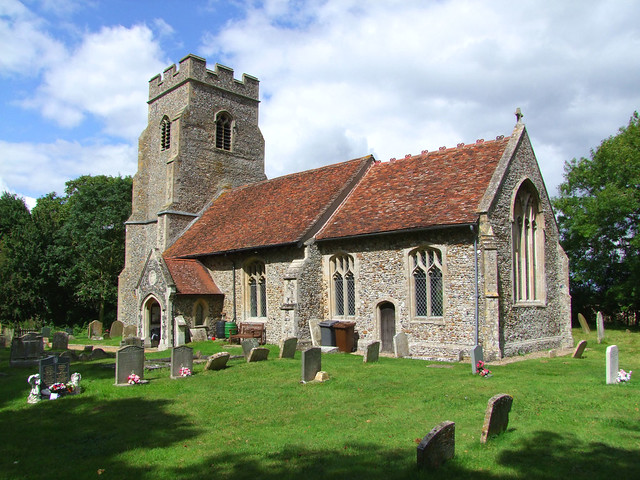
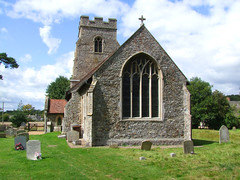
water tower for company. The graveyard is
beautifully sheltered, if a little overneat. The
church itself also looks well cared for, its
exterior bearing witness to the fact that the
tower collapsed in a storm in 1873, and during
the rebuilding the opportunity was taken to
completely refurbish the rest of the structure.
All except the chancel and nave walls dates from
this time and later.
The church is kept locked with a keyholder
nearby. When I phoned, he briefly mistook my call
for one bothering him about solar panels or
mis-sold payment protection insurance, but
eventually we each worked out what the other was
talking about, and soon I stepped into a
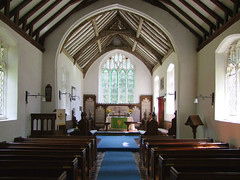
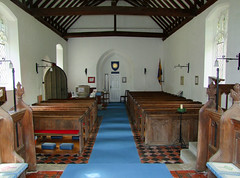
gorgeously warm interior, all limewash and
polish. The church is full of light, the
whiteness of the walls reflecting the sunshine
pouring in through the high windows.
The Victorian
restoration was a good one, high quality
work that has aged well. In any case,
research has found little evidence that
anything of any value or interest was
destroyed by it; even in the late 18th
and early 19th centuries antiquarians had
found it, to quote David Davy, little
in any way interesting. Offsetting
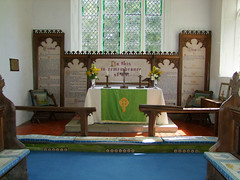
the modern nave is the ancient chancel,
rebuilt in the late 15th century. The
roof is a delight, and again, light pours
in through the seriously perpendicular
windows. They give a sense that the
church is bigger than it actually is.
While I was finishing photographing the
interior of the church, a man and his
elderly mother arrived to have a look
inside. As is often the case in a small,
remote church, they were a little alarmed
to find someone already inside,
especially a wild-haired man in cycling
clothes, but we said hello to each other
politely. The man told me that he was
pleased and surprised to find the church
open, so I didn't disabuse him of this
notion. His mother went up into the
chancel, and the man confided in me
"she's trying to work out if she's
been here before, but it's not a very
memorable church, is it", with which
I had to agree, but I do like this church
a lot. I like above all its sense of
continuity, that here was a fairly simple
parish church that had been buffeted and
shaken by the winds of history, and had
responded by reflecting the changing
aesthetics, theologies and emotions of
its parishioners. |
|
 |
|
|
|
Simon Knott, August 2014
|
|
|