Lost in the lonely
hills to the south east of Bury, the church is a noble
prospect, a hill top tower raising its head to heaven. It
is said that you can see 16 other towers from the top of
it. You certainly get a fine view of this one from the
busy Bury to Sudbury road, but three miles later you find
yourself very much in the outback. A field in this parish
had the medieval name Hellesdun, and is one of the sites
suggested as that of the martyrdom of St Edmund, which
happened at a place of that name. To be honest, Hellesdon
in Norwich seems more likely and even Suffolk's Hoxne,
but there is also a Sutton here, the name of the place
where the body was taken, and Hoxne has never
satisfactorily come up with one of those.
As is so often the case with a church you've seen from
miles off, the tower disappears as you get nearby. There
is now a sign at the entrance to the narrow lane leading
up to it, but on more than one occasion in the past I
have cycled straight past. The track leads up between two
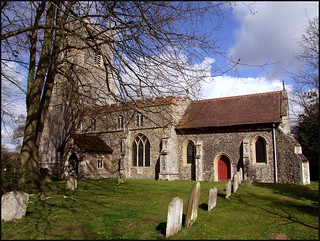
gardens, and when you get there, it isn't a huge building
at all, but quite homely, like its neighbour Little
Whelnetham. That 15th century tower is impressive though,
lifting to heaven. Unusually, it has a large dedicatory
inscription at ground level, picked out in black flint in
the stonework on the two westerly buttresses. Her
begynnyth John Bacon owthe of the fundacyon Jhu pserve
him it reads, which is to say that John Bacon was
the author of the start of the foundation (building) of
the tower, Jesus preserve him.
The graveyard is a
wildlife sanctuary, with open fields beyond. A light
clerestory came with the north aisle, but Mortlock
thought the rest of the building much earlier, probably
Norman. In any case, there is a great sense of
continuity, although perhaps the late medieval glory of
the Perpendicular rules over all. Coming back in May 2019
I stepped through the doorway into the familiar, bright
interior, the high windows flooding the nave with light.
This is a very well done 19th century restoration, but
not without the memory of the more distant past.
Two benches in the north aisle reveal it. One bench end
is actually a 19th century replacement, apparently a
flying dog but actually the flying lion evangelistic
symbol of St Mark. The other is old, probably 15th
century. It is a poppyhead which has a face in it with a
protruding tongue. It might be intended a green man, but
or perhaps the figure of scandal, found in exactly the
same way across the county at Blythburgh.
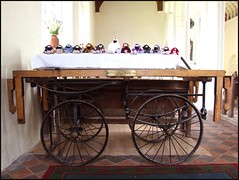
Also in the north aisle is the parish's funeral bier. We
tend to think of these as ancient as well, but of course
they are mainly 19th and 20th century. Many were in use
well into living memory. A few in Suffolk still are. This
one has a plaque on it which reveals that it was paid for
by the Entertainments Committee in 1924.
You could not be in doubt of the dedication of this
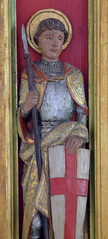
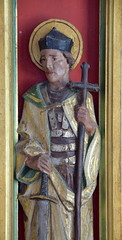
church. There are fragments of a 15th Century figure of
St George in a chancel window, and a 20th century carved
image of St George stands in a medieval niche flanking
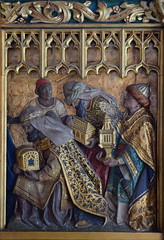
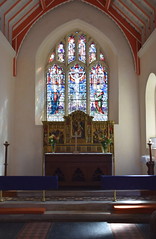
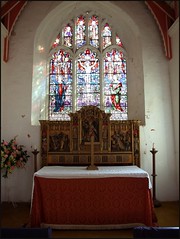
the chancel arch, and the glorious reredos, a memorial to
the lost boys of the Great War, is the best of its kind
in the county. St George must have been a very high
Anglo-catholic church in its day, and the reredos, with
its depictions of the Adoration of the Shepherds and the
Magi, and the figures of St George and St Felix flanking
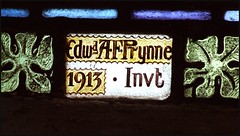
the piece, is a relic of those days. Above it, the
crucifixion in the east window is to the design of Edward
Fellows Prynne in 1913 and made by Thomas Fellowes, one
of the last shouts of the triumphant pre-WWI Church of
England.
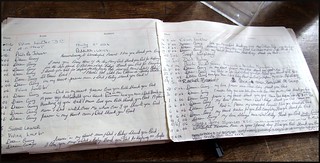
I always leaf through
the visitors' book when I visit a church, don't you? And
so it was that a number of years ago I noticed that this
church had a regular visitor who signed the book and made
a comment on the occasion of every visit, sometimes
daily. Some double page spreads consisted of nothing but
the record of her visits. A contact of mine observed that
this was typically 'Normal for Suffolk', and so it was,
and why not indeed, but the person in question has
obviously moved on, because they no longer feature in the
visitors' book.
I stepped outside again into the busy late spring of
deepest rural Suffolk. This was one of the parishes that
Adrian Bell mixed into an amalgam as Benfield St George
in his masterpiece Corduroy, the single best
evocation of Suffolk rural life in the early part of the
20th Century. I had thought of him a few weeks before,
cycling this way, and seeing the deep cut fields leading
the eye to the horizon, like the corduroy of his
imagination. Now, in April, the furrows were a deep
green.
Not far from here is Bradfield Wood, an ancient woodland
superbly maintained by the Suffolk Trust for Nature
Conservation. There is a silence there that you find
rarely these days in the southern half of England, so
close are we so often to major roads. In this area, that
unnoticed background noise falls away, birdsong and
windrush rises imperceptibly, and here in Bradfield there
is a sense of things beyond the present, beyond the
material.