St Mary, Bramford

www.suffolkchurches.co.uk - a journey through the churches of Suffolk
|
St Mary, Bramford |
|
|
||
www.suffolkchurches.co.uk - a journey through the churches of Suffolk |
||



Follow these journeys as they happen at Last Of England Twitter.
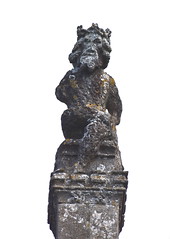
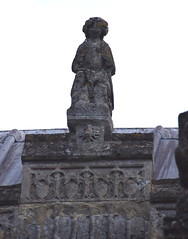
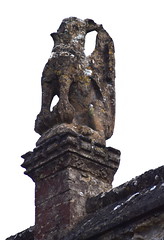
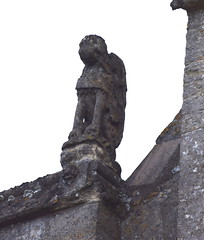
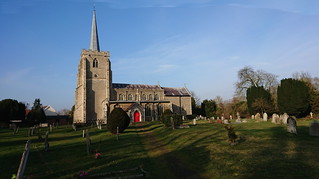
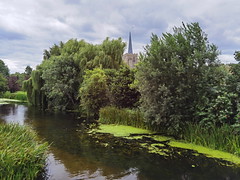
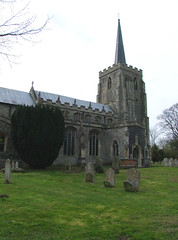
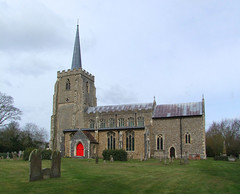
The urban sprawl of Ipswich reaches far beyond the official limits of the Borough, but there are still places within a few of miles of the Cornhill that feel like proper Suffolk villages. The River Gipping and its water meadows here form a lovely barrier to progress encroaching from the east, and on the far bank of the river is the pleasing village of Bramford and its church of St Mary. The church sits at the end of a little lane lined by 17th Century cottages, and you approach it from the north side. Of all the medieval parish churches in the Ipswich area, this one feels most like the large East Anglian medieval Perpendicular church that people expect to see when they come to Suffolk, from the outside at least. But there is more to it than that. Along the battlements of the north aisles, statues on pinnacles stand like guardians. These are unusual in East Anglia. Some of them are allegorical, some theological, some perhaps mythical or heraldic. They are hard to photograph, or even to see clearly, on a sunny day because they are on the north side of the church, and in any case they are eroded by half a millennium of soft Suffolk rain and encrusted with lichen. One is clearly an ape in a monk's habit examining a urine flask. This can also be seen on the screen at Suffield in Norfolk. It is a satire on contemplative orders. The ape here is chained, suggesting that he is tied to his friary. Two others are evangelistic symbols of St Matthew and St Mark. One of the strangest is a woodwose, the wild man of the Suffolk woods. He is commonly found in late medieval carvings and as often he carries a club, but the one here also appears to be wearing a crown. There is a gryphon and a chained beast, and a curious animal that might be a hare or a sheep, though both are unusual in late medieval East Anglian stonework.
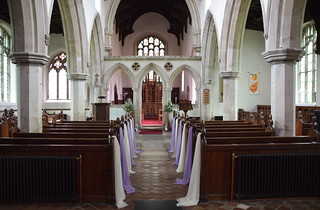
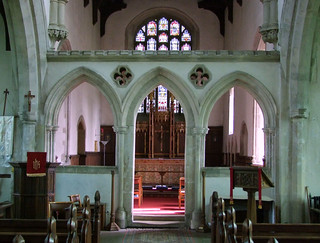
The grand 15th Century
tower, the pinnacled aisle battlements of the north aisle
and the deep, imposing porch are so impressive and so
splendidly late Perp that it comes as something of a
surprise to step inside and see that they are an
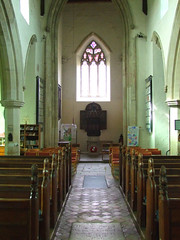
elaboration of what is actually an earlier church. The
arcades of the wide, neat interior are of the early 14th
Century (which is to say, before the Black Death) and the
chancel is earlier still, and most striking of all as you
face east is one of Suffolk's only two surviving medieval
stone rood screens. It dates from about 1300. There are
several of these across the border in Essex, but it seems
so unusual to see it here in an otherwise familiar
medieval space. As James Bettley points out in the new Buildings
of England: Suffolk, it is part of the architecture
rather than the furnishing. It gives an impression of the
way medieval churches would unfold as a series of rooms
before the 15th Century passion for wide open
congregational and processional spaces. You need a fairly
vivid imagination to conjure up its medieval appearance,
surmounted as it would be by a wooden loft and painted
rood group. It would also have been clad in imagery, and
buttressed by altars. The quatrefoil holes were punched
through and the battlements added by the fanciful
Frederick Barnes in the 1860s, when the chancel received
its ritualist makeover. Suffolk's other stone screen is
at Little Wenham, but it is more simple and functional
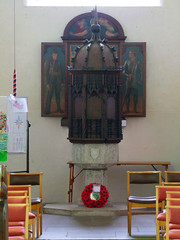
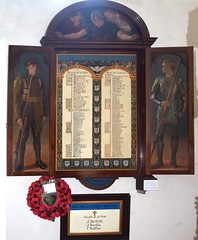
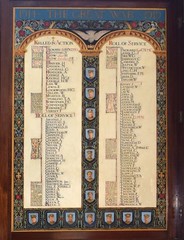
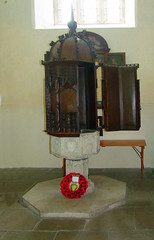
than this one. During the 19th Century, the font was moved into the space beneath the tower to create a baptistery. The font is chiefly remarkable for its late 16th Century cover, which, like the one at Boxford, has doors which open outwards to give access to the water. When the large local factory of Fison, Packard & Prentice closed, the firm's elegant war memorial from the time when it was simply Edward Packard & Co was resited on the west wall of the tower behind the font, which provides a nice foil for the font but does make the war memorial difficult to photograph. However, if it had not been moved it would have been lost to us, for the factory was destroyed by a furious arson attack in early 2019. The memorial is organised as a triptych, the outer boards depicting a British soldier and St George, the central board listing first those who were killed and then those who served. Charmingly, there are portraits of the lost boys down the centre and along the bottom. It's recorded that it was 'created by the Misses Packard'.
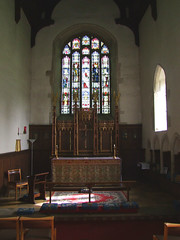
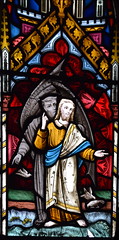
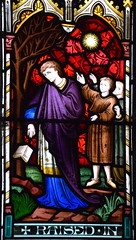
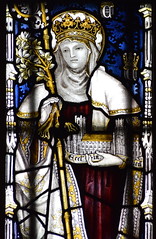
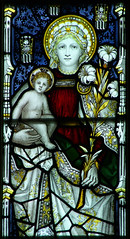
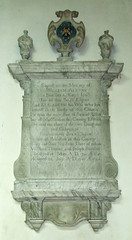
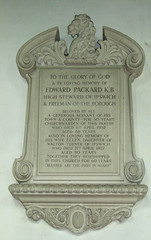
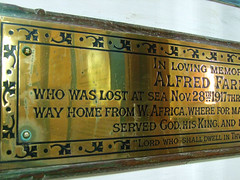
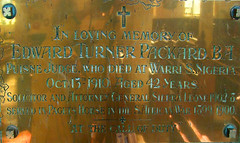
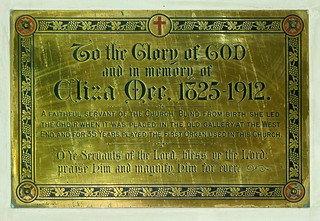
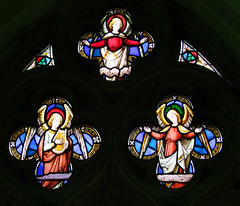
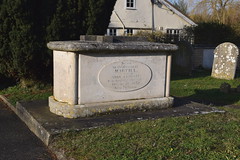
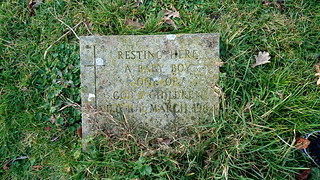
The parish war memorial is in the south aisle. Incidentally, the Packards were a local family of some importance. A number of 19th and 20th Century memorials in the church remark on their activities both here in Suffolk and out in the empire. But best of all the memorials, I liked the little brass plaque to Eliza Mee, who died in 1912. It records that Blind from birth, she led the choir when it was placed in the old gallery, and for 35 years played the first organ used in this church. Stepping into the chancel, the reredos by W D Caroe is a good example of turn-of-the-last-century seriousness. It sits beneath a familiarly stodgy window by Kempe & Co, typical of their early 20th Century style. The bulky choir stalls, also by Caroe, have been removed from the chancel and placed in the south aisle. The chancel must have felt very cramped when they were still in situ. The most interesting stained glass is that in the west window of the north aisle, now hidden behind the organ. It depicts, rather curiously, various scenes of people being tempted to do bad things, and was the work of Samuel Evans of Smethwick, their only work in East Anglia. James Bettley notes that it was put together by Haggars of Ipswich. A more recent, and I am afraid more traumatic, incident in Bramford's long history is remembered by a small gravemarker along the path to the south of the church. Resting here, a baby boy, one of God's children, reads the inscription. The area of woodland east of the church beside the river is known locally as the Marshes. On Sunday 11th March 1984 some teenagers were sheltering from the rain in the Marshes under a tree. Bored, one of them kicked over an old car petrol tank which had been dumped. Underneath, they found the body of a baby boy. The pathologist's report revealed that the child had been about a week old, and had not died of natural causes. The little boy was buried in Bramford churchyard. An exhaustive police investigation was unable to solve the mystery. Simon Knott, September 2021 Follow these journeys as they happen at Last Of England Twitter.
|
|
||||||||||||||||||||||||||||||||||||||||||||||||||||||