| |
|

Follow these journeys as they happen at Last Of England
Twitter.
Here we are in the gentle yet secretive
hills to the east of Lavenham. It was April 2019, and I'd
come by the top road from Monks Eleigh, a lonely road
where cars rarely stray and grass grows up in the middle.
I imagined it was a bleak place in winter, probably
snowbound between the hedges. About halfway between the
two villages I was woken from my reverie by a large
roebuck jumping through a gap in the hedge across the
road about ten yards ahead of me. I brought my bike to a
swift halt, and watched in wonder as he was followed by
two more bucks, and then three, and then a couple more.
In the end I watched thirteen of them pass before me, as
big as calves.
They knew I was there. They looked back at me from a
field of shooting barley, their white rumps in a line.
And then they broke for cover, and were gone over the
rise.
Still full of this thrilling sight I freewheeled down
into the village until I reached the church. It had been
several years since my last visit, but I remembered much
about the place because St Mary is a church of
outstanding interest, but little known to those who rely
on older books for the churches they visit, for the great
treasure here was not discovered until 1961. Even without
knowing about it you can see that this is a lovely
village church, rebuilt with 14th Century wealth that
came from the cloth trade, for this was one of the
villages where wool was spun in river-backed courtyards
for the Lavenham merchants.
The name of the village reflects a dramatic event. At
some point in its history, it was destroyed by fire
(Brent='burnt'). Not far away, there is Bradfield
Combust, a name denoting a similar incident. The church
sits in a long sleeve of a churchyard, full of robust
birdsong in the late winter sunshine, its chancel pointed
towards the road. Externally, St Mary is that rare beast
in Suffolk, a largely late Decorated building. It looks
well on its rising ground. The old door with its ironwork
latch is probably the one provided by village carpenter
and blacksmith back in the 14th Century, a startling
thought. I lifted it, and once again I stepped into the
cool inside, a beautiful cool, ancient space, the walls
laid with brick, the 19th century furnishings immaculate.
Sam Mortlock was right to call it charming.
One of the stories that haunted me as a child was that of
Howard Carter finally discovering Tutankhamun's tomb in
the Valley of the Kings. If you remember, it was on one
of the last days, just before the money ran out. Carter
breaks a tiny hole in the seal of the door. He shines his
torch through at the treasures beyond. "What can you
see?" asks a breathless assistant. "Wonderful
things", whispers Carter.
In 1961, the Victorian reredos was removed from the
sanctuary of St Mary, to enable a repair to the east
wall. Traces of colour were visible behind the thin layer
of plaster. Gently, it was removed, revealing, as in
Carter's words, wonderful things, for here are some of
the finest and most beautiful wall paintings in Suffolk.
Most striking is the crucifixion scene above the altar,
forming a retable. The Blessed Virgin and St John flank
the crucified Christ. They date from the start of the
14th century, making them roughly contemporary with the
figures at Little Wenham and on the Thornham Parva
retable. They are similarly angular yet fluid, as though
in motion. These are doubly remarkable survivals, for
early in 2016 they were attacked by someone with a knife
or screwdriver, perhaps someone with an anti-religious
mania or a hatred of images. It took over a year for the
wallpainting specialist Dr Andrea Kirkham to collect
together thousands of flakes of plaster and paint and
restore them to their original place. You really would
not know to look at it today.
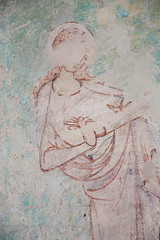  

Either side of the reredos are slightly
earlier paintings, late 13th Century. To the left, two
angels censing a space with thuribles, and the space must
have contained an image bracket, probably for a
crucifixion, or perhaps an image of the Blessed Virgin.
But the most unusual scene is to the right of the
crucifixion. This shows the Harrowing of Hell. Christ
descends into Hell to free Adam and those condemned
before the arrival of salvation. But the most intriguing
feature is the figure kneeling in the bottom corner. He
is probably the donor, and part of his intecessionary
scroll survives.
There was a falling out of fashion for non-liturgical
wall paintings in the middle years of the 15th century.
Many seem to have been whitewashed then, a full century
before the protestant Reformation, not to see the light
of day again for nearly half a millennium. Perhaps the
two outer scenes were covered then, and the painted
reredos lasted until the Reformation itself.
 
Eerily, the scene in this central painting
is echoed in the 1860s glass by the O'Connor workshop
above, although of course the Victorians cannot have
known that they were doing so. And as if the wall
paintings were not enough, the sanctuary is contained
within another great treasure, the three-sided 17th
Century communion rails. There are fewer than half a
dozen sets of these in all East Anglia.
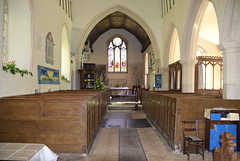
The box pews in the nave are complemented by some
surviving 15th century benches at the west end. At one
time, they may have faced the Decorated parclose screen
in the south aisle. It is slightly later than the wall
paintings, but you can begin to imagine the Catholic life
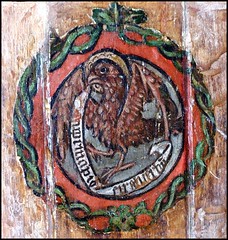
and liturgy of this place. Mortlock thought it the oldest
screen in Suffolk, and curiously St John is represented
on it by an eagle, more often on screens in East Anglia
he is shown by a poisoned chalice, the eagle surviving
elsewhere only at Sotherton in Suffolk and Magdalen in
Norfolk. The screened chapel later became a family pew.
Up in the chancel is one of Suffolk's more dramatic
memorials. It is to Edward Colman, who died in the 1740s,
at a time when many English churches were falling into
disrepair, and no doubt welcomed the patronage of those
who wished to use the buildings as a kind of mausoleum.
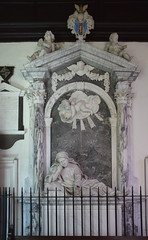
Colman reclines life-size behind a spiked iron fence,
which looks as if it is there to stop him escaping. These
fences are typical of the period, but many must have been
removed during World War Two for scrap. There is a
pensive smile on his face, as if he is resigning himself
to the inevitable. High above, a crown in heaven waits
for him, clasped in the chubby arms of a cherub, and
Colman stretches out his left hand as if to receive it.
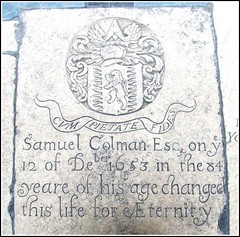
Colman's father is remembered for
bequeathing to the church a parish library of more than a
thousand books. They had their own building, which was
demolished in the restoration of 1860, but the volumes
had been dispersed some years earlier. Many can now be
found in university libraries around the world. The
memorial was apparently the work of Thomas Dunne, who
built churches for Hawksmoor. The Colmans, and other
parishioners, were baptised in the Purbeck marble font
with its elegant cover at the west end of the south
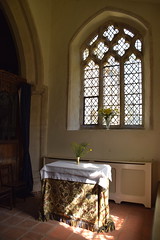
arcade. A beautiful light falling into this aisle
distracts from the height of the nave, which looks as if
it might have been waiting for clerestories and a north
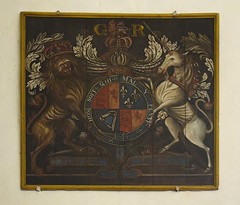
aisle before the Reformation intervened. The north wall
is home to the royal arms of Queen Anne, relettered for
George I, a hatchment, and a surviving biblical
inscription from those days when the Elizabethan
Settlement tried to make us all into protestants.
The spring afternoon was almost over, a chill beginning
to make itself felt in the low sunshine. It was time to
head back to Ipswich. I wandered back down to the road in
the bright sunlight and headed north into the hills, the
haunting and beautiful church at Kettlebaston keeping me
company on a ridge to the east. I looked back to make out
the tower of Brent Eleigh church behind me. Soon, the low
hills enfolded it, and it disappeared.
Simon
Knott, September 2019
Follow these journeys as they happen at Last Of England
Twitter.

 
| |
| |
|
|
|
|
|
|
|
| |
|
|
|
|
|
|
|
|
The Churches of East
Anglia websites are
non-profit-making, in fact they
are run at a loss. But if you
enjoy using them and find them
useful, a small contribution
towards the costs of web space,
train fares and the like would be
most gratefully received. You can
donate via Paypal.
|
|
|
|
|
|
|
|
|
|
|
|
|
|
|
|
|
|
|
|
|
|
|
|
| |
|
|
|
|
|
|
|
|
|
|
|
|
|
|
|
|
|