| |
|
 |
|
I am very much ashamed to
say that when I first wrote about this
church in the summer of 2002, I was led
into temptation to mess about a bit. It
was something like the 300th church on
the site, and I'd discussed with a
journalist friend the dangers of the site
becoming formulaic, a listing of external
and internal features, the occasional
photograph. This was in the days before I
embraced digital photography, of course.
He suggested, as a joke, that perhaps I
could try writing them in the style of
different authors, and we settled on a
list of James Joyce, Marcel Proust,
Ernest Hemingway and Micky Spillane as
the writers with styles most easy to
replicate. Well, Hemingway and
Spillane never got done, but Joyce and
Proust did. St Mary's was the Joyce
entry, although it would be truer to say
that it was a pastiche of his 1916 work Ulysses.
I thought it would be a harmless piece of
fun, given that St Mary is redundant so
the parish were unlikely to be offended,
and in any case I didn't think anyone
actually read what I wrote.
As it turned out, I was
wrong. They did. Lots of people contacted
me about it, but as the response, on the
whole, was positive, I left it, and left
it, meaning to go back to St Mary and
rewrite it after I acquired a digital
camera in 2003. Unfortunately, it has
taken until 2016 for me to make that
journey. Sorry, Bungay. Sorry, Joyce.
|
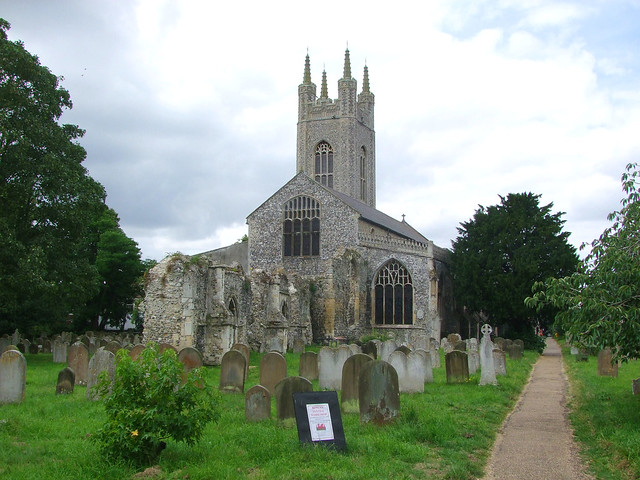
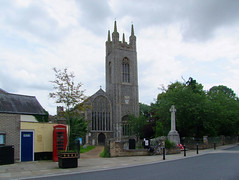
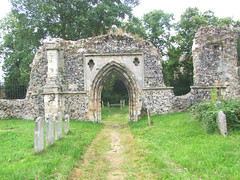
St
Mary is quite the grandest redundant medieval
church in Suffolk. The tower, of 1475, is one of
the most spectacular Perpendicular moments in a
county not short of them. What remains to the
east of it was the parochial nave of a
Benedictine convent established in Bungay in the
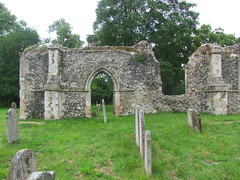
late 12th Century. The ruins beyond were
conventual buildings, including the nun's choir
which stood to the east of the nave. At the
dissolution it became the parish church, but was
gutted in the great Bungay fire of 1688. Thus,
the interior is entirely post-Reformation in
content and character. There were successive 19th
Century restorations, one led by Thomas Jekyll as
at neighbouring Holy Trinity, another later in
the century by that safe pair of hands Richard
Phipson, the diocesan architect.
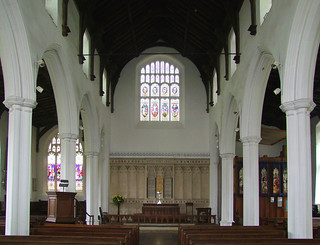
Because
of this, interest in the interior rests largely
on two things, the civic memorials and the 19th
Century glass, both very good of their kind.
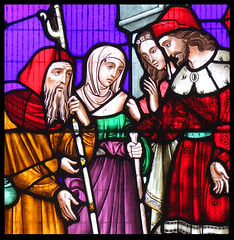
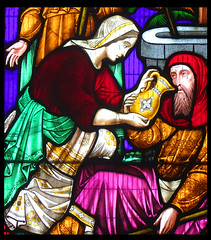
Jekyll's restoration saw the installation of
windows by Charles and Alexander Gibbs.
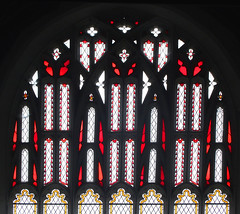
Unfortunately, that in the west window has not
survived other than Alexander Gibbs's typically
fizzy orange lozenges in the tracery of the upper
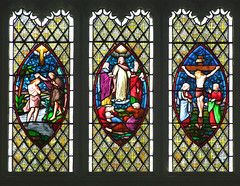
lights. But the east window of the north aisle
does survive, and depicts the Works of Mercy.
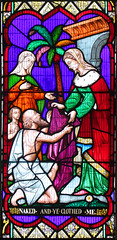 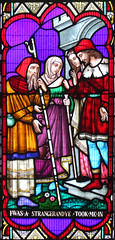 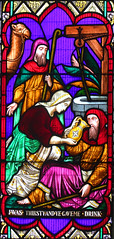 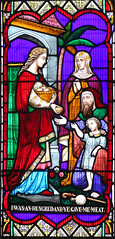
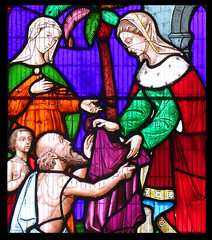 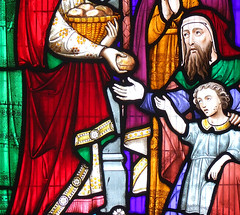 
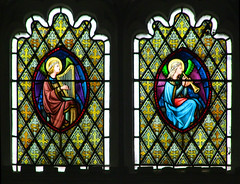
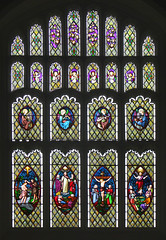
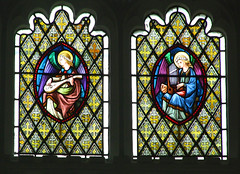
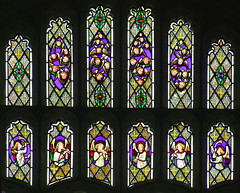
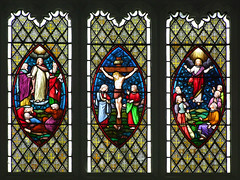
If
the Gibbs brothers' work in the north aisle is
vibrant, the east window is restrained and
elegant. It is a window of two halves, the upper
lights featuring Powell & Sons' jolly angels,
the lower lights four scenes in the Life of
Christ and more angels by Thomas Baillie.
Presumably Baillie was also responsible for
setting the Powell angels in the flowery quarries
used in his own window.
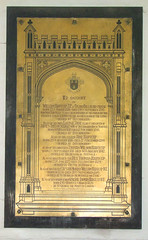
The memorials
include the Norwich sculptor Thomas Rawlins the
Younger's elegant 1760 monument for Henry
Williams; a monument to Pergrina Browne by
Rawlins's father as well as several other
monuments of the 18th century, mostly by Norwich
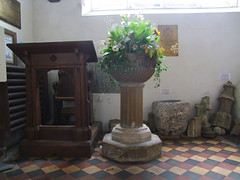
workshops. The only other furnishings of interest
are an 18th Century font, installed here as at
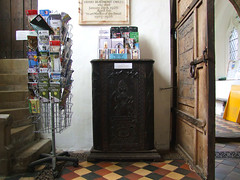
Holy Trinity after the fire, and a dole cupboard
of 1675 signed with a rebus, the letter Q and a
rat, to show it was given by a curate. It may not
have come from here originally, as the initials
of the man do not match anything in the records
here.
| An interior and an exterior
of different significances then.
Internally it is not a dull church, but
St Mary's great glory is of course its
exterior, as at St Michael in
neighbouring Beccles which also suffered
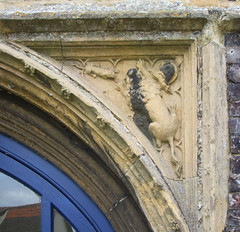
a serious fire. Here, there are plenty of
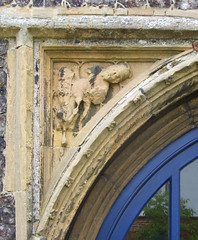
details to spot and wonder at. What, for
example, do you make of the reliefs in
the spandrels of the north porch? One
appears to show a lion and a man - is he
killing the lion, or is the lion eating
him? The other, in some ways more
mysterious, shows a lion with a cat, or
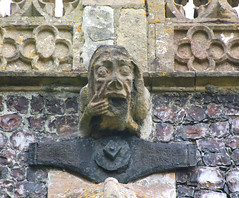
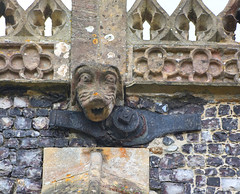
possibly a lion cub. There are several
excellent grotesques along the north side
of the building, including one man
holding his mouth open as if suffereing
an attack of toothache, and at the north
east corner is a man kneeling to pray,
but apparently supporting the building on
his back - a patron, perhaps? So
there we are, I went back to St Mary at
last, and I can put that Joyce pastiche
to rest, although you can still read the
text (though not the photographs that
went with it) here.
And the Proust entry? Well, you'll just
have to find it.
|
|
 |
|
|
|