| |
|
 |
|
Bury St Edmunds
was one of the cradles of Catholic
Christianity in England, its shrine Abbey
of St Edmund third only to Canterbury and
Walsingham as a goal of pilgrimage. At
the Reformation, the great Abbey was
destroyed, and was not allowed to become
a Cathedral. Otherwise, Bury could,
today, be a Cathedral city like Norwich,
Ely or Peterborough.
During the long, dark penal years, the
Faith was sustained in Suffolk by Priests
in the Bury area. These Priests, at
considerable risk of a grisly public
death, were generally sustained by
recusant families in the area, either the
Gages at Hengrave, or the Rookwoods at
Stanningfield. Our Lady and St Joseph at
Coldham Cottage, Lawshall, on the edge of
the Stanningfield estate, survives as a
Catholic parish church to this day. In Bury itself, a group of
brave Jesuits established a school in the
Abbey grounds in the years after the
Restoration, only to be put to flight by
the 'Glorious' Protestant Revolution of
1689, when the Catholic James II was
deposed in favour of the Dutch William of
Orange.
|
Catholic Priests continued
to be active in the Bury area throughout the 18th
century, providing a ministry to the rest of
Suffolk, still at no small risk until the
Emancipation Act of 1780. In 1768 they risked
building a chapel behind the presbytery, and in
1791, it became possible to officially licence
this for public assemblies. In the 1820s,
Catholics were, at last, allowed unlicensed free
assembly, and it was not long before the church
of St Edmund was built in 1837, the first new
large Catholic church in East Anglia since the
Reformation.
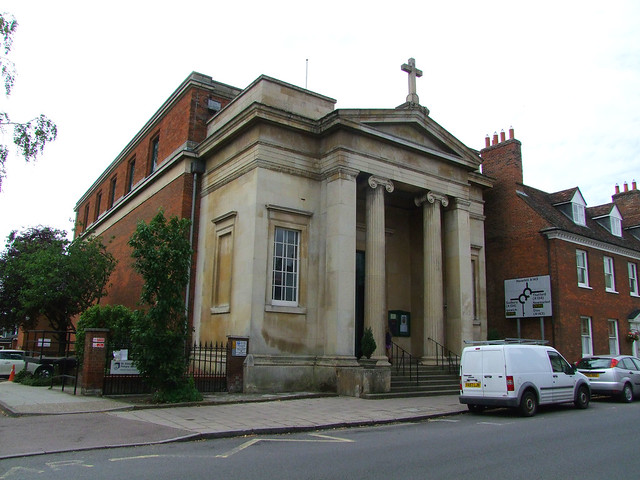
| St Edmund's
setting is wholly urban, as are the
settings of all Bury's churches. The
church is aligned north-south, with
liturgical east at the south end. It is
built in the Grecian style, that most
pure of Classical forms, and the
architect was Charles Day. The rather
severe frontage has recently been
cleaned, and consists of two Ionic
columns flanking the great west door. You
step inside to a substantial porch area,
reminiscent of a great 1930s cinema; one
almost expects to see a ticket booth. The
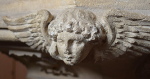
interior doorway is most curious, with
two classical figures supporting a large
marble pediment. Pevsner says that it is
a former fireplace surround from the
now-demolished Rushbrooke Hall.
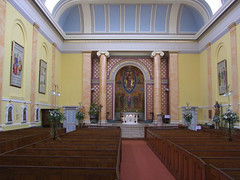
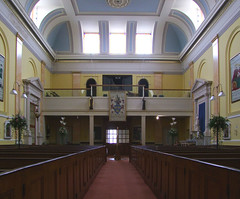
The inside comes as a
surprise, for this is Suffolk's only
Catholic church with box pews. They are
the original set from the 1830s, and are
a delight, their mellow uneven facings
breaking up the otherwise rather sombre
and opulent Classicism of this great
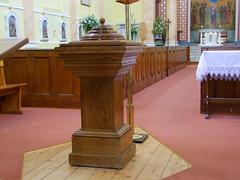
church. The modern wooden font sits at
the north end of the central gangway, but
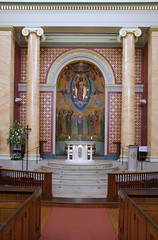
one's eyes are drawn irresistibly towards
the great sanctuary. Behind the altar, a
gorgeous mosaic of the Ascension dates, I
think, from an 1870s reordering. In
keeping with the solemn grandeur, the
Stations of the Cross are large and
sombre. However, the beautiful art
nouveau lamps rather relieve this. A
gallery at the north end contains the
organ.Two grand doorways were also taken
from the demolished Rushbrooke Hall and
pressed into service on either side of
the nave. The one in the north-west
corner leads into the Blessed Sacrament
chapel, the original 1768 chapel.
The primary school sits to the east of
the building, with the towering heights
of the famous Greene King brewery beyond,
makers of Abbot Ale. With a regular
Sunday Mass attendance of over 800, St
Edmund has one of the the largest
congregations of any church in Suffolk.
|
|
|
|
|
|