e-mail simon@suffolkchurches.co.uk
St George, Bury St Edmunds
A captivating town, it is worthy of so great a history, with its fine old streets and squares, the spacious ruins of its abbey, Norman and medieval towers of great splendour, ancient inns and noble churches... - Bury St Edmunds in The King's England by Arthur Mee, 1941. It is sixty years later. You take the Fornham road from near the railway station, past the ruins of the medieval hospital, and underneath the A14, which cuts brutally above the road, as if protecting central Bury from its suburbs. Soon, you can turn west into the narrow winding streets. No road is straight, and it becomes a maze, as if you could not reach your goal without a map - or, indeed, escape it easily afterwards. After a mile or so of this, you reach this church.
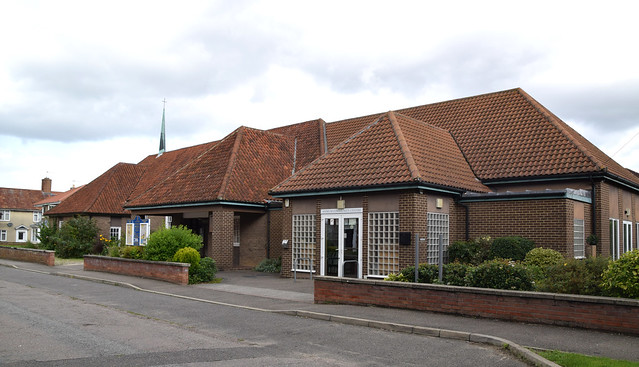
St George from liturgical north - the transepts are later. St George is set in the middle of the Mildenhall Road estate, one of Suffolk's roughest. It is surrounded by tenement blocks in grim yellow brick, one with boarded-up windows, another with doors hanging off. It so happened that we were in Bury with the car, and on the way back from the leisure centre I bullied my family into dropping me off here. The rain had eased off, but it was still very wet. I got out the car. My children pressed their faces against the steamed up windows, their Daddy disappearing into the haze. A sullen bunch of youths watched me as I crossed the road, then sat on the wall with some interest as I hopped about their churchyard, taking photos. St George was built in 1951 as a community centre, contemporary with the tenement blocks - the whole estate was built to serve the industry to the north of the town, particularly British Sugar. It is in brownish-yellow brick with large casement windows, and with the wide, high pitched roofs fashionable at the time. These features are clearly intended to echo the same on the blocks of flats. In 1967 it was converted into a church, with the addition of a sanctuary, a lady chapel, and a pretty spirelet. The parish was carved out of that of the Anglo-catholic shrine of St John the Baptist with which it shares a Priest. Mortlock claims that the building is also used for Catholic Masses, but I could find no evidence of this.
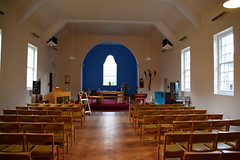
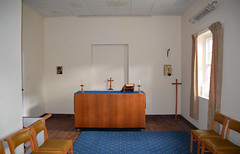
The chancel end, now free of graffiti. More recently, offices and meeting rooms have been added, in the form of transepts, and the whole place geared up for a busy life. Obviously, it was locked. There was no one about. Maybe, if I had come at a different time, or on a different day, it would have been a hive of activity. God knows, the local area needs something. However, on this particular day, anyone in need of prayer on the Mildenhall Road estate would just have to do it privately in their own tenement room. And I would very much like to have seen inside. Mortlock mentions the simplicity, and the prayerful atmosphere (again, how much the local people could do with free access to that!) and there is the lady chapel, which sounds beautiful. But I was stuck outside. It began to rain again, as I did a quick tour of the building. The sanctuary end had been plastered with graffiti at some point, although an attempt has been made to remove this. The youths watched as I photographed it. Otherwise, there was no sign of life, and I managed to get back into the car without either being sold drugs or getting mugged. I wonder what barmy old Arthur Mee would have made of it all?
St George is located on Anselm Road, in north Bury. This is not far from Fornham Road, but there probably isn't any point in me describing the maze-like approach to it - far better to find it on a street map. I found it firmly locked. |