| |
|
Butley is a fascinating
village. The familiar part sits on the top road,
and runs more or less on into Chillesford. Part
of the village here is actually in Wantisden
parish. On the creek below is the less well-known
Butley Mills, a collection of 19th century
buildings. A road leading off the high street is
lined with rural council houses, a reminder that
this is a working village. It climbs into the
woods, where you'll find the remarkable Butley
Priory Gatehouse, probably the finest surviving
medieval gatehouse in England. It looks like the
west end of a cathedral dropped off, its
remarkable flushwork the setting for a
bewildering array of shields. It is now a private
house, but open sometimes for concerts and the
like.
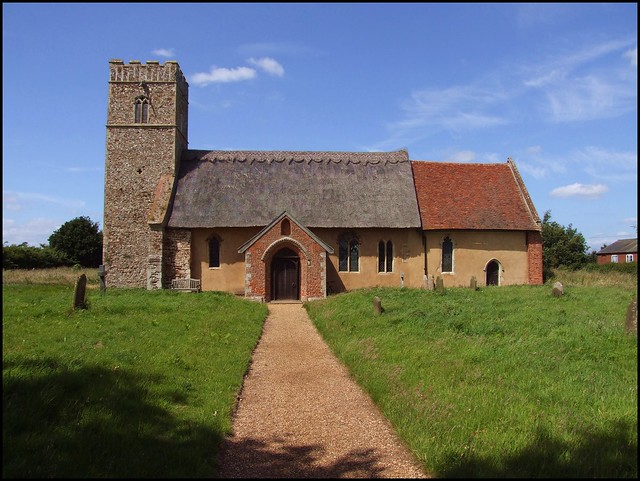
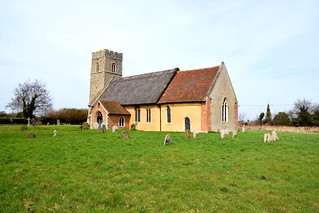
In comparison with such richness, St John the
Baptist is rather homely, a simple Suffolk parish
church not so very different from a hundred
others. Like many, the nave was more or less the
original Norman church. The chancel was added and
the tower done up in the 14th century. From the
south, it is a lovely sight, mainly because of
the way its thatched roof and elegant porch
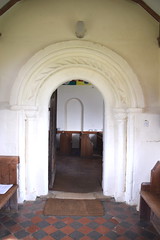
combine. A path leads through from the south-west
corner of the wild graveyard, and you step
through an ancient, beautiful doorway. The porch
itself is a fine Tudor red brick one, and you
then step through another, even older doorway,
the Norman doorway of about 1150. The door is at
least as old as the porch, and may even be as old
as the doorway.
 |
|
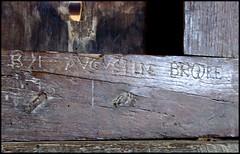
That it is old
enough to have needed repairs becomes
obvious once you are inside the church,
for on the inside of this door is a
fascinating piece of social history. The
date 1571 is inscribed, and beside it the
name Augustine Brooke, the letters carved
about 4 feet from the floor. Sam Mortlock
notes that this name can be traced in the
records of nearby Butley Priory, as that
of a child taught there in 1538. It is
fascinating to think that this man grew
up on both sides of the Reformation
divide, perhaps to become a churchwarden
and to set his name against a repair. Internally, this wall on the
south side shows its great age,
especially towards the west. It is not a
wall you'd want to have to hang a picture
on. The soft ground of the heathland, and
the coastal winter storms of half a
millennium, have left their impress.
|
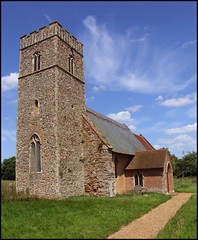
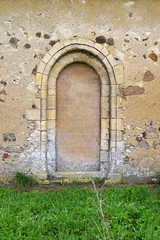
Curiously, right at the
west end is a doorway into a stairway. Where did
it go? When you look at the outside of the west
wall from the churchyard, the faint outline of
another doorway can be seen in the brickwork. But
what purpose had a doorway at a height of about
25ft leading to the outside? Perhaps it had led
to a wooden stage which would give access to the
tower - although, of course, it may well be even
older than the tower.
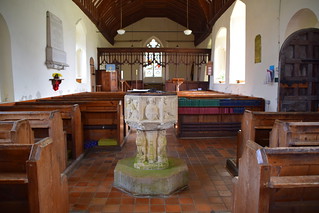
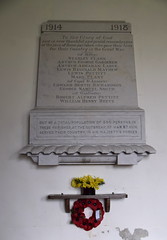
On the north side of the nave, the war memorial
is by Munro Cautley, who was diocesan architect
at the time. The rood screen is original 15th
century work, but totally tamed by the sanding
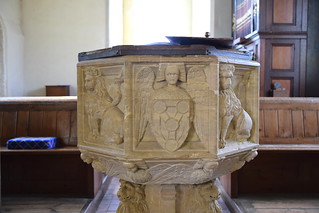
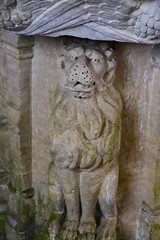
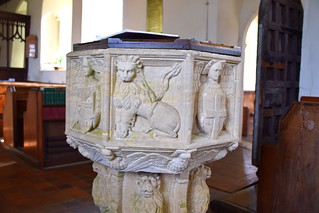
and varnishing of the centuries. The font is very
well preserved, suspiciously so, and I think that
the bowl, at least, may have been recut. One of
the shields bears the symbol of the Holy Trinity.
This symbol seems to have often survived the
iconoclasts of the 16th and 17th centuries,
perhaps because they didn't understand it, and
thought it heraldic. The Anglican reformers in
particular left heraldic imagery alone, realising
the role it played in keeping the local ordinary
people in their place.
Visiting in April 2018, I found a retired couple
sitting outside the church beside their electric
bikes, enjoying a cup of coffee from a flask in
the early spring sunshine. They didn't speak much
English, but it turned out that they were Dutch,
and they came to Suffolk each spring to cycle
around the countryside. They told me that they
liked East Anglia very much, and I told them that
I liked Holland too. European friendship
signalled and sealed, I bid them farewell, got
back on my bike and headed on to Chillesford.
|
|
|