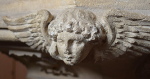
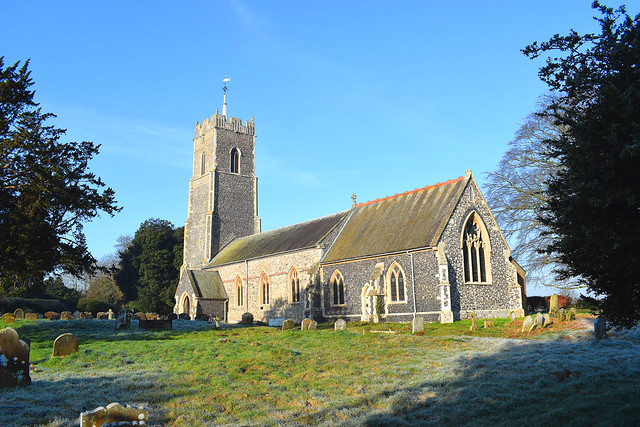
St John the Baptist, Campsea Ashe

www.suffolkchurches.co.uk - a journey through the churches of Suffolk
|
St John the Baptist, Campsea Ashe |
|
|
||
www.suffolkchurches.co.uk - a journey through the churches of Suffolk |
||


Follow these journeys as they happen at Last Of England Twitter.
| Campsea Ashe is a village that
many people may have passed through without realising it,
for the Ipswich to Lowestoft railway line has a stop
here, although the station is named for the town of
Wickham Market, a mile and a half away. The church sits
just on the other side of the railway bridge from the
station, and because of this it is a church I have
visited many times either at the start or the end of a
bike ride. I have always found it open. As you might
expect, the parish name has a number of variations in its
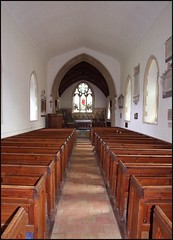
spelling with Campsey Ash also being popular. Village churches in this part of Suffolk are typically long and tunnel-like, and this is accentuated at Campsea Ashe by the slenderness of the tall tower which Simon Cotton found referred to in a bequest of 1432 when William Hore, chaplain, gave a noble towards it. The nave seems to have been completed by 1469 when William Blaxhale left 6 marks to the church, half to the new missal and half to the new candlebeam. This was clearly not enough, for John Jacobb in 1479 left half a noble towards the fabric of the 'candilbeem'. At the turn of the 16th Century there were bequests towards a covering for the font and the painting of the font. There was a major restoration here at the unusual date of the 1780s which James Bettley in the revised Buildings of England credits to the enthusiastic and antiquarian-minded rector Samuel Kilderbee. JP St Aubyn came along in the 1860s, refacing much of the church in renewed flint. The tunnel-like feel is apparent inside too, although the nave and chancel are not continuous under one roof as is often found in this area. The interior is pretty much all St Aubyn's, two older survivals being a reset 15th Century heraldic shield in glass and a canopied early 16th Century brass to a priest, Alexander Inglisshe. Everything is neat and well-cared for, a pleasing space lit by some decent late 19th and early 20th Century glass, most of it by Powell & Sons. The best of their work here is glass on the south side of the nave by Henry Holiday in the 1880s depicting Faith with her cross, and Hope with her anchor. The light colours are jewel-like in this setting.
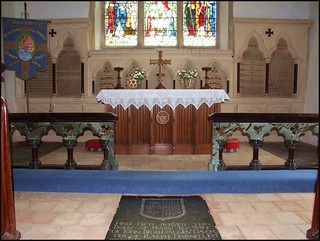
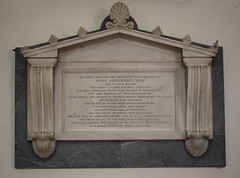
The east window is also by Powell & Sons in 1912, depicting the risen Christ in Majesty, with six saints at his feet. The glass is a memorial to the Lowther family. The left hand three are Saint John the Baptist, the Blessed Virgin Mary and St Peter. On the right is St Hilda, who represents Yorkshire where William Lowther's wife was born, St Edmund for Suffolk, and St Oswald for Cumberland where the Lowther family seat is. The Lowthers have several memorials
here, the most curious being one in an apparently 18th
Century style which dates from the early 1950s. The
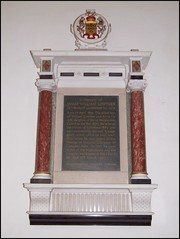
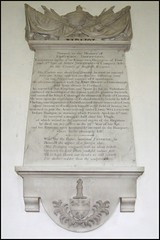
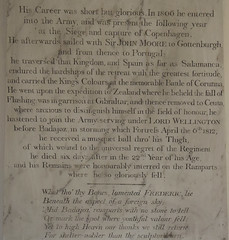
grandest memorial here is to Frederic Sheppard, who died
at the Battle of Badajoz in 1812. His army days took
him from the Siege of Copenhagen to Portugal, and then to
the retreat from Salamanca; he carried the King's colours
at the memorable Battle of Corunna, took part in the
expedition to Zealand where he beheld the fall of
Flushing, and then fought at Gibraltar and Cueta on
either side of the Mediterranean. He finally ran out
of luck when he received a musquet ball thro' his
thigh, of which wound to the universal regret of his
regiment he died six days after... and his remains were
honourably interred on the ramparts where he so
gloriously fell. Remarkably, given that he had a
distinguished career, he was just 22 years old. |
Simon Knott, December 2020
Follow these journeys as they happen at Last Of England Twitter.







Amazon commission helps cover the running costs of this site


