| |
|
.jpg) |
|
I had been looking forward
to revisiting Cavenham church for a long
time. Back in 2003, it had been one of
the five last of Suffolk's medieval
parish churches which I had visited, all
in a single day, to complete the set as
it were. But this meant it wasn't really
a priority for a revisit, of course.
However, the years pass, and in Open
Churches Week 2011 I found myself up in
this part of Suffolk again. Here, where
the Breckland begins, fields and copses
sprawl between honest working villages,
and it feels as if it might be the real
heart of a Suffolk. A pity then, that
this is one of the very few areas in all
East Anglia where the churches are kept
locked. St Andrew has at
least the blessing of a keyholder notice,
and this is good because his little church
is far more interesting than at first it
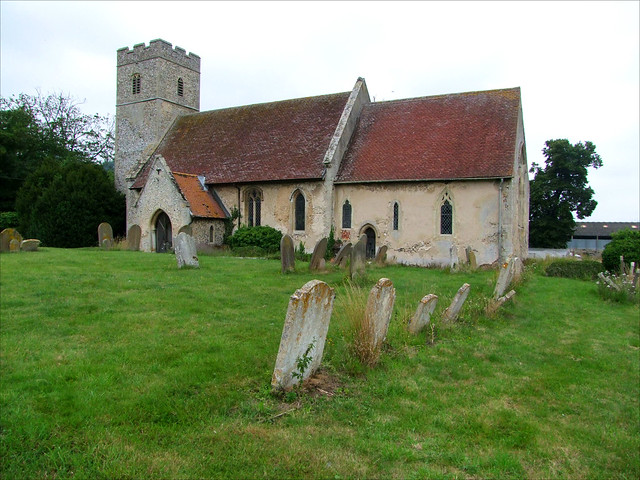
might appear. The most striking and
unusual thing about the exterior is the
drip course high on the western face of
the tower. At one time, a structure was
built against this side. What on earth
could it have been? Western galilee
porches are very unusual in Suffolk;
there are only two, and one of them is on
a round tower. The one on a square tower
is at Debenham, and the church
there is a large urban structure, quite
different to this little country outpost.
Besides, this drip course is very high,
higher than the nave, and so it must have
been at least a two-storey structure. The
tower is not wide, so it is not
impossible a structure here was wider
than the body of the church.
|
A
possible clue is a few miles off at Lakenheath. There, in the years after
the Reformation, a village school was built
against the west face of the tower. It is two
storeys high, and access is possible into the
church through the former west door. Perhaps
something similar happened here. The structure at
Lakenheath was built with masonry rescued from
the ruin of Eriswell St Peter, but perhaps the materials
used here were less good, and the structure was
later demolished. At some point in the 19th
century the bottom of the west door seems to have
been blocked up, and there is now a window here.
Another
possibility, of course, is that this was once a
much larger cruciform church with a central
tower, although this seems very unlikely given
the age of the present nave and chancel. It is
a very high drip course, though.
You
might notice the two reliefs carved under the
western gable of the nave. They look as if they
might be rabbits, or more accurately coneys,
since the word ‘rabbit’ meant the meat
of the beast until at least the 19th century.
Perhaps they are from a bestiary, or are
heraldic; but we are on the edge of one of the
main production centres of coney fur from the
middle ages onwards.
You
enter through the south porch. This is a small
church, and not terribly light inside, but one
thing that might strike you is that there is a
considerable amount of surviving wall paint. The
familiar 14th century red ochre is on door arches
in the nave, and there is more up in the chancel,
particularly on a tomb recess. We know that all
our churches were richly decorated inside, but
somewhere like this you can see what that might
have meant; not just devotional pictures, but
simple decoration as well.
There
is just one small surviving fragment of wall
painting, but it is of outstanding interest. It
is in the north-east corner of the nave, and
shows what appears to be a king with a scythe,
and some children in front of him. The subject
appears to be Suffolk’s only surviving
representation of St Walstan. Walstan was an East
Anglian Saint who came to be associated with
ploughmen, and as such his cult was political as
well as devotional. The heart of the Walstan cult
was just to the west of Norwich at Bawburgh and
Tasburgh, but it was almost entirely effaced and
forgotten in the years after the Reformation. It
is only painstaking research in recent years that
has restored to us this forgotten focus of rural
English Catholicism. Perhaps further research
will confirm for certain that this is him here at
Cavenham.
.jpg) .jpg) .jpg) .jpg) .jpg)
Another
intriguing medieval survival is the glass in the
south-west window of the chancel. At first sight
it appears plain; but look closely in the yellow
border, which Mortlock tells us is 13th century.
At the very top there is an inscription in Norman
French asking for prayers for Adam the Vicar. In
contrast, the window in the south east corner of
the nave is a lush 1920s war memorial depicting
St George. HeThe drawing of his face is not good,
giving it a peculiarly cartoon-like feel.
The
more you look around this church, the more
surviving medieval evidence there is. The screen
is a good one, although it has been scoured of
its catholic imagery. The traces of repainting
may be early 17th century, for it was at this
time the curious embellishments above the
entrance were made. Another medieval survivor is
the grand columned piscina up in the sanctuary; recut certainly, but not
the surviving head of one of the sedilia arches.
There
is a post-Reformation brass inscription in the
middle of the nave floor to John Symunt, a model
of protestant simplicity. At the west end of the
church the font looks like a melted
cheese; it is hard to tell if it is in its
original configuration, or, indeed, if it was
actually a font at all. A big clue that it was is
that it has been heavily plastered over, as many
fonts were in the later 16th century. There is a
17th century coffin plate on a window sill at the
back of the church, but it is in very bad
condition and was probably dug up in the
graveyard. More recently, the WWI memorial is a
1920s stained glass window by Jones & Willis
depicting St George, but it really isn't very
good, I'm afraid.
| Perhaps
the strangest survival here is the
extensive graffiti on the eastern faces
of the chancel arch. Some of it is dated
to the 1640s and 1650s, which is during
the Commonwealth. At this time, the
Church of England was supressed, and
replaced with a presbyterian system of
church government. Some churches hosted
congregational worship, but others were
put to different uses. Perhaps this
graffiti survives from a time when the
chancel was in use as a school, or even a
stable. Coming back in
2011, I found the church much as I
remembered it, but couldn't help thinking
it had a rather forlorn and unkempt feel
to it. It's a shame. This is super
church, little-known but full of
interest. It should have more visitors,
and there is really no reason to keep it
locked. It should be open.
|
|
.jpg) |
|
|
|

.jpg)
.jpg)
.jpg)
.jpg)
.jpg)
.jpg)
.jpg)
.jpg)
.jpg)
.jpg)
.jpg)
.jpg)
.jpg)
.jpg)
.jpg)
.jpg)
.jpg)
.jpg)
.jpg)