| |
|
It wasn't long
after I first came to Charsfield, some thirty years ago
now, that I first met the writer Ronald Blythe. Although
he was by then living over the border in Essex, Ronnie
has remained most people's idea of Mr Suffolk, and his
writing is a touchstone to what Suffolk means. But what
is a typical Suffolk village? Where is it? All villages
have their unique aspects, and those they hold in common
with others. When I first wrote about this church on the
Suffolk Churches site, I was not the first to suggest
that here, in Charsfield, there is a microcosm of what it
means to be in Suffolk - the church, the pub, the old
cottages, yes, but also the council houses, the football
pitch, the Victorian school extended with prefabs. Here
are the rural poor, living cheek by jowl with the
incoming professionals and the County gentry, with all
the diversity and tension this imparts to village life.
Ronald Blythe wrote about Charsfield, and called it
Akenfield. To read his 1969 book Akenfield now
is to read about any number of Suffolk villages in the
late 1960s, but Charsfield it is, nonetheless.
Not many books like Akenfield get written today.
It is a rich, surprisingly bleak narrative, often brutal,
at other times very moving, even painfully so. It is
contemporary with other social dramas like Cathy Come
Home, and it now feels its age. It is no rural
idyll. For instance, we meet the reclusive Davie, living
in a dire, tumbledown cottage. He remembers being sent
off to the First World War; he was given a gun, which he
understood because of rabbiting, and a New Testament,
which he didn't, and used alternately for rolling
cigarettes and toilet paper.
"Did you kill men, Davie?" asks the
writer. Davie replies "I got several" -
the same answer to a question about how he did on a rook
drive. 'Several', in Suffolk, means many. "What
was the worst thing, Davie?" Davie considers.
"Why, the wet, of course".
Half a century on, Charsfield is a richer place in broad
economic terms, as is everywhere else in Suffolk. But it
is less rich in diversity, in the sheer drama of human
existence. A small price to pay. In the years after Akenfield,
Peggy Cole, who lived in the village in a house called
'Akenfield', broadcast on BBC Radio Suffolk and wrote in
the East Anglian Daily Times about Suffolk folklore and
village life. So the pulse of Suffolk was still being
taken in Charsfield. Both Cole and Blythe appeared in
Peter Hall's award-winning 1974 television production of Akenfield,
as did many other Charsfield residents.
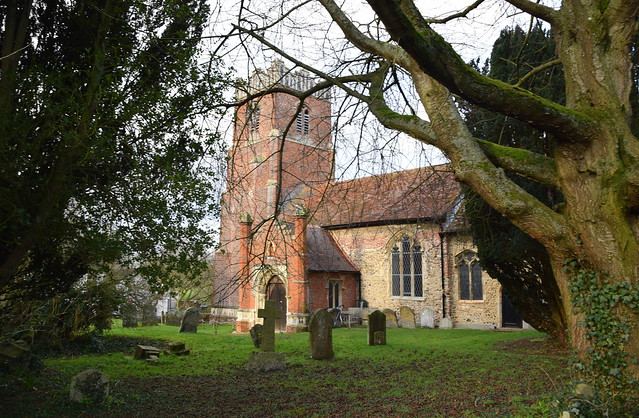
If you visit Charsfield, you will eventually wander up
the hill to the church. There, you will discover
Suffolk's prettiest red brick Tudor tower and porch,
against the body of an older church. But the base of the
previous tower survives, and it is really quite
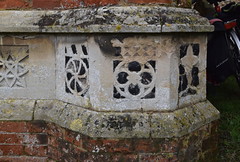
remarkable. On the west side, either side of the doorway,
there is a dedicatory inscription, and panels around the
other two sides show the emblem of St Edmund, the Marian
symbol, and a eucharistic chalice and wafer with Our
Lady's initials in each corner. There are others, too,
and of course they have done well to survive.
Simon Cotton tells me of a bequest to a "new"
tower in 1454. This is curious, for it clearly
long-predates the Tudor period, but must postdate the
earlier tower. Perhaps there were still insufficient
funds for the rebuilding at that time, although Simon
found no other bequests. Take away the tower and the
porch, and this is a very homely little building indeed.
Incidentally, if you have seen the film of Akenfield
you may be surprised not to recognise this church. In
fact, the graveyard here is so severely tight that it
made filming difficult, and so the church at neighbouring
Hoo was used in the film instead.
For many years the church retained a broken bell in the
porch, with the inscription sic sacheverellus ore
melos immortali olli ecclesiae defensori hanc dicat
Gulielmus Leman de Chersfield Eques 1710 ('since
Sacheverell's eloquence is so musical, so this is
dedicated to him, the immortal defender of the church, by
Sir William Leman of Charsfield 1710'). Henry Sacheverell
was an instrument of the established church in a now
largely forgotten controversy. He published an attack on
those who defended the rights of non-conformists. When he
was accused of seditious libel, thousands bought copies
of his speech for the defence, and the government of the
day was brought down. The incoming Tories richly rewarded
him, including the local Leman family.
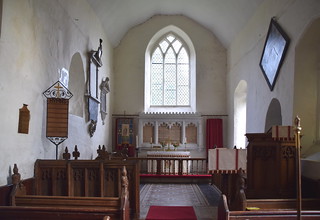
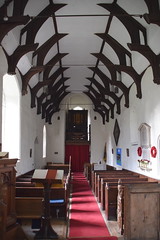
You step into a quiet, simple little interior, with no
great excitements, which is just as it should be. The
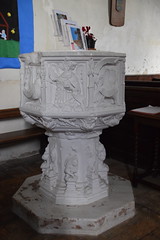
font is immediately opposite, and on one side, instead of
an angel, there is a representation of St Botolph, a
local saint with connections at Iken and Burgh. The war
memorial is halfway along the north side, and remembers
those who fought and died alongside reclusive Davie.
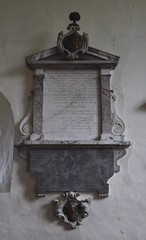
Further east is the memorial to another William Leman. It
records, grandiloquently, that Here also mingled with
his parents dust sleeps till the resurrection of the Just
of William Leman the mortal Part. And the immortal? That
is gone to the blest regions of Eternal Light there
waiting for the Lord to reunite and raise them with his
parents up on high to live with him, unto Eternity.
Below the memorial, a cheeky boy sits with his feet in
the stocks on an early 20th century bench end. Some 350
years earlier, another local woodcarver produced the
front of the ringing chamber, and signed it G S 1587.
So often, out cycling, I find villages I'd like to live
in. Usually, it is winter, and there's a smell of
woodsmoke in the air. Such villages have no modern
council houses like the ones in Charsfield. Instead,
little cottages huddle together, cosy against the
dwindling light and frost. How idyllic! And then I think
of Leonard, aged 71, recalling his Akenfield childhood: "It
was very hard living indeed... our cottage was nearly
empty, except for people. There was a scrubbed brick
floor, and just one rug made of scraps of old clothes
pegged into a sack. Six of us boys and girls slept in one
bedroom, and our parents and the baby slept in the other.
There was no newspaper, and nothing to read except the
Bible. All the village houses were like this."
"Our food was apples, potatoes, swedes and bread.
Nobody could get enough to eat, no matter how hard they
tried. Two of my brothers were out to work. One was eight
years old and he got three shillings a week. Our biggest
trouble was water. There was no water near... 'Drink all
you can at school', we were told. There was a tap
there."
"Our parents and all the cottage people were very
religious and very patriotic. The patriotic songs and
church hymns seemed equally holy. They took our breath
away. It was all 'My country' - country, country,
country. You heard nothing else. There was no music in
the village then, except at the chapel or the church, and
our family liked it so much that we hurried from one to
the other to hear all we could. People believed in
religion then, which I think was a good thing, because if
they hadn't got religion there would have been a
revolution."
"I want to say this simply as a fact, that Suffolk
people in my day were worked to death. It literally
happened. It is not a figure of speech. I was worked
mercilessly. I am not complaining about it. It is what
happened to me."
I cycled on, through the narrow lanes to Dallinghoo,
through the fields where Leonard Thompson and his young
brothers slaved. I thought about how attractive going off
to war must have seemed. Of those East Anglian
generations, brutalised and betrayed.
Simon
Knott, February 2020
Follow these journeys as they happen at Last Of England
Twitter.
| |
| |
|
|
|
|
|
|
|
| |
|
|
|
|
|
|
|
|
The Churches of East
Anglia websites are
non-profit-making. But if you
enjoy using them and find them
useful, a small contribution
towards the costs of web space,
train fares and the like would be
most gratefully received. You can
donate via Paypal.
|
|
|
|
|
|
|
|
|
|
|
|
|
|
|
|
|
|
|
|
|
|
|
|
| |
|
|
|
|
|
|
|
|
|
|
|
|
|
|
|
|
|