| |
|
 |
|
Cockfield is a large,
sprawling parish with a small population,
living around scattered greens and along
the ancient road at the heart of the old
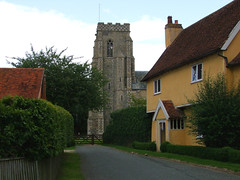
village. The church sits up a lane, past
the war memorial and the village school.
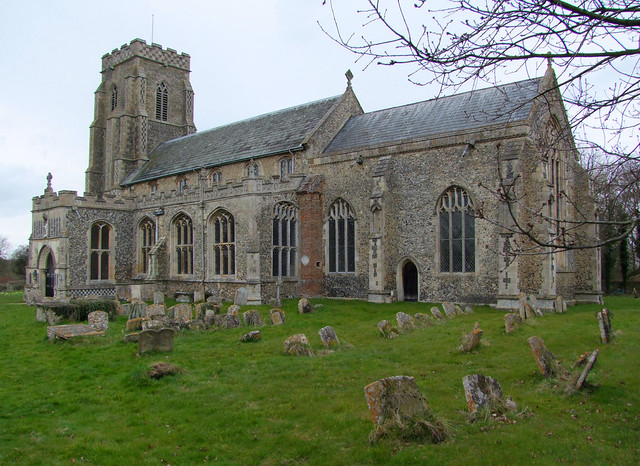
It feels intensely rural. Externally, St Peter is one
of the great Suffolk churches. It is big.
It sits in what was one of the county's
wealthiest medieval parishes; a 19th
century Rector here would take home
£1050 a year, roughly £200,000 in
today's money. He would also get to live
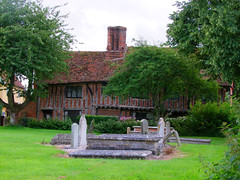
in the stunning former gild house, on the
south-eastern side of the graveyard. Not
surprisingly, few of them moved on, or
retired. The
church was a major construction of the
14th century, a lengthy, single campaign
and then embellished with all that the
15th century had to offer. Given that the
Springs and the de Veres were residents,
this may come as no surprise; the parish
must have been awash with cash. The
building could be used in a textbook to
illustrate the development from Decorated
to Perpendicular.
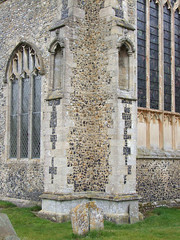
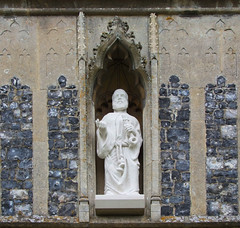
Perhaps the most striking features at
first sight are the elaborate image
niches in the buttresses to the east. The
chancel is probably the oldest part of
the church, and these echo niches seen in
the east end at Cotton, which is of a
similar age. The quality here, however,
is superb. The tower followed soon after
the chancel. There are very curious
flint-infillings of door-sized panels
right at the top of the tower on the
north and south sides. Mortlock claims
that they were windows put in by an 18th
century Rector to enable him to pursue
his enthusiasm for astronomy. Can this be
right? I'd like to think so. It would
also give us an idea what he was spending
all his money on. Alternatively, they
might once have been massive image
niches, although I've not seen their like
elsewhere.
|
The south side was probably
the last bit finished, and the grandness of the
aisle battlements reflect this. The porch has
three massive niches that cannot have been used
for very long. The whole piece seems rather too
magnificent for such a rural outpost; but
remember, in the late 15th century, Cockfield was
at the heart of industrial England, midway
between the three great merchant towns of
Lavenham, Sudbury and Bury St Edmunds. This is
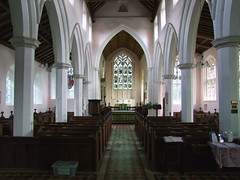
reflected by the interior - you feel as if you
are stepping into a large, urban church. In part,
this is a result of the significant 19th century
restoration, which replaced all the furnishings
and most of the windows. It was not done
unkindly; not much had survived the medieval
period, and what did was taken care of. At the
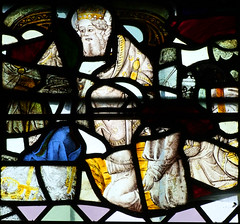
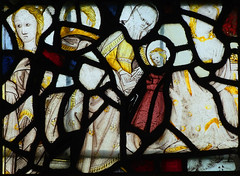
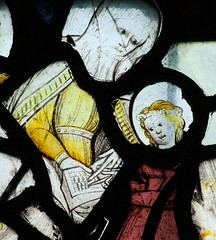
east end of the south aisle are some fine panels
of medieval glass, including a tender scene of St
Anne teaching the Blessed Virgin to read. Across
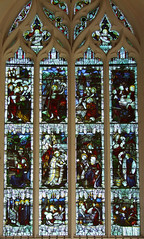
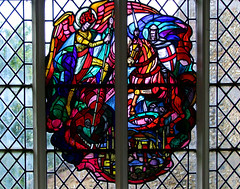
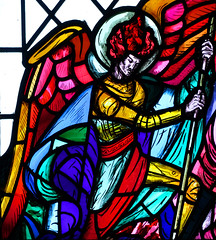
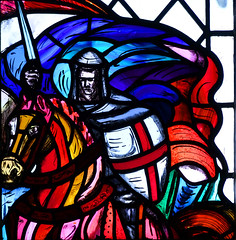
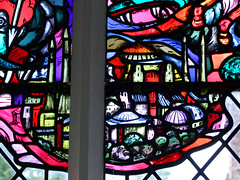
the church in the east window of the north aisle
is a dramatic modern depiction of St Michael and
St George above the City of God. I think the
artist was Rosemary Everett.
Rather too taken care of
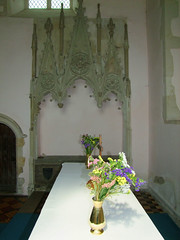
was one of Suffolk's largest Easter sepulchres,
up in the chancel. Contemporary with the chancel,
the Victorians recut it it with more enthusiasm
than accuracy, I fear - although, as Mortlock
says, the effect is impressive. The blank shields
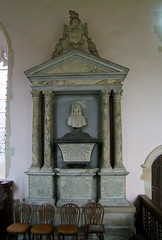
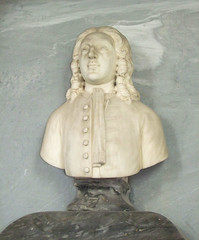
in the base are original. Just to the west is the
grand memorial to James Harvey, who died in his
early twenties in 1723. This is the full Georgian
works; indeed, it probably dates from a half
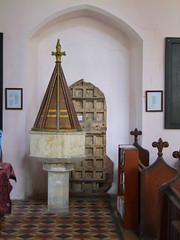
century after Harvey's death. The church has two
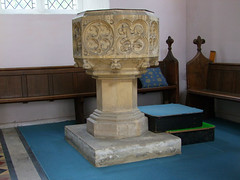
fonts. One of them, the Victorian one, is set at
the east end of the north aisle. The medieval one
is at the other end of the aisle, with a rather
unusual display behind it - a detached medieval
door.
| An unlikely name
associated with Cockfield given its long
history is the author Robert Louis
Stephenson. His cousin married Churchill
Babington, the redoubtable Rector of
Cockfield. Babington was better known in
his day as a naturalist, antiquarian and
writer, and was greatly admired by Prime
Minister William Gladstone. The young
Stephenson came often to visit and stay
with his cousin and her remarkable
husband, writing enthusiastically of his
adventures and explorations in and around
the village, and giving a vivid
Scotsman's eye view of a genteel and
civilised English country parish in the
later years of the 19th Century. Three hundred years earlier,
Cockfield had been a hotbed of
puritanism, as befits a place in the
heartland of the first English industrial
revolution. Mortlock recalls the
elegantly named John Knewstub, Rector
here in the 1580s, who convened one of
the early conferences to discuss a way of
getting rid of Bishops and Cathedrals,
and replacing them with a presbyterian
system of church government. His
enthusiasms would lead inexorably to the
English Civil War.
|
|
 |
|
|
|