St Peter, Cransford

www.suffolkchurches.co.uk - a journey through the churches of Suffolk
|
St Peter, Cransford |
|
|
||
www.suffolkchurches.co.uk - a journey through the churches of Suffolk |
||

Follow these journeys as they happen at Last Of England Twitter.
We were a few weeks into the second year of the Great Coronavirus Pandemic, and I was cycling around another bit of Suffolk looking for churches that were still open. Since the start of the pandemic the year before I had visited perhaps 120 Suffolk churches, all of which I would have expected to find open back in normal times, but now only about half of them were. There were various reasons for this, I suppose, some parishes being over-cautious or merely wanting to protect their ageing keyholders and churchwardens, others obeying the letter of the Church of England's advice rather than its spirit. It seemed a pity. As one correspondent pointed out to me, few buildings are as well-ventilated as a rural medieval church! But in this area to the north of Framlingham the churches still seemed mostly to be open, and so I was pleased. It was an unseasonably
warm spring day, and I was put in mind of two previous
visits, one about five years before on a late July
afternoon with the temperature in the high eighties. As
with today I'd left Bruisyard and climbed the steep
narrow back lane to the top of the ridge before
freewheeling down into Cransford, the cooling breeze a
pleasure. And then there was another occasion when I'd
made the same journey, an icebound day in January 2009,
the coldest month in Suffolk for years. Although the bulk
of the snow was still a week or so away, the frost which
laced the trees and lay heavily across the rolling fields
isolated the villages and clarified the landscape. As I
cycled from Bruisyard, I could have been in any century.
I came down into Cransford as the snow began to scatter
wildly through the air about me, great goose feathers of
frozen white. A man standing in his garden told me it was
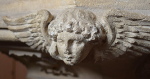
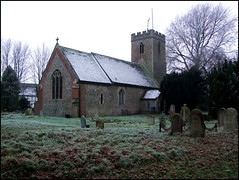
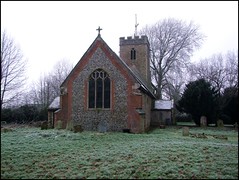
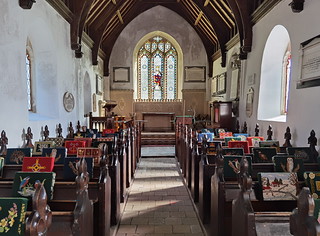
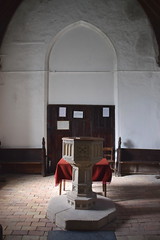
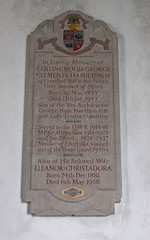
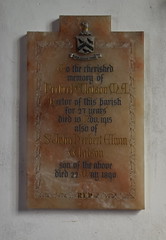
minus three, but it had felt much colder. Externally, Cransford's is certainly a typical small country church. Its 15th Century tower contains a contemporary bell and the nave predated it by a couple of centuries. There was a major restoration here in the 1840s, and then another one twenty years later which brought the chancel with its uncompromising Perp tracery. The church always seems to be open, and you step into a quiet coolness that is all of the 19th Century. The Victorians had prepared this place for ordinary people to worship in it, and those 19th Century Cransforders would instantly recognise their church if they came back to it today. Everything was renewed, but there is a harmony to the work, with nothing blowsy or over-grand. The furnishings are good quality work of the 1870s, the stained glass by Lavers, Barraud & Westlake in the east and west windows is not over-imposing. The font is from the 1840s, and remembers two children of the parish who died in infancy. James Bettley in the revised Buildings of England volume for Suffolk: East credits it to the stone mason Henry Clutten of nearby Framlingham. There are a number of decent memorials to the Borrett family of Cransford Hall. Nothing survives from the medieval life of this church - or, almost nothing, for if you look low down on either side of the tower arch there are two cowled faces of the 14th Century. I wonder why they are so low. Perhaps they were reset from elsewhere. The 1851 Census of Religious Worship suggests that they were an enthusiastic church-going lot in this parish. Out of a parish population of slightly more than three hundred, there were fully half that number attending the village Baptist chapel but still enough to provide a hundred more here in the parish church along with fifty scholars. This would suggest that just about everyone in Cransford was attending church that day, although of course much of the Baptist chapel congregation must have gathered from a wider area. Even so, it was a remarkably high attendance rate for this part of Suffolk. The chapel survives, in rebuilt form, today. |
Simon Knott, April 2021
Follow these journeys as they happen at Last Of England Twitter.





|
||||||||||||||||||||||||||||||||||||||||||||||||||||||