| |
|
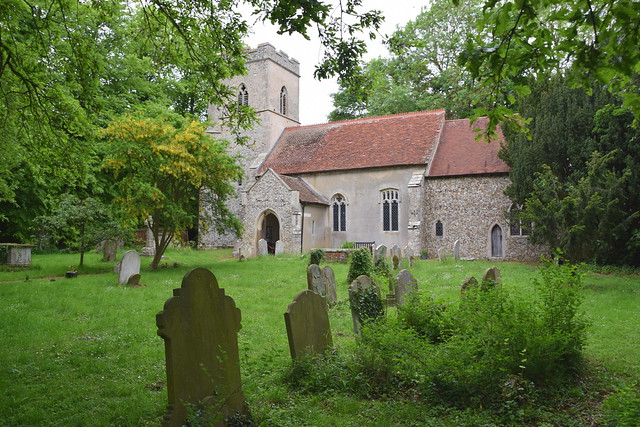
This is a church
of great interest, despite its Victorian makeover. But
first, you will have to find it. There are fleeting
glimpses on the road from the village of Creeting St
Mary, but, closer, the church is completely hidden by the
trees that surround it. It lies at the end of a gravel
track, about a third of a mile from the road. This is
signposted, but the sign is also obscured by trees. A
secret, hidden place. And yet, from the corner of the
graveyard can be glimpsed the vast paint factory complex
at Stowmarket in the valley below. And St Peter is
separated from its village by the four lanes of the A14,
the roar of which can be heard from the churchyard. How
has this happened? Simply, Creeting St Peter consists
mainly of council houses and farm cottages, working
people's houses. People like this do not get asked if
they want a motorway at the bottom of the garden.
I first came here on a day of the high summer of 1998,
when the trees were boiling with green. Coming back on a
fresh spring day in 2007, I found the graveyard full of
light. Two men with a Commonwealth War Graves Commission
white van were busy beside the path, resetting a
headstone. In the summer of 2019 the trees boiled again,
and a heavy silent heat lay across the churchyard.
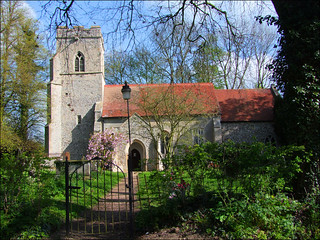
The tower is a pretty, Victorianised one from the 15th
century. It bears obvious signs of substantial recent
repairs, as does the porch below. The most striking thing
about the outside of the church, though, is the series of
knapped flint crosses on several of the buttresses. Each
is about 90cm high, and there are five of them. However,
seven other buttresses show signs of repair where the
cross would have been, making twelve in all. Almost
certainly, then, these were external consecration
crosses, a rare survival.
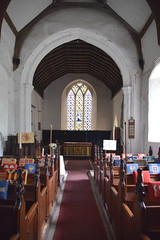
You step into a church which is open to pilgrims and
strangers every day. It is gloomy at first, especially on
a summer's day, but as your eyes become accustomed to the
light you see what is perhaps the most remarkable feature
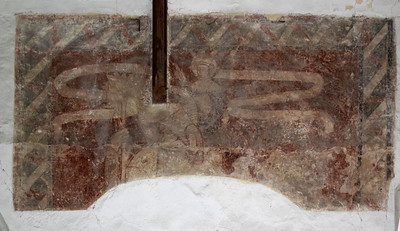
of the church on the north nave wall, the upper part of a
great St Christopher wall painting. The colours are
dulled, but the painting is highly detailed, although it
is a little hard to decode at first, because the top of
St Christopher's head has been obscured by a roof beam,
and the Christ child appears to be the central figure.
Once you've seen that he is sitting on the shoulder of a
larger figure, all is clear. The important survival is
that this St Christopher retains its scrolled Latin
inscription, which translates roughly as Whosoever
regards this image shall feel no burden in his heart
today. Much of the lower part of the image has been
destroyed, but a detail survives in the bottom right hand
corner of a mermaid holding a mirror and comb.The
greatest fear of late medieval Christians was a sudden
death, leaving their sins unconfessed. Intercessory
prayers were made to St Christopher for protection
against such an eventuality, and this made him one of the
most visible and significant parts of the 15th century
economy of grace.
Creeting St Peter
church was derelict by the 18th century, so we have the
Victorians to thank for its survival. Theirs is the roof,
the furnishings, windows and sanctuary, and it is all
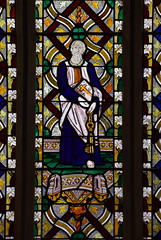
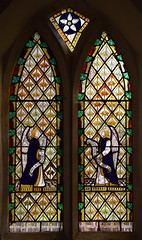
well done. The east window is particularly interesting,
as it predates the Victorian stained glass industry. It
was made by a Rector of the church. It shows St Peter, so
we may assume that this is one of the county's earliest
responses to the Oxford Movement-inspired revival of
interest in medieval theology and sacramental art. The
pulpit is slightly older than the other furnishings, and
if you climb up into it you will see that it is
heptagonal, the only one I know in Suffolk.
Another curiosity is the font. It is almost identical to
that at Earl Stonham, four miles away, but unlike that
one, this is in immaculate condition. Mortlock felt that
it hadn't been recut, and the carving is certainly in a
15th century style. There seems to be nothing missing,
except that the shields have no symbols on them. They
don't seem to have been attacked by iconoclasts. Perhaps
the font was never finished, but perhaps it is more
likely that it is a clever Victorian copy of Earl
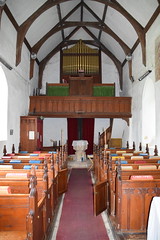
Stonham's. Above the font, the 19th century gallery now
contains the organ, which was rescued from a London
church bombed in the Second World War.
Three fish swirl on the altar hanging, which is either by
the great Isobel Clover, or the work of one of her
pupils. On a quarry in a nave window is inscribed Be
still my soul with the musical notation above it.
They enhance the feel of what is obviously a well-loved,
well-used and looked-after church.
Simon
Knott, November 2019
Follow these journeys as they happen at Last Of England
Twitter.

Amazon commission helps cover the running
costs of this site
|
|
|