| |
|
This pretty little
church is as remote from its village as it is from the
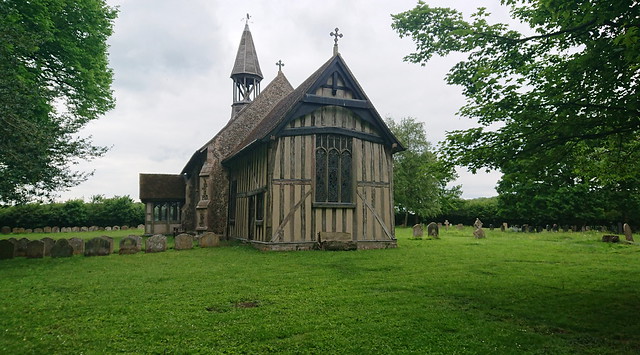
rest of the world. What is more, it has the only
timber-framed chancel in Suffolk. You get to it along a
path from the lonely road between Coddenham and Stonham
Aspal. The village is a good mile away, along the old
Roman road. Beside the church is the site of the former
manor house, and the path to the church runs along the
edge of the old moat.
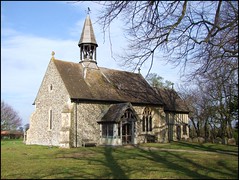
You approach the church from the east, through a little
gate. What a lovely sight it is! The external east wall
is delightful, like a fairy-tale cottage. The early 16th
century porch is contemporary with it, but the nave is
largely Victorian, by local architect Edward Hakewill,
which may fill those of us who have met him before with a
sense of foreboding.
There was never a tower, and in fact this church was a
chapel of ease to Coddenham until the 20th century. The
exterior might lead you to expect a humble, rustic
interior, but in fact this pretty little building
contains something quite different, for inside is
Hakewill's best restoration in Suffolk. We get used to
Hakewill's dark, gloomy interiors - Shottisham, for
example, or Rushmere before George Pace came along. Here,
the structure of the building prevented him adding his
favoured low north aisle, and instead we have an opulence
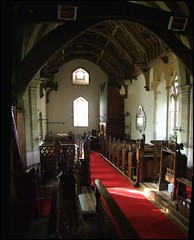
which is powerful on such a small scale. It is still dark
inside, but the low sun through small windows picks out
rich woodwork and jewel-like glass. He retained the early
16th Century roof above, arched braces alternating with
hammer beams. It is likely that the same carpenters were
responsible for the south porch.
High in the west wall is that rare thing in Suffolk, a
glass set of royal arms, this one for Victoria and
contemporary with Hakewill's work. Ward & Hughes's
east window has three small scenes depicting the
Resurrection flanked by the raising of Lazarus and the
raising of Jairus's daughter. The two outer scenes appear
again on the reredos at neighbouring Gosbeck, flanking
the Crucifixion. Otherwise, the glass is all decorative,
and set as it is among the dark wood you get the feeling
of the hall of a large country house: you almost expect
to hear a grandfather clock ticking. I wondered if John
Betjeman ever visited Crowfield, for I feel sure that he
would have loved it.
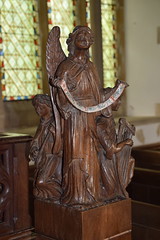
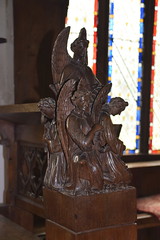
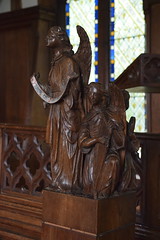
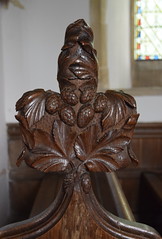
The carved bench and stall ends are of the highest
quality. Sam Mortlock credits them to James Wormald and
William Polly. Polly had also worked with Hakewill at
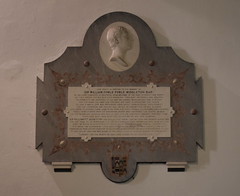
Rushmere St Andrew. The restoration was bankrolled by the
widow of Sir William Fowle Fowle Middleton of Shrubland
Hall. Her husband is remembered on the north wall by his
late tenantry, for his high integrity and worth,
and it records their high esteem for one who ever
promoted their best interests and welfare.
The inscription continues in the grand classical manner
of a century earlier. He seems to have been a good bloke.
His medallion portrait in profile above renders him
noble, as if he had been a Roman senator who retired to
the country, and died there, among the grateful peasants
whose lives he had chosen to transform. Shrubland Hall
later became a self-styled 'spa health farm', but today
is closed, and will no doubt now be converted into
apartments, as is the way with such things.
Simon
Knott, November 2019
Follow these journeys as they happen at Last Of England
Twitter.
| |
| |
|
|
|
|
|
|
|
| |
|
|
|
|
|
|
|
|
The Churches of East
Anglia websites are
non-profit-making, in fact they
are run at a considerable loss.
But if you enjoy using them and
find them useful, a small
contribution towards the cost of
web space, train fares and the
like would be most gratefully
received. You can donate via
Paypal.
|
|
|
|
|
|
|
|
|
|
|
|
|
|
|
|
|
|
|
|
|
|
|
|
| |
|
|
|
|
|
|
|
|
|
|
|
|
|
|
|
|
|
|