St Mary, Culford

www.suffolkchurches.co.uk - a journey through the churches of Suffolk
|
St Mary, Culford |
|
|
||
www.suffolkchurches.co.uk - a journey through the churches of Suffolk |
||

Follow these journeys as they happen at Last Of England Twitter.
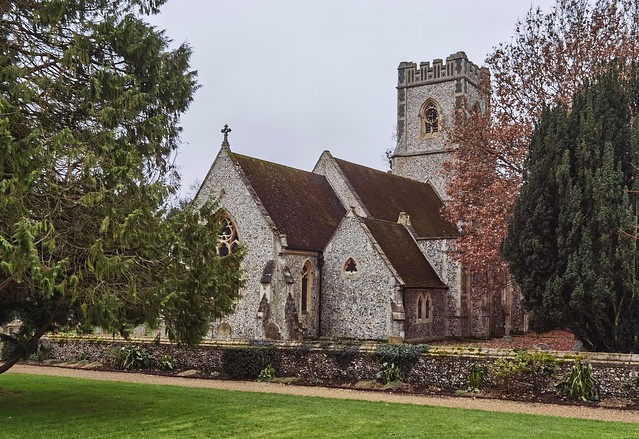
| The heathland to the north of Bury
St Edmunds can be bleak, especially in winter, but
Culford is a cosily domestic former estate village, and
to the west of its busy street is the park of Culford
Hall, in its time the home of the Bacons, the
Cornwallises, the Benyons and the Earls of Cadogan. Today
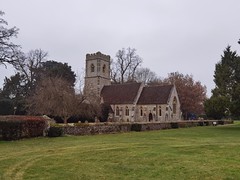
it is a public school, and the church sits in a walled
churchyard within its busy grounds. The Reverend Edward
Benyon, who inherited the estate in 1839 and must have
been quite the wealthiest East Anglian incumbent of his
age, had the church rebuilt at his own expense in 1851.
Pines and yews overarch the trim, clipped lawns that
separate the churchyard from the park road, and if the
church is not entirely in an East Anglian style, being in
a somewhat splendid flint-and-dressed stone form of
Decorated, it is a good example of a rural 19th Century
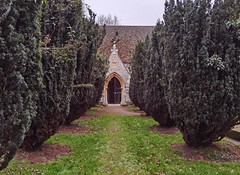
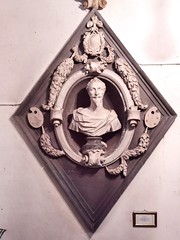
church built without too much concern for cost. It replaced what White's 1844 Suffolk called a small, neat structure, built at the end of the 17th Century at the expense of Sir Stephen Fox, father-in-law of the third Lord Cornwallis, which in turn presumably replaced a medieval building. Nothing survives of this church except for the memorials, but as we will see they are interesting and in one case quite remarkable. Curiously, the lower part of the tower of an earlier church is said to remain within the flint casing of the new church, but it seems unlikely to have been built in the 17th Century, so did it survive from the medieval church? Considering his wealth, Benyon's choice of architect was a relatively minor one, William Habershon, whose practice was responsible for a number of minor domestic buildings in Suffolk as well as the restoration of Boulge church on behalf of the Fitzgerald family. It isn't entirely clear how he came to be the architect here, because at the same time that Habershon was working on the church one of the great architects of the age, Sir Arthur Blomfield, was busy on the Culford estate. Habershon had been employed by Benyon to rebuild Ingham rectory, and I suppose that Benyon must have liked it. For many years Blomfield was said to be responsible for the church, a mistake in the first edition of Nikolaus Pevsner's Buildings of England volume for Suffolk which was then repeated elsewhere, despite the fact that a tablet in the church records Habershon as the architect. James Bettley's 2016 revised edition puts matters right. An avenue of yews leads up to the
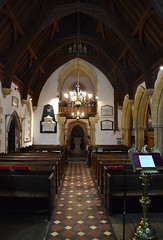
south doorway, and you step inside to a dark hush,
typical of churches built in the 19th Century for the
newly fashionable High Church worship. The interior
appears all of a piece, tiled floors, sombre woodwork,
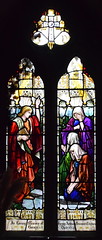
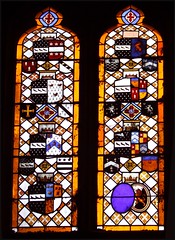
and glass by John Forsyth, a pupil of Henry Holiday, in
the north aisle which was added in the first decade of
the 20th Century, the work of a fashionable London
architect, Clyde Young.
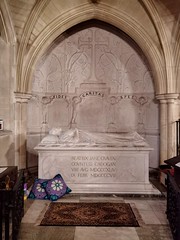
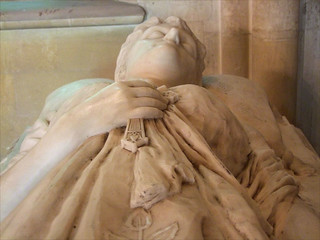
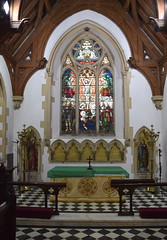
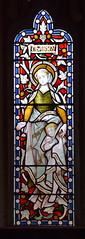
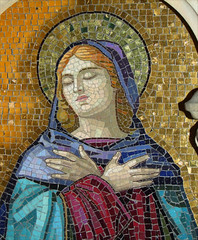
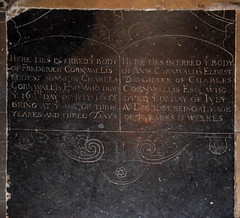
The memorial is in its original place from the church's predecessor, and Habershon rebuilt the chancel around it, causing it to sit rather awkwardly below floor level, but the other memorials were moved elsewhere so that this space could become a liturgical and devotional stage. It is splendidly tiled under a hammerbeam roof with more early 20th Century glass by John Forsyth.The figures of Faith, Hope and Charity that are in the glass of the lancet windows are by Hardman & Co in the 1860s, and James Bettley thought they might also have been responsible for the original east window. The reredos below it is flanked by opus sectile depictions of the Annunciation that came as part of Clyde Young's 1908 restoration. They look as if they should be the work of Powell & Son,s although they are not mentioned in the Powells opus sectile order book. A number of ledger stones towards the west end of the nave remember members of the Cornwallis family, mostly children, but if the Lady Jane Bacon memorial is the memory of Culford which most people will take away, it is not the largest memorial here. That accolade is reserved for the large, elegant memorial to the Countess of Cadogan, who died in 1907. The north aisle was constructed to accommodate it. Railed in, beneath a dramatic arch with figures of Faith, Hope and Charity, it has echoes of the memorial at Holkham to the Countess of Leicester. The sculptor was Countess Feodora Gleichen.
Outside, among the gravestones of
villagers and estate workers, are other memorials to
members of the Benyon and Cadogan clans. A glimpse of
Edwardian piety comes from the memorial to the north of
the church, an angel supporting a cross in memory of the
nine year old Viscount Chelsea. Simon Knott, February 2022 Follow these journeys as they happen at Last Of England Twitter. |











|
||||||||||||||||||||||||||||||||||||||||||||||||||||||