St Mary, Dallinghoo

www.suffolkchurches.co.uk - a journey through the churches of Suffolk
|
St Mary, Dallinghoo |
|
|
||
www.suffolkchurches.co.uk - a journey through the churches of Suffolk |
||


Follow these journeys as they happen at Last Of England Twitter.
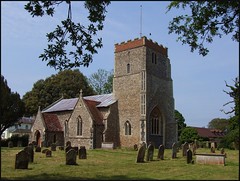
Uniquely in East
Anglia, Dallinghoo church has its tower at the east end.
Is this because it was built back to front? Well, no.
What you see now are the remains of a church with a
central tower. The chancel has gone, abandoned in the
18th Century, and there never were any transepts on the
tower. So just the nave survives, with a tower at the
eastern end rather than the west and a stubby 19th
Century organ chamber on the south side of the nave. As
you step through the south porch into the body of the
nave and look east, you would never notice the
difference, except I do not think I could stand in that
sanctuary without being conscious of the colossal weight
above me. The church seems to have been largely complete
by the start of the 14th Century. In 1426, the rector
John Bray left instructions in his will that the chancel
roof and paving should be replaced out of the proceeds
of goods sold, but no further bequests to the
structure are known. Then, at the start of the 16th
Century, there are several amounts of money left to the
painting of the candlebeam, which is to say the
roodscreen, including one large bequest in 1509 made by
Robert Arnold of Rendham of £6 13s 4d (roughly £8,000
in today's money, so perhaps it was also intended for
construction costs). Nothing whatsoever of the roodscreen
survives. Simon Knott, February 2020 Follow these journeys as they happen at Last Of England Twitter.
Amazon commission helps cover the running costs of this site |