e-mail: simon@suffolkchurches.co.uk
All Saints, Darsham
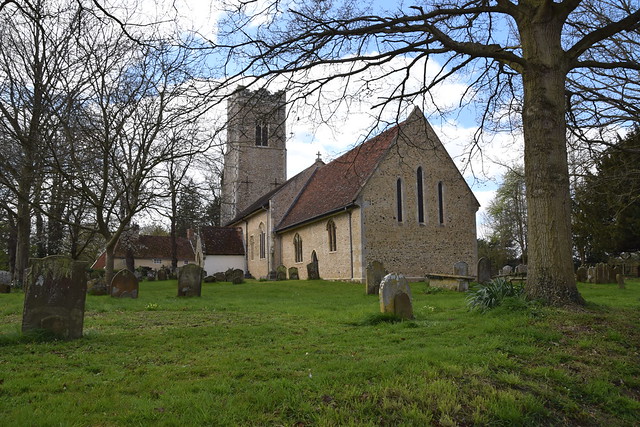
Before: The pretty tower with its elegant buttresses, against the neat, trim nave. Shame about the rendering, though. |
Darsham will be
familiar to many as the name of a railway station on the Ipswich to Lowestoft line. In fact, the station is
really that for the nearby small town of Yoxford, to which it is closer. The
station name is an accident of history; but Darsham does
have a curiously cosy, suburban feel to it that may be
explained by its proximity to the railway. Darsham station is on the busy A12, beside the former Stradbroke Arms Hotel, now the Halfway Cafe (halfway between Ipswich and Lowestoft? Or between splendour and desolation, perhaps). But the village straggles eastwards of here, and you travel for more than a mile before you reach the church. The road makes way for the churchyard, diverting widely to get round it, as at Rendlesham. This is a sign of antiquity, and All Saints presents a grand aspect as you approach it from the west, its 15th century tower rather more slender than we're used to, and its narrow buttresses very elegant. Bequests were left for it in 1460 and 1500 by members of the Lewich family; the latter bequest specified battlements, so we may assume that the tower was all but complete by then. |
After. The rendering has been removed from the nave wall, and the honey colour of the stonework matches the elegance of the tower. Well done, Darsham! This photo is by local historian Olive Reeve. When I visited, in the summer of 1999, the south wall looking out over the wide graveyard had been rendered in a sort of bland porridge, which rarely looks good. Also, it had caused some structural problems, as we shall see. The porch is one of those built to celebrate the 1887 Golden Jubilee of Queen Victoria. I arrived here late one summer afternoon, and the chilly interior was rather gloomy as I stepped inside. Maybe it was the wholesale Victorianisation, but the real problem was the peeling walls. Olive Reeve, the Parish Recorder, tells me that the damp and peeling interior south wall had proved to have been troublesome for many years. There had been several attempts to cure the problem, and at some stage before the last century the wall was cement rendered on the outside. Unfortunately this exacerbated the problem and drove the damp inwards. Luckily, I was soon followed into the church by the man who'd come to lock it up. He gave me a brief but amusing guided tour, revealing All Saints' charms, and cheering me up into the bargain. |
All Saints looking east - the tell-tale flaking on the south wall... |
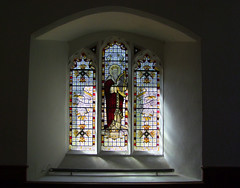
Firstly, there is an
image niche set in the window splay on the south side of
the nave. The font carries a dedicatory inscription, as at Orford and Blythburgh, asking for prayers for the
soul of a former priest, one Galfri Symond. The two
pre-Reformation brasses in the church also carry requests
for intercessionary prayers, anathema to the Anglicans
and Puritans alike. So, they have done well to survive.
Perhaps Catholicism had powerful friends in this parish. The three narrow lancets at the east end are very fine, and, while one would not wish them on every church, they preserve a sense of mystery about the chancel. My guide revealed that the very next day, scaffolding was going up, and the walls would be replastered, sealed and painted. Olive Reeve tells me that the offending cement was removed by this work, but because the original mortar had deteriorated enough for the possible collapse of the wall, it was necessary to remortar using the original material. here is an interesting postscript to this story. A couple of months later, as part of the renovation, the old roodloft stairs were opened up. Inside were found a number of skulls, which proved to be medieval. They had probably been disturbed by building work in the 18th century, and were sealed in the rood loft stairway as a joke on future generations. My guide was obviously not the first resident of Darsham with a sense of humour. |
| T I understand that
these skulls were given a respectable burial, and now the
interior is quite lovely, as the post refurbishment
photograph by Olive Reeve below shows. Darsham is a
happy, welcoming church, and they would love you to visit
them. I know this, because they have contacted me to tell
me so, and I am happy to pass such enthusiasm on to the
world.
All Saints, Darsham, is just to the east of the A12, just north of Yoxford. I found it open. See MAP You can also visit the Darsham, Dunwich and Westleton website. Please note that two of the photo's on this page are by Olive Reeve, and retain her copyright. |