St Mary Magdalene, Debenham

www.suffolkchurches.co.uk - a journey through the churches of Suffolk
|
St Mary Magdalene, Debenham |
|
|
||
www.suffolkchurches.co.uk - a journey through the churches of Suffolk |
||


Follow these journeys as they happen at Last Of England Twitter.
Debenham sits in
high Suffolk away from anywhere of any size, giving it a
sense of self-importance which is not undeserved. A large
village, but as with more famous Lavenham, which has
roughly the same population, its street layout and
venerable buildings never let you forget that you are in
fact in a tiny town. As towns go, Debenham is unusual,
because it is the largest settlement in East Anglia that
the Victorian railways never reached. Curiously, there
was a plan during the 20th Century for trains to come
here, as we shall see. But Victorian industry never
troubled it much, except for a brick factory, and because
of this it has a quite different character to other
Suffolk places of its size. It is softer, more pastoral,
with elegant little former shops lining its high
street.This isn't a place many people pass through,
unless on the back road from Ipswich to Eye. It is more a
place that tourists know to be beautiful, and local
villages look to for amenities, the Co-op, the school,
the sports centre. White's Suffolk Gazetteer of
1844 found about 3,500 people living in and around it,
and I do not suppose that there are many more than this
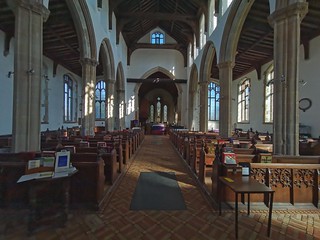
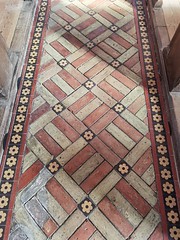
today. Thereafter came the rebuilding of the nave, aisles and clerestory. James Bettley, revising the Buildings of England volume for East Suffolk, records that the wood in the fine hammerbeam roof has been ring-dated to the first decade of the 15th Century. In the arcades, Birkin Haward traced the hand of the master mason Hawes of Occold, whose work is identifiable at more than a dozen Suffolk churches. The church as we see it today was likely more or less complete by the 1460s, for after this point the many wills and bequests transcribed by Peter Northeast and Simon Cotton have no mention of the building fabric other than the provision of a vestry. In the 1470s several parishioners were leaving money towards a great bell to match the three lesser ones in the same tower, and after that bequests went to furnishings and decoration until the Reformation intervened. The tower was truncated after a lightning strike of the 17th Century, but diocesan surveyor Herbert Green's 1880s restoration was surprisingly kind, and resisted too much cosmetic repair work. The ring of eight bells is today thought to be one of the most mellow in the county, I am told by bell-ringing acquaintances. So you enter the church through the galilee porch and beneath the tower, which creates a sense of a series of unfolding spaces. What at first appears to be an imposing 19th Century memorial under the tower turns out to be a tribute to a remarkable feat of bell-ringing. On Whit-Monday June 6th 1892, it reads, was rung on these harmonious bells a true and complete peal of Oxford Treble Bob Major comprising 16,608 changes in 10 hours and 32 minutes, being the longest time ever one set of men have stood to ring without rest, and is the greatest number of changes yet composed in the method. It was rung by eight Suffolk men, and is considered by competent judges to be the most remarkable peal-ringing achievement on record. Finally opening the double west doors into the nave almost comes as a surprise. You step into a big church made gorgeous by the brick patterning of the floor, the fruit of Debenham's one major 19th Century industry. Red and white bricks are laid in a diamond pattern, with small floral tiles in the points of the diamonds. It dates from the 1870s restoration by Corey & Ferguson, although to their debit they did also remove the west gallery and box pews. It is surely one of the loveliest church floors in Suffolk. It's a good setting for a couple of striking memorials.
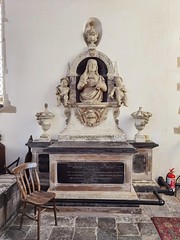
In the south aisle is a splendid Baroque moment of the very end of the 17th Century. It remembers John Simpson, an apothecary of this town. It was paid for by his close friend the Reverend John Sheppard of nearby Wetheringsett, and it is clear from their correspondence that together they had planned the memorial in some detail before Simpson's death. It is typical in its style of the memorials which in the following century would become increasingly secularised, even pagan, with fulsome superlative tributes. But Simpson and Sheppard sees to have intended this memorial to act as a kind of catechetical tool, a protestant equivalent of the glass, wall paintings and sculptures intended to reinforce Catholic orthodoxy centuries earlier in the years before the Reformation. The monument consists of a large tombchest which used to be set behind iron railings, though these have gone since my last visit. It is surmounted by a large, decorated niche. Simpson sits rather tightly in the niche making a gesture that is at once valedictory and a benediction, and he is flanked by two typically Classical putti, and the whole piece is surmounted by an urn. But the putti are labelled Fides and Spes ('Faith' and 'Hope') while the urn is labelled Charitas ('Charity'), and so Simpson is surrounded by the iconography of Christian virtue. The inscription on the tomb chest bears repeating in full: We boast not here (kind reader) a
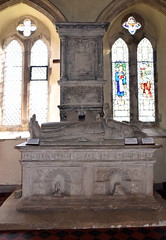
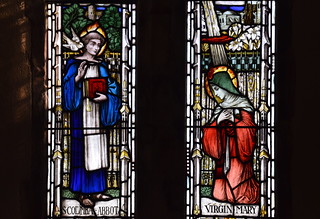
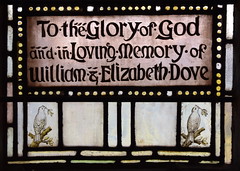
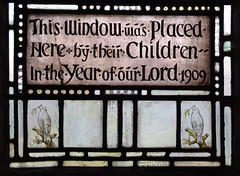
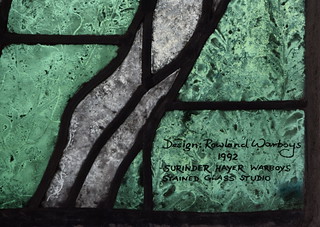
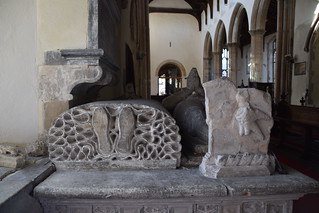
descent This is fascinating, because Simpson and Sheppard both grew up in the white heat of Puritan theology, and lived through a time when the world was turned upside down. In reaction, there would be a considerable ejection of the spirit of puritanism in the years after the Restoration. But almost forty years after the end of the Commonwealth, Simpson and Sheppard desired to express in this inscription basic puritan sentiments transformed and made gentle by the years since, the realism and charity of a man who has lived through much, and has come to realise what is important. No fundamentalists, they left the people of Debenham with a users manual for their souls, a reminder of how they should live their lives, but also perhaps a warning against the vanity of those who would rule over them. It is as if it is an expression of a second settlement, a bedding down of theology after the long years of discord and extremism. Good and wise indeed. Two other former Debenham citizens of a century earlier lie in the chancel. Sir Charles Framlingham and his wife Lady Dorothy appear to have been woken suddenly from sleep, their eyes wide and staring, as if terror-struck. Her ruff is fabulous. Their recumbent effigies lie on a rather battered tombchest, its kneeling figures doubtless removed by enthusiastic parishioners of John Simpson's predecessors in the middle of the 17th Century. Perhaps they thought they were saints. What little coloured glass this big church has is up in the chancel, all of it fairly good. The 19th Century restoration placed triple lancets in the east, and together with glass depicting the Crucifixion by Heaton, Butler & Bayne this creates a sense of intimacy. On the north side of the chancel is a window with glass by Rowland Warboys, an intricately patterned piece of leaves and branches. On the south side is a remarkably good Arts and Crafts depiction of St Columba and the Blessed Virgin at the Annunciation, of about 1910. It remembers the Dove family, and it would be interesting to know who it was by.
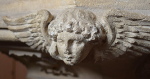
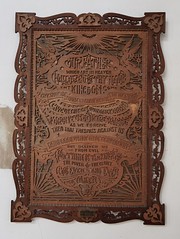
At the east end of the south aisle there was a chapel, its piscina surviving. The rood loft stairs opened off of it, rather than in the nave or chancel. At the east end of the north aisle is a curiosity, a piscina made up of odds and ends rescued from elsewhere, including what appears to be a 13th Century Bishop's head. Beside it is a real period piece, a fretwork Lords Prayer. The font sits at the west end of the same aisle, and is a battered example of the late medieval East Anglian type with an elegant 17th Century cover. Above the chancel arch, the rood beam is still in place. Like many survivors of this kind, it was probably its bulk that persuaded later reformers and restorers from removing it, lest it have a structural purpose and the church fall down without it which, I hope I have conveyed, would be a great shame. And so, I said goodbye to this lovely, tiny town and headed north. After about a mile I reached the place where the remarkable Mid-Suffolk Light Railway ran on its way from Haughley Junction to Laxfield (it was planned to reach Halesworth, but this never materialised). This early 20th Century enterprise was the setting for John Hadfield's novel Love on a Branch Line, and the 'Middy' was still remembered fondly by older Suffolkers when I moved to the county forty years ago. At the time of the First World War, a spur was built from Kenton Junction to a field just north of Debenham. It was an expensive and hare-brained extension, for permission to carry passengers along this stretch was never obtained, and nor was the last stretch into Debenham itself ever constructed. So, Debenham fended off the iron giants to the very last, and they will never come now. Use of the spur for goods traffic was discontinued after a few short years, and the rails were removed. The cost of this spur contributed ultimately to the Middy's demise. Although very little evidence of this company's railway survives today, there are substantial remains of a bridge and embankment of the Kenton-to-Debenham spur on the road to Aspall, about a mile north of the church. The traffic rushes by, but to clamber up on this overgrown ridge is to consort with ghosts. Simon Knott, April 2022 Follow these journeys as they happen at Last Of England Twitter. |






|
||||||||||||||||||||||||||||||||||||||||||||||||||||||