St Mary, Depden

www.suffolkchurches.co.uk - a journey through the churches of Suffolk
|
St Mary, Depden |
|
|
||
www.suffolkchurches.co.uk - a journey through the churches of Suffolk |
||

Follow these journeys as they happen at Last Of England Twitter.
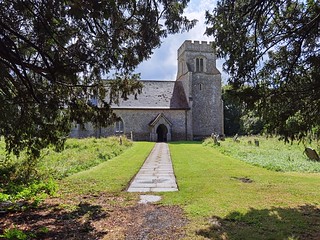
| Unless you knew, you would not
even think to look. This substantial medieval church is
lost in the woods, a good third of a mile from the
nearest road, and the only way to reach it is to walk
along a narrow track that runs along the side of fields
and then through the woods themselves. There is a notice
at the start of the track on the sliproad from the Bury
to Haverhill road listing the telephone numbers of the
keyholders, and then it is simply a matter of following
the track. Incidentally, unlike Sotterley which is a
similar walk from the nearest road, this route has to be
used by the Sunday congregation as well. This makes the
church's approach one of the most romantic of any church
in East Anglia. St Mary is so tree-bowered
that you don't actually see the church until you stumble
across it from the north, the churchyard opening out as
if it were a forest clearing in a fairy tale. Apart from
the tower, which will evidence dates to after 1451, this
is a church that was substantially as it is now by the
end of the 14th Century, and the windows of the nave and
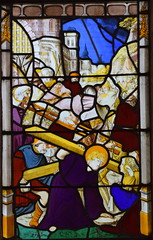
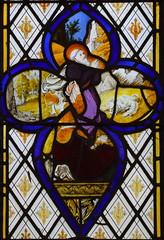
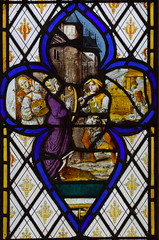
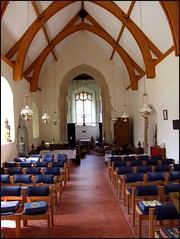
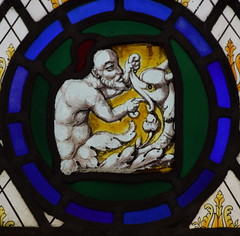
chancel may even date to the previous century. It seems to be a collection purchased from a dealer, perhaps JC Hampp of Norwich, and was likely installed here in the early 19th Century by Samuel Yarrington. Some of the glass is 16th century and from Steinfeld Abbey in Germany. The two central panels are from a sequence of the Passion, and depict Christ meeting St Veronica while carrying his cross, and then in the next he is taken down from the cross and cradled in his mother's arms. But it is a little detail in the panels which make them particularly memorable, for in both of them we see a man with a ladder, walking beside Jesus on the way to Calvary, and then walking away in the distance as the disciples mourn their Messiah, his day's work done. Some are roundels of Old Testament subjects. Shadrach, Meshach, and Abednego stand before Nebuchadnezzar, while a sore-covered Job is told by his wife to curse God and die in another.
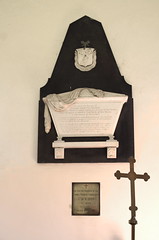
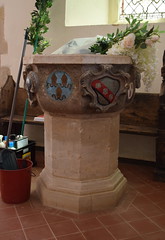
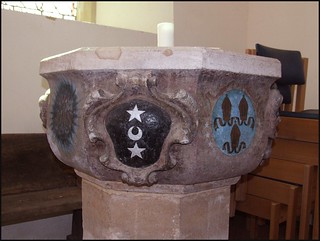
Two pairs of late 16th Century figure brasses reset on the north wall remember Anne Drewry and her two husbands, George Waldegrave and Sir Thomas Jermyn, thus three of the most prominent Suffolk family names of that century coming together. She kneels across a prayer desk from each of them in separate scenes, but a single inscription beneath connects them. Sarah Loretta Lloyd's memorial of 1838 was erected by her husband, the rector. Her inscription numbers her virtues in the style of the previous century, but continues with the excitement of the new century's evangelical revival, telling us that she was called to join the Spirits of the Just made Perfect, and on the 3rd May 1838 she passed through the Valley of the Shadow of Death fearing no evil. The font on the south side of the nave is a curiosity. It seems likely to be 18th Century, and may be a continental piece that arrived here in the same way as the glass in the east window. It is painted with roundels and cartouches which are likely to be more recent, I think. The window above it of the Blessed Virgin and child is an early 20th Century work by Heaton, Butler & Bayne. It is splendid that this church has not only survived, but it is still in regular use. The local parish should be proud of themselves for what they have achieved here in the middle of the woods. It used to be said that the Church of England ministers simply by existing, a presence in every community, and that its medieval churches were its greatest act of witness. This is an unfashionable view nowadays when business management and cost-cutting seem to be the order of the day, but If it is so, then it is doubly true here. |
Simon Knott, September 2021




Follow these journeys as they happen at Last Of England Twitter.
|
||||||||||||||||||||||||||||||||||||||||||||||||||||||