St Mary, East Bergholt

www.suffolkchurches.co.uk - a journey through the churches of Suffolk
|
St Mary, East Bergholt |
|
|
||
www.suffolkchurches.co.uk - a journey through the churches of Suffolk |
||







Follow these journeys as they happen at Last Of England Twitter.
| East Bergholt is in that part of
border country known as Dedham Vale, where the River
Stour cuts through a rolling landscape before sprawling
out into the wide mud flats that prise Suffolk and Essex
apart. There is a West Bergholt, but it is several miles
away on the far side of the river in the other county.
East Bergholt is a scattered parish, its hamlets
straggling out away from the main village and almost
reaching Brantham and the busy Manningtree to Ipswich
road through the settlement of East End. One of East
Bergholt's hamlets is more famous than the village
itself. This is Flatford, down on the river, which after
Sutton Hoo is probably Suffolk's single biggest tourist
attraction. The Mill and Willie Lott's Cottage were both
derelict by the early years of the 20th Century, but they
were rescued and restored. Today, thousands of people
visit them every year. This of course is all the fault of the artist John Constable, whose was born in Flatford and whose paintings of the mill pond and the buildings beside it can be found on a thousand calendars, place mats and chocolate box lids. Along with that of Thomas Gainsborough, who was born just a few miles away, Constable's work is considered by many to sum up the spirit of Suffolk and its wide open skies, and this part of the county has become known as Constable Country. But both of them had to leave Suffolk to achieve fame and fortune. Unlike Thomas Hardy, whose work constantly harks back with nostalgia to the Dorset of his youth, both Constable and Gainsborough moved on to other and greater things. Constable is often described as the
miller's son. In fact his father, Golding Constable, was
the mill-owner, which isn't quite the same thing. White's
1844 Directory of Suffolk lists John's younger
brother Abram, who by then had inherited the business
from their father, as a corn miller and coal and corn
merchant. The Constables were businessmen, and the
family also owned the mill upriver at Dedham as well as a
grain ship which was moored downriver at Mistley. Because
of their wealth the young Constable had the leisure to
paint, but as he grew older he was frustrated by not
being able to make a living out of it. He finally
achieved security, and the freedom to follow his vocation
rather than going into the family business, by marrying
into money. His wife, Maria Bicknell, inherited £20,000,
about four million pounds in today's money, from her
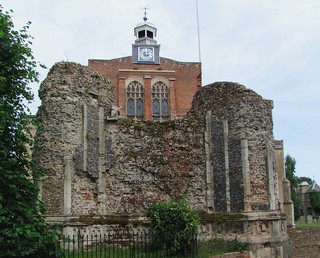
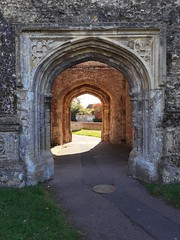
grandfather who was the rector of this church. If your parish had lots of seriously wealthy people, as was the case here in the busy cloth-making parish of East Bergholt, you pretty much got the whole church rebuilt. However, when you reach the west end of the church the grandeur dissolves, for you can see that the tower was never completed. It reaches barely to the level of the clerestory, and then it peters out in a confusion of fixtures and footings. Time has melted them, five hundred years exposure to the elements has given them strange curves and contours, as if this were the ruin of a collapsed tower, which it isn't. A surprising number of bequests to the rebuilding of East Bergholt church survive. From the mid-15th Century onwards, large amounts of money were left to both the structure and the furnishings, and by the early 16th Century they start to specifically mention the tower. It seems to have been begun in the mid-1520s, but the final bequest was in 1542 when one Thomas Grithe left a hundred marks to the steple, and then that was it. The tower had been commenced in a fit of optimism, but the Reformation now intervened, and bequests dried up, for who would want to contribute money to a church where prayers for the dead were now circumscribed, and in any case the money would be likely to be sequestered by the state? Ironically, the tower was begun hard against the western edge of the churchyard, and so a processional way had to be cut beneath the tower to allow for the liturgical processions of Holy Week and certain saints days. You can see the same thing under the towers at Combs, Stanton St John and at St Lawrence in Ipswich. What would the completed tower built to scale against this great church have looked like? Perhaps nearby Dedham and Stoke-by-Nayland provide the answer. However, the absence of a tower has given St Mary something you'll rarely see elsewhere in England, for on the north side of the churchyard they hung the bells in a ground level bell cage.
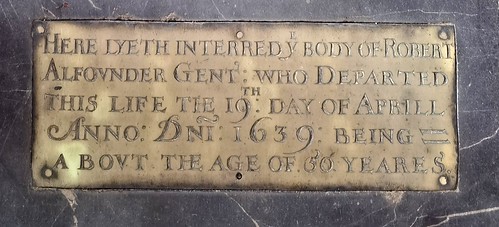
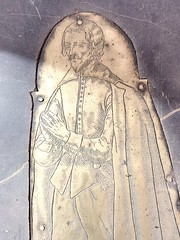
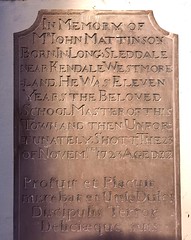
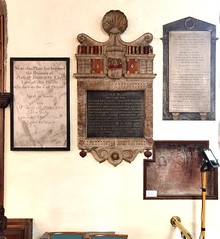
There are five bells, pleasingly viewable at close quarters. This bell cage dates from 1531, and it is all the more remarkable because it was probably intended as a temporary structure. There are a couple of bell cages across the river in Essex at Wrabness and Wix, though on nothing like the scale of this one. The bells are the heaviest ring of five in the world, and were rung by hand, until there was an accident in 1999. Because of this, the bells were among the few Suffolk peals not to ring in the millennium. But they have since been returned to use, after a project to make them safer. Beside the bell cage, the rood turret rises like a castle keep. The star of the De Veres is bold upon it. The church looms above you, a sense intensified by the tightness of the churchyard boundary. A mighty tower here would have been a remarkable thing. Walking back beneath where it would have been you reach a grand two-storey south porch through which you enter the church. The first impression on stepping inside may be a disappointing one, for this is overwhelmingly an urban 19th Century interior thanks to several considerable restoration, most notably that which took place from 1855 to 1869 under the hands of the rector, Joseph Woolley, who as James Bettley in his revision of the Buildings of England volume for east Suffolk notes acted as his own architect. And yet we shouldn't blame him for too much, for it is unlikely that very much survived of East Bergholt's late medieval glory. This was the heartland of puritanism in south Suffolk during the early 17th Century. The government's official visitor to the churches of Suffolk, the iconoclast William Dowsing, lived in the next parish of Stratford St Mary, where the minister was sequestered for his sacramentalist beliefs. But Dowsing didn't even bother to visit East Bergholt, suggesting that he knew the church well, and did not think there was a need to do so. In addition, the protestant credentials of the minister here were never questioned. By the 18th century, St Mary contained box pews, a preaching platform, texts on the walls, and probably not a lot else. This was entirely unsuited to the liturgical requirements of the 19th Century Oxford Movement revival, which sought a return to the sacramental religion of the medieval Church, and so the inside St Mary underwent an almost complete refurbishment. It is the post-Reformation centuries that speak loudest inside this church now, and they've left us with a number of interesting memorials in the aisles, none of them grand. The brass figure of Robert Alfounder, gentleman, is dressed in the height of early 17th Century fashion. His inscription tells us that he departed this life on the 19th day of Aprill Annon Domini 1639 being about the age of 50 yeares. In the north aisle is a small memorial to John Mattinson, who was for Eleven years the Beloved School Master of this Town, and then Unfortunately Shott the 23rd November 1723. I wondered if he had suffered this fate during the execution of his duties. Nearby, another inscription reminds us that what ere thou art here reader, see in this pale glass what thou shalt be, despised worms and putrid slime, then dust forgot and lost in time. A memorial on the wall in this aisle has lost its painted inscription but retains the reliefs of a muzzled bear and a coronet on one side, and a camel on the other.
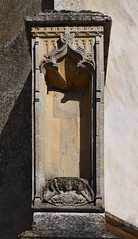
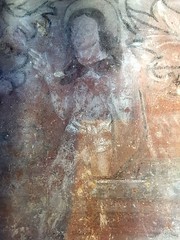
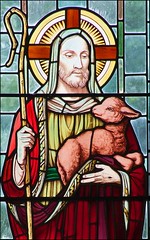
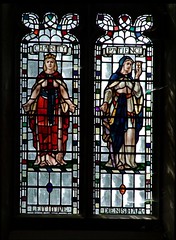
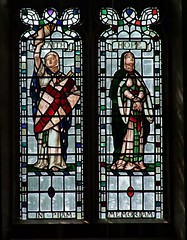
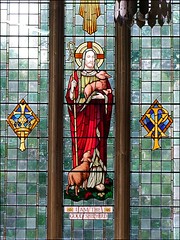
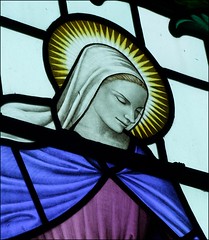
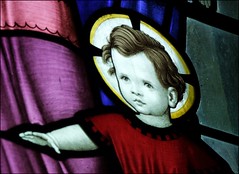
The brick floors survived the restoration and make a nice contrast with the furnishings. The font is dated 1862, a plainer and simpler piece than its near-contemporary down the road at Stratford St Mary. There are some medieval survivals. In the north wall of the sanctuary stands a heavily restored early 16th Century Easter sepulchre. At the back is a painting of Christ rising from the tomb, which would have been concealed by a veil until the first light of Easter morning. Also in the sanctuary are an image niche, and traces of a consecration cross. There is a large scheme of glass in the aisles by Lavers, Barraud & Westlake, so much of it that it becomes a little monotonous I'm afraid. In the south aisle there's an 1877 memorial window to the parish's most famous son, John Constable with glass by the unrelated WH Constable of Cambridge. As James Bettley observes, it is unworthy in every way: perhaps those who commissioned it were seduced by the maker's name. One of the panels depicts St Luke painting the first icon of the Blessed Virgin and child. The 20th Century glass is better, and best of all of it is a window almost completely obscured by the organ, the young Christ with his mother by Francis Skeat, one of only two windows by the artist in Suffolk, the other being at Chelmondiston. It's a great pity that it is not more visible. The largest of the memorials in the chancel is to Edward Lambe who died in 1617. It shows him kneeling with two angels pulling back curtains to reveal him. His inscription tells us that all his life he lived a batcheler well learned in devyne and common lawes. With his councell he helped many yett tooke fees scarsse of any. The 1636 memorial of William Jones shows his books on shelves above his inscription flanking a fiery lamp, and the plain memorial to the right of it remembers Durand and Mary Rhudde and their grand-daughter Maria Constable, John Constable's wife, and was commissioned by the artist. As you may imagine, East Bergholt church is not short of visitors attracted here by the Constable story, but in any case it is a pleasing and elegant place despite the overwhelming 19th Century restoration, as is its large village, which must always have been a pleasant place to live. In 1844, White's Directory comments on its well-stocked shops and handsome mansions. At the time, there were about 1500 inhabitants, but it had once been larger, a market town no less, although the market had fallen into disuse by the 18th Century. It must have been well known to travellers from London heading into East Anglia, handily placed halfway between Colchester and Ipswich for the watering of horses and stopping for provisions. At the time of the 1851 Census of Religious Worship, the rector of East Bergholt Joshua Rowley also held the rectories of neighbouring Brantham and Holton St Mary, giving him a joint annual income of £1,400, roughly a quarter of a million pounds a year in today's money, by far the largest income of any Suffolk incumbent. One might reasonably have expected him to employ curates to do his work for him, which in fact he did do for Holton St Mary, but otherwise he was resident and led services in both his other churches that day. There were three hundred people present for the morning service at East Bergholt, and almost five hundred attended the afternoon sermon, so he seems to have been a popular if somewhat highly-paid pastor. |
Simon Knott, October 2022
Follow these journeys as they happen at Last Of England Twitter.







|
||||||||||||||||||||||||||||||||||||||||||||||||||||||