| |
|
Almost every
Suffolk child knows Easton, for here is Easton Farm Park,
beloved of school trips and Sunday family outings. At the
farm, you get to see cows milked, sheep shorn and horses
shoed, mostly in the old ways, a remembrance of times
past. Of particular interest are the dairy and the forge,
both conjuring up something of what it must have been
like to live on a large Suffolk estate a century ago.The
Farm Park is on the road to Letheringham, a wild, remote
place, but Easton itself is urbane and polite.
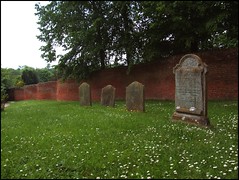
Even if you don't have children, you might still know of
Easton for the 18th century crinkle-crankle wall which
surrounds the former estate of the Dukes of Hamilton, and
their house, Easton Hall. Norman Scarfe tells me that the
wall is the longest of its kind in the world. The Hall
itself was demolished in the 1920s, and shipped off to
America to be rebuilt on a ranch. The Farm Park was the
Hall farm, and the estate's pack of hounds is still
housed in the village, although of course these days they
must do without foxes. In addition, the wall goes right
up to the church, so that no ordinary folk needed to see
the Hamiltons on their way to and from Divine Service. It
surrounds three sides of the graveyard.
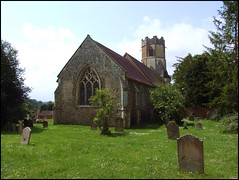
All Saints sits on a mound, evidence of an early
foundation, and you climb to the south porch. There is a
north porch, too, but that was for the exclusive use of
the Hall. Like so many in this part of the world, this is
a 13th century church extensively refurbished two
centuries later. Symptomatic of this is the octagonal
15th century belfry, familiar from several Suffolk round
towers, but here built on to a square base of 200 years
earlier.
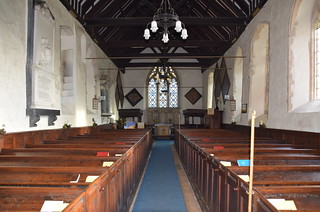
There is no chancel arch, the nave and chancel being
continuous as is common in east Suffolk. The interior is
essentially a 19th century refurbishment, although the
pew set is pre-Victorian, dating from the Regency period.
The dark wood and gentle cinema curves is a reminder of
how the period was to influence Jazz Modern and Art Deco
with its neo-classical clean lines, an understandable
reaction to the stifling late Victorianism which Art
Nouveau never really escaped. To see them, you might
almost detect the 1930s hand of Diocesan architect Monro
Cautley, but it predates his work by more than a hundred
years.
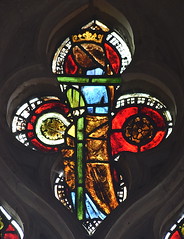
14th Century glass is not common in Suffolk, but a small
panel depicting St Helen is set in one of the upper
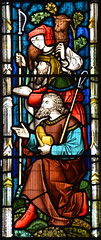
lights in contemporary tracery. A nave window depicting
the Adoration of the Shepherds and the Magi is by Hardman
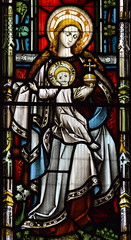
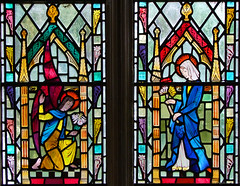
& Co. There is a beautiful Annunciation window by M
Farrar Bell of 1964 for Susan Carrie Stone, who died in
1962. Her ashes lie at Easton, the simple
inscription reads.
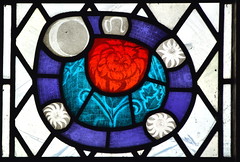
Opposite it is another simple modern window, for Phyllis
Hill who died in 1965. It illustrates verses from the
Benedicite. A poppy and a cornflower are at the heart of
irregular roundels depicting the sun and alpha on one
side, and the moon and omega on the other. It is by
Andrew Anderson.
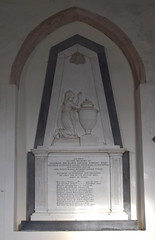
There are of course memorials of the Dukes of Hamilton
here, and of their predecessors the Earls of Rochford.
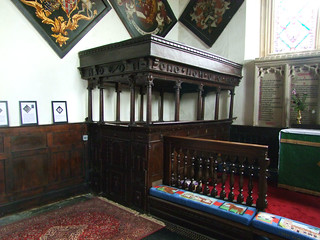
But their predecessors at the Hall, the Wingfields,
thought so highly of themselves in the 17th century that
they actually had their family pews built up in the
sanctuary. These are quite extraordinary objects, one
either side, quite unlike anything else in Suffolk.
Mortlock thinks that they were put there during the
Commonwealth period, which makes you wonder what was
going on between. Perhaps there is a case for them being
slightly earlier, as the need to be close to the altar
would be in keeping with Laudian sacramentalism.
There are brasses, and no less than nine hatchments for
all three families displayed in the chancel. Taken
together with with the pews there would be no doubt who
was in charge around here. So, yet another snapshot of
life in a Suffolk village in years gone by.
Simon
Knott, January 2020
Follow these journeys as they happen at Last Of England
Twitter.
Amazon commission helps cover the running
costs of this site
|
|
|