St Mary, Erwarton

www.suffolkchurches.co.uk - a journey through the churches of Suffolk
|
St Mary, Erwarton |
|
|
||
www.suffolkchurches.co.uk - a journey through the churches of Suffolk |
||

Follow these journeys as they happen at Last Of England Twitter.
We are out near
the end of the Shotley Peninsula, and Erwarton is a
pretty little village on the outskirts of the much larger
and more workaday village of Shotley. We are away from
the main road in one of those strange, leafy valleys
which wrinkle the Peninsula. You can never be more than a
couple of miles from open water out here, and in fact the
wide river mouth of the River Stour as it empties into
the last few hundred yards of the River Orwell lies just
a few hundred yards away from Erwarton church. Even so,
it feels odd to be able to stand in the churchyard and
watch the great ships unloading on Parkeston Quay on the
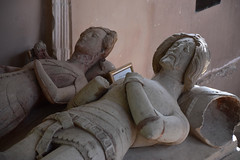
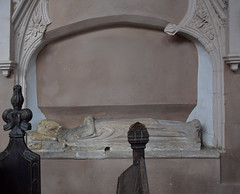
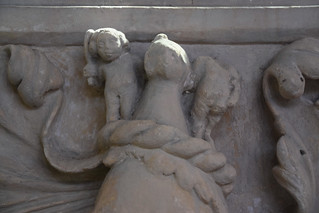
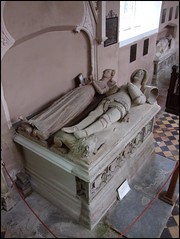
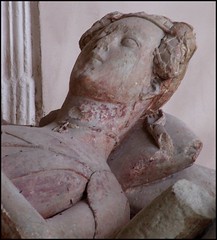
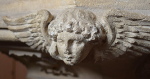
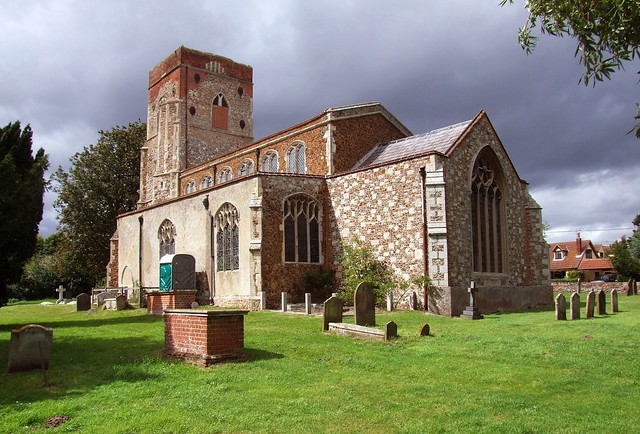
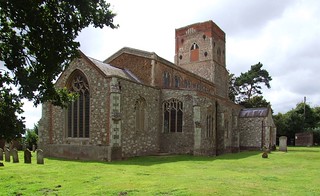
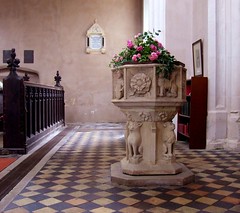
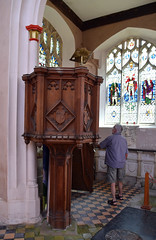
Essex side of the river. The chancel was rebuilt in the 1830s, an early date, yet still fully articulate Decorated Gothic, though Pevsner thought without the thoroughness one would expect later in the 19th Century. The west doorway is grand, flanked by crowned lions and with an angel in flight overhead, all 15th Century. You enter through the north door into the square, light nave, the aisles spreading beyond the arcades beneath early roofs, the feeling of a church that has relaxed gently onto the ground. There is a feeling of openness, and yes, perhaps of sadness too, of a wide empty space stripped of the late medieval liturgical furnishings that it was built to contain. William Ollett led the 1838 restoration, and his are the furnishings. At this early date the church was still intended as a preaching space as much as a sacramental one, hence his remarkably tall pulpit which towers over the range of benches. It is fascinating to see the priorities of the Georgian church tipping over into what the Victorian church will become. And Ollett's restoration was sympathetic to the earlier survivals, the most striking of which on entering the church is the fine 15th Century font in the typical East Anglian style of the time. The lions around the stem seem particularly happy. The other notable survivals at Erwarton are the monuments, of which there are an unusually large number for this part of Suffolk. The knight sleeping in the south aisle is said to be the grandly named Sir Batholomew D'Avillers, who died in 1287. The canopy above him and the tomb chest on which he lies are a later date, probably contemporary with the memorial further east in the same aisle to Sir Bartholomew Bacon and his wife, Anne. This dates from the end of the 14th Century, although Anne didn't die until 1435 so it may originally have been made for someone else. An early 14th Century memorial in the north aisle contains a lady in a wimple who is said to be Lady Isobel Bacon, daughter of Sir Bartholomew across the church.
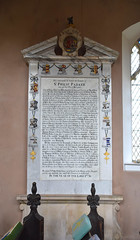
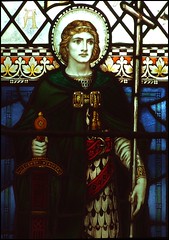
The jewel in the creamy light of the nave is the 1915 glass by Powell & Sons in the south aisle. It dates from immediately after the First World War, and one window remembers the youngest son of the Hall. The light 1991 window by the Surinder and Rowland Warboys provides an interesting counterpoint. It remembers the wallpaper designer Frank Mortimer Cole who died in 1990, and James Bettley in the revised Buildings of England: Suffolk East tells us that it is inspired by Pugin's designs for Cole & Son's wallpaper. In 1736 Sir Philip Parker saw fit to have installed in the north aisle a remarkably verbose memorial detailing all his ancestors, but Erwarton's most famous memorial cannot be seen. Legend has it that Anne Boleyn, second wife of Henry VIII and mother of Elizabeth I, stayed often at Erwarton Hall. She gave instructions, it is said, that her heart was to be buried in this church after her death. In 1838, when Ollett was renovating the north aisle, a small, heart-shaped casket was discovered, walled into an alcove. It was reburied, with due ceremony, beneath the organ, and a little plaque there gives some details about it. I remember a visit here in the high summer of 2008 when I got into a discussion with two ladies in the church about the Boleyn legend. They were firm believers. And yet I wonder how old the story is. Did the discovery of the heart-shaped casket link up with a tale that went back to the 16th Century? Or was it a story invented to link the discovery with the fact that Boleyn had stayed at the Hall? It was something to ponder as I cycled on up the steep and narrow lane past the busy pub. To my left, the harvest continued against a backdrop of great ships on the wide, silent river, and ahead of me lay the emptiness of the peninsula, the rocket ship spire of the Royal Hospital School at Holbrook a sentinel above the hedgerows. |
Follow these journeys as they happen at Last Of England Twitter.
Simon Knott, January 2021





|
||||||||||||||||||||||||||||||||||||||||||||||||||||||