| |
|
| |
|
Aren't people funny about
Felixstowe? I know visitors who claim to love
Suffolk, and come east as often as they can. They
have a special affection for Aldeburgh, or
Southwold, or Framlingham, or some other tourist
hotspot. But they treat Felixstowe with disdain,
and I know many people like that who have never
even visited it.
None of them live in Ipswich, of course, because
Felixstowe is Ipswich-by-the-sea, and the hamlet
of Felixstowe Ferry is a peaceful, secret outpost
that everyone in Ipswich knows about. You head
north of Old Felixstowe, the sea dramatic beneath
you, Bawdsey Manor and its pine woods ahead,
probably the most dramatic coastal view in all
East Anglia. If travelling by car and feeling
lazy, you pass Felixstowe Ferry golf course, as
unattractive as all golf courses are, but it is
the setting for M.R. James' famous ghost story Oh
Whistle, And I'll Come To You, My Lad. If
you want a better route, however, you pull into
the car park before the golf course, and walk the
undemanding mile or so along the coastal path
past two grand Martello towers, before arriving
in this remote and delightful little spot.
There used to be two good pubs here, but the
Victoria is now closed. The other is the Ferry
Boat Inn, which I remember fondly from before its
unfortunate modernisation. However, The Ferry
Café is a Suffolk institution, famous for its
substantial and cheap breakfasts, and (whisper it
if you dare) the more recently opened Winkles
Café down by the pier is just as good,
especially for fish and chips. There are also a
couple of seafood shops, and even a gallery, in
this little place that cannot be home to more
than thirty people.
Famously, you can take the passenger ferry from
here across to Bawdsey, and many Ipswich children
will tell you that they come here to 'go
crabbing' - but most people will respond with
surprise if you tell them that there is a church
here as well.
St Nicholas was originally built in 1870, a
mission outstation to the medieval parish church
of Old Felixstowe, St Peter and St Paul, about a
mile and a half to the south. At the time, the
mother church was undergoing a major restoration,
and perhaps this was part of the same funding
project. I've no reason to think that this was an
any less sparsely populated and remote spot in
those days, so the establishment of a chapel of
ease probably reflects the Anglican enthusiasm of
those heady days more than any conceivable need.
It was intended to serve as a school, as well as
a church. On and off, it did so as both, until
one night in 1943, when a stray bomb wrecked the
little building.
Felixstowe Ferry was always vulnerable to these
attacks, often by German pilots heading back from
raids in the Midlands with undropped bombs.
Bawdsey Manor, half a mile away across the
estuary mouth, was a top secret RAF research
establishment. It was there that radar was
developed. The whole of this coast came under
special measures during the War, with only
essential personnel allowed into it.
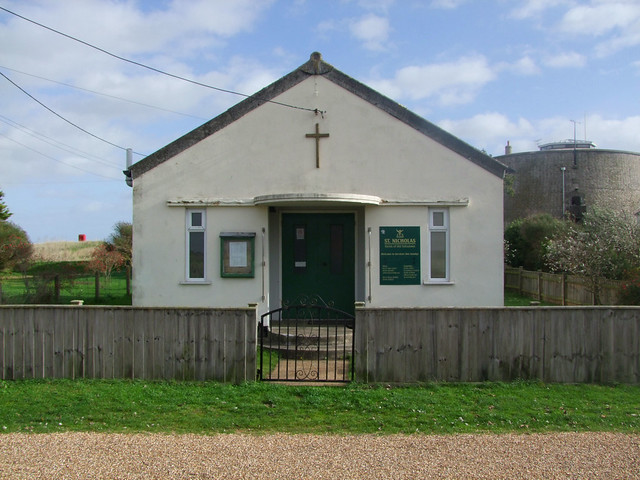
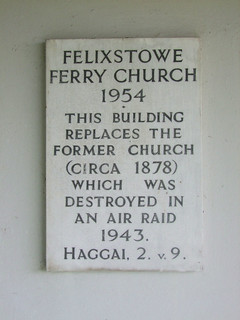
The current St Nicholas was erected in 1954. It
is about as functional as it is possible for a
building to be, and you probably wouldn't
recognise it as a church without the notice at
the west door. It is set in a neatly clipped lawn
with flowerbeds, and a garden gate from the path
that leads down to it from the road. All in all,
it is perfectly fitting, a typically English
seaside stab at domesticity in this wild and
remote place.
And be in no doubt
that Suffolk is wild here. Stand at that
gate, and look out, and the marshes
spread beyond you, punctuated here and
there by clumps of gorse. This spot is
carved from nature, and nature might
easily claim it back. It is already doing
so to the east, where the Deben estuary
cuts a little further westwards every
year, carrying away hundreds of tons of
shingle and dumping them offshore,
creating an island that did not exist
when I first came here 30 years ago.
There, at the river mouth, there are two
colours, light grey and dark grey. Sea,
sky and shingle alternately take them on,
and the sense of a shifting, impermanent
landscape is tangible.
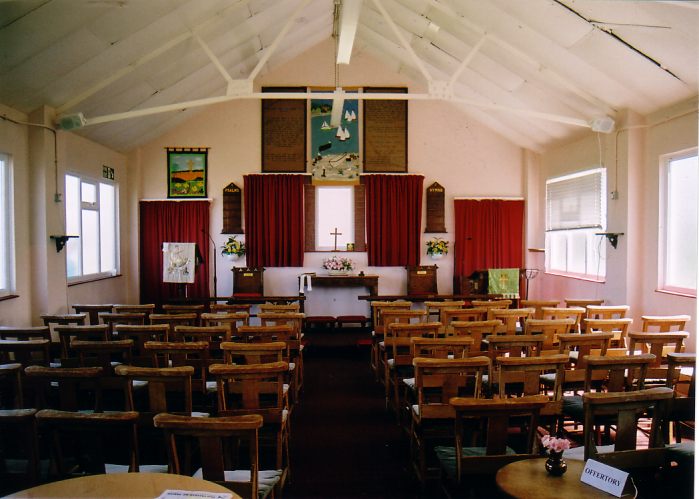
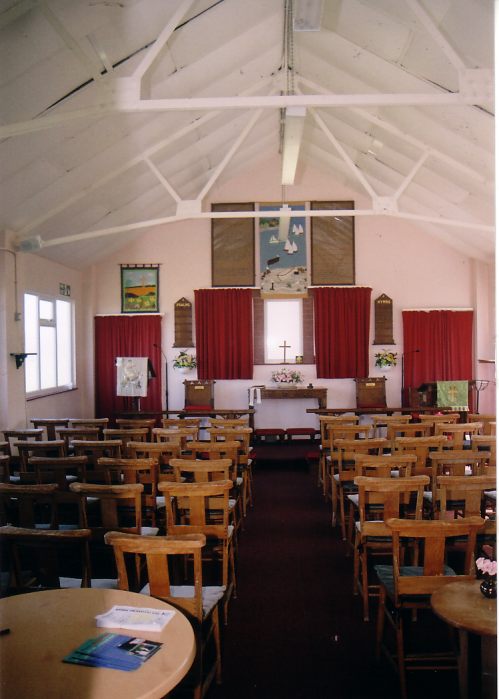
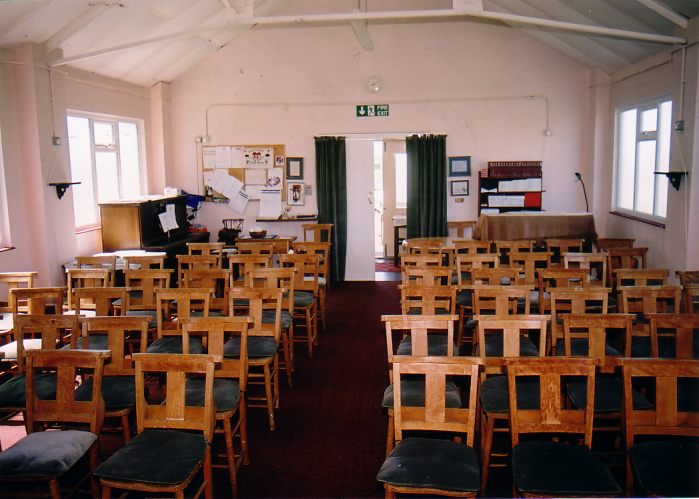
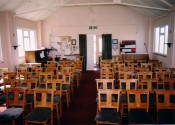
I only know what this church is like
inside from photographs, and Peter
Stephens has kindly lent his for you to
see below. I've always found it locked,
and the frosted windows allow no view of
the interior. If this was a Catholic
church, we would place a statue inside,
call it a shrine, and it would receive
thousands of visitors every year.
However, this is the Church of England,
and it must cut its clothes to suit its
cloth. So, this little church has been
threatened with redundancy, and even fell
into disuse for a while. But, as is the
way at present, Anglicans with their
backs to the wall seem more prepared to
come out and fight, and this church is
now a significant part of the benefice
that includes St Andrew and St Peter and
St Paul. They are committed to regular
services, and this church is back in
regular use - at least, until the Deben
reaches it.
On the second Sunday in July each year,
as St. Nicholas is the patron saint of
sailors, they hold a Sea Sunday service
in the afternoon. Worth stopping for
if you can. And then travel on, ever
northwards. Stand at the ferry pier, and
look across to Bawdsey, with its pine
woods and foreign houses looking full of
possibilities. So, take the ferry across,
because it is an adventure waiting to
happen. |
|
 |
|
|
|
Simon Knott, July 2003, updated August
2015
The photographs below were taken by Peter
Stephens and retain his copyright.
|
|
|