| |
|
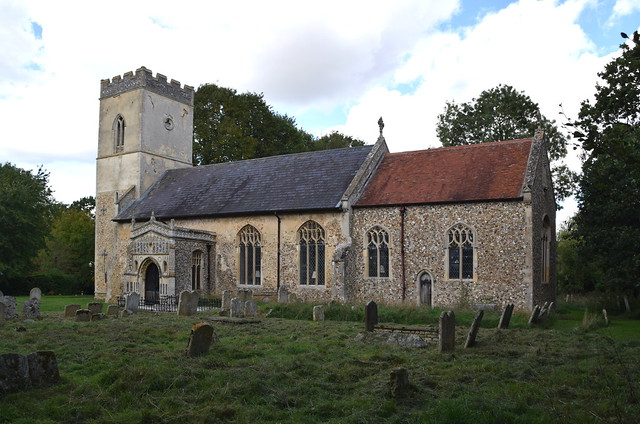
Finningham
is a busy village on the back road between
Stowmarket and Rickinghall, and the tower of St
Bartholomew is a familiar sight to travellers on
the main line between Norwich and Ipswich. The
church is pleasingly set away from the main road
in a little maze of lanes.
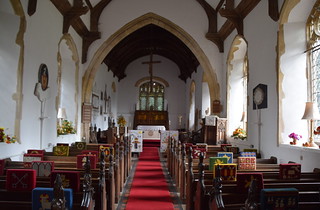
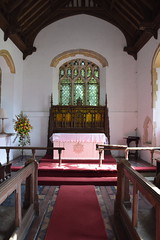
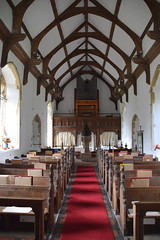
Everything is in proportion. This is a small
church, an intimate one. There are no aisles or
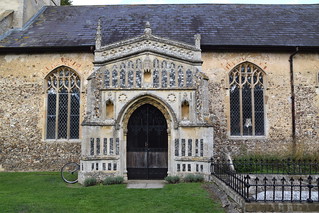
clerestory. The elegant 19th Century glass sets
the tone in the porch, and you step into a fairly
dim space, the red carpet and dark woodwork
creating a sense of seriousness. The hand of the
Victorians fell heavily here, but there are still
some intriguing medieval survivals, more than you
might expect. The best of these is the range of
figures reset in the top lights of the east
window. They are fragmentary, partly composite,
and obviously the survivals of what was a much
larger sequence, which may have come from
elsewhere in the church, or from another church
altogether. Four of the six figures appear to be
Apostles, with St James and St Simon obvious
among them. A figure with a harp is probably an
angel, and another figure is a composite of
several angels, one hand holding a cymbal and the
other a book.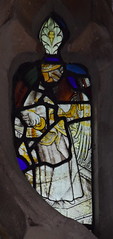 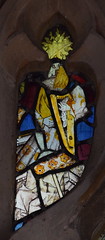 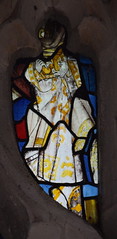 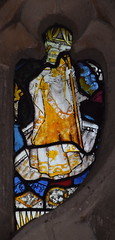 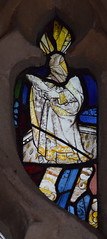 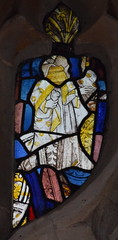
The
other medieval survival of great significance at
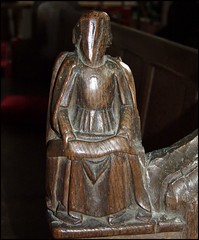
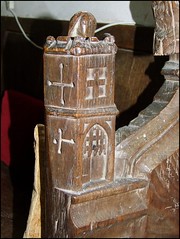
Finningham is a set of three bench ends. One of
them shows a figure in a tower, their head
peeping out of the top. This may be part of a set
of the Seven Works of Mercy, illustrating
Christ's injunction to visit the prisoner.
Similar bench ends can be found in several other
East Anglian churches. Nearby, another
fragmentary bench end may also depict a tower,
but I couldn't help wondering if it was actually
intended to be a pulpit. A third shows a seated
angel holding a scroll. This may be intended to
represent the Evangelist St Matthew, but there
are several larger East Anglian churches where
seated angels with scrolls accompany
illustrations from the Seven Deadly Sins, the
Seven Sacraments and the Seven Works of Mercy on
adjacent benches. If this is the case, it may
well be that the bench ends came from another,
larger church originally.
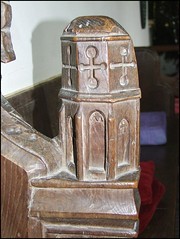  
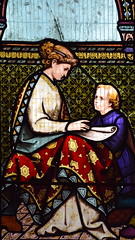
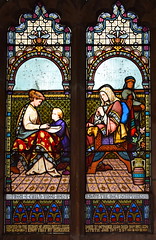
There
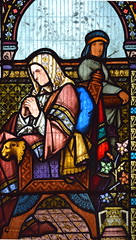
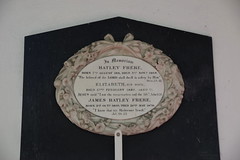
is an intriguing memorial window to the 19 year
old James Hatley Frere, who died in 1870. It
shows, or appears to show, the young James with
his mother and grandmother in a depiction of
Eunice sharing scripture with the young Timothy
while Lois looks on, each member of the Frere
family playing their appropriate part. Unusual,
but who was the artist? No one seems to know, but
it struck me as similar to some of the minor work
of that time by the great Henry Holiday.
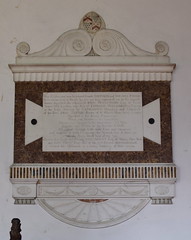
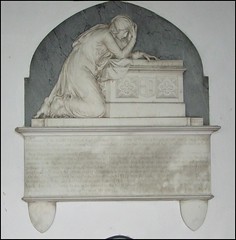
There are other memorials, mostly to the Frere
family but including one to Sir John Fenn, who
had married into the Frere family and was the
18th Century antiquarian who rediscovered the
Paston letters. His wife, Sam Mortlock enjoys
telling us, was the authoress of earnest books
for children written under pseudonyms including
Mrs Teachwell and Mrs Lovechild, and as such
became the model for Lady Bountiful in George
Borrow's equally earnest novel Lavengro.
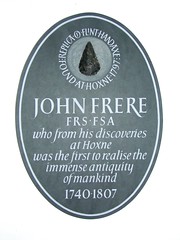
A recent arrival in the church is the memorial to
John Frere, lettered by the Kindersley Workshop
of Cambridge. Frere is an unsung hero of English
science. Born in 1740 just over the Norfolk
border at Roydon, he was MP for Norwich, but was
also a historian and an antiquary. He became
interested in the ancient stone arrow heads which
he uncovered near Hoxne, along with old bones
which appeared to belong to completely unfamiliar
animals. He wrote a paper for the Society of
Antiquaries about his discovery of weapons of
war, fabricated by a people who had not the use
of metals... The situation in which these weapons
were found may tempt us to refer them to a very
remote period indeed, even beyond that of the
present world...
This contradiction of a strictly Biblical view of
human development was considered so radical that
the Society suppressed it, and Frere's work did
not come to light until the 1860s, by which time
the likes of Anning, Wallace and Darwin had
confirmed Frere's suspicions about the longevity
of the human race and the likely origins of human
species. As the Minnesota State University
website quaintly puts it, Frere was the
discoverer of England's Antiquity of Humans.
|
|
|