St Andrew, Freckenham

www.suffolkchurches.co.uk - a journey through the churches of Suffolk
|
St Andrew, Freckenham |
|
|
||
www.suffolkchurches.co.uk - a journey through the churches of Suffolk |
||


Follow these journeys as they happen at Last Of England Twitter.
| Freckenham sits on the infant
River Lark, which at this point forms the border between
Suffolk and Cambridgeshire, and some of the houses are on
the Cambridgeshire side of the river. It's a picturesque
village, which most aren't around here in this solidly
working landscape. But perhaps it is the gentle hills
that make the difference here, and the parish church of
Freckenham sits at the highest point in the parish. Your
first sight of it as you approach it from the lane is
attractive yet curious, for a large, barn-like roof
overlays both nave and chancel, dropping down to enclose
the 15th Century north aisle which peeps out beneath it
and then the little vestry which looks almost like an
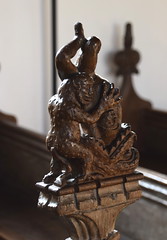
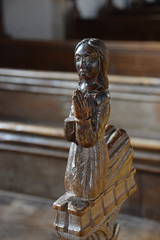
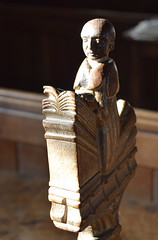
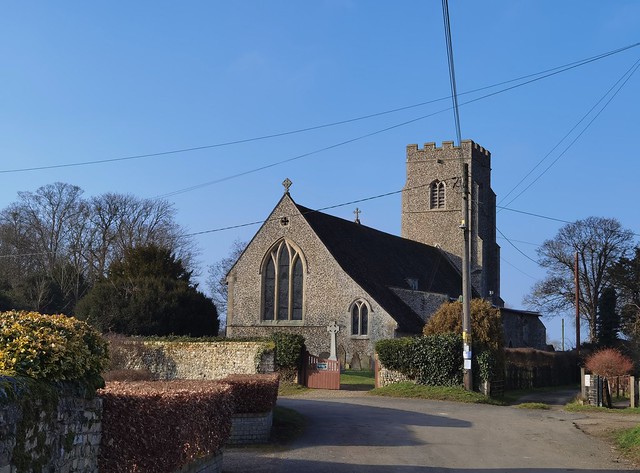
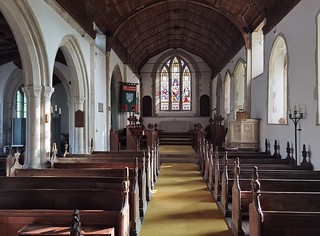
afterthought. The early 14th Century church was extensively restored in two stages during the second half of the 19th Century. Pevsner disapproved, thinking it over-restored, but Mortlock observed that it was done so well that it isn't easy to tell the old from the new, and perhaps this amounts to the same thing. The major restoration was by George Street in the late 1860s, but in 1882 the tower collapsed and JD Wyatt rebuilt it in a convincingly original if crisp style. Street's work imposes itself most from the south, and you might even think this a Victorian church. However, the three light east window tracery appears to be the original from the early 14th Century church, and the original roofs to aisle and chancel are preserved under what is effectively Street's outer covering. His too I think are the little dormer windows at either end of what would have been the rood, a nice conceit, especially as there is no roodscreen. You enter through the south porch, and I was pleased to find that the church is now open every day, which it hadn't been on my previous visits. The church unfolds quickly eastwards, for there is no chancel arch, no break at all between nave and chancel other than a series of six steps from nave to sanctuary. This is suggestive of a High Church enthusiasm, but if such ever existed at Freckenham it is gone now. The church has a good collection of bench ends on its 15th Century benches, although they are too perfect to imagine that they are unrestored. Indeed, it is clear to see where new sections have been cut in, especially for replacement heads. The best of them is a devil forcing a sinner down into the jaws of hell, and also memorable is a woman kneeling at a prayer desk with a rosary.
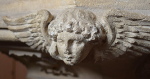
Alabaster reliefs must once have been a major feature of English parish churches, but they were all removed as a result of the injunction against images issued in the 1540s. When William Dowsing went on his way around Cambridgeshire and Suffolk a century later, he didn't find a single one still in use. Most likely some had been destroyed, but many were sold abroad. Nottinghamshire alabasters had always had a good reputation in continental Europe, and the Anglican reformers found a ready market. The Musée de Cluny in Paris has a large collection. Some found their way back into English churches as a result of early 19th century restorations, for by then Revolution had laid waste to French and Belgian churches, and the market was moving the other way. In a few cases, the alabasters were recovered locally, for set in the north aisle wall is an image that was found during building work in the 18th Century, by which time antiquarians outnumbered iconoclasts. It was probably just one panel of a reredos. It shows St Eligius, a 5th Century bishop who, having trouble shoeing a horse, cut its legs off, shoed them, and then stuck them back on again. An appropriate image to find in this horsey country to the north of Newmarket, I thought. The poor little horse here looks a little dubious about the saint's miracle-working powers. That an image of such a minor saint could have been made is perhaps a mark of how much we have lost. The font sits at the west end of the north aisle, and above it is 15th Century roof. Pairs of angels, one holding a crown of thorns and the other praying, act as bosses in the vaulting. Some have replacement wings, some are wholly later copies, but it is done very well. Also done well are the beautifully lettered early 19th Century Lord's Prayer and Creed boards now mounted on the north side of the sanctuary. They would once have been behind the altar, but they would have been removed as part of Street's restoration. I assume it was Street who brought the stone pulpit here. It's never a good look, and yet the late 19th Century had a great enthusiasm for them. |
Simon Knott, February 2023
Follow these journeys as they happen at Last Of England Twitter.


|
||||||||||||||||||||||||||||||||||||||||||||||||||||||