| |
|
 |
|
It had been so long since I
last visited Great Barton that I really
did not remember the village at all. It
is a large place, a bit of Bury St
Edmunds broken off really, only the
railway line separating it from the
Moreton Hall Estate. The church sits a
good half mile from the village, down a
narrow dusty lane. A large hare sat on
the road in front of me as I left the
village, and loped along just ahead in no
particular hurry until we reached the
church gates, where he turned and looked
at me, and then preceded me into the
graveyard. It was hard not to imagine
that he was an omen of some kind. Holy
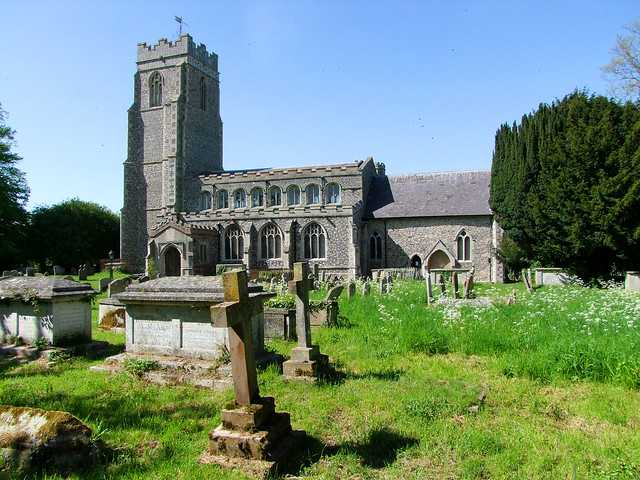
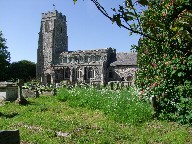
Innocents is one of those spectacular
15th Century rebuilds that East Anglia
did so well, and is all the more so for
being so remote. Mortlock calls it
'handsome', which is about right. The big
tower rides high above the clerestory and
aisles, the long, earlier chancel
extending beyond. It has much in common
with Rougham, just across the A14.
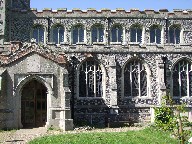
Windows to aisle and clerestory create
something of the wall of glass effect so
beloved of the later Middle Ages.
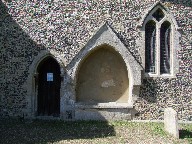
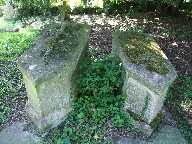
Unusually, there is a tomb recess in the
outside of the south wall of the chancel
which was possibly for the donor of the
chancel.
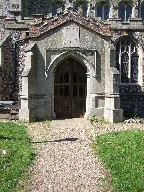
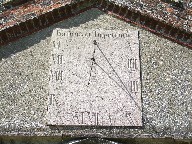
The 15th Century south porch
carries a later sun dial with the
inscription periunt et imputantor,
which means something like 'they perish
and are judged'.
|
You
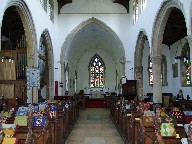
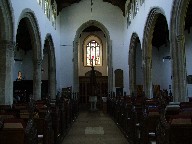
step inside to a big church. Despite the windows
of the south aisle being filled with coloured
glass, the church is full of airy light and
space. This is accentuated by the hugeness of the
chancel arch, which goes with the 13th Century
chancel - that is to say, nave and aisles were
built to scale with it as a starting point. In
such a great space the furnishings do not
intrude, and they are pretty much all the work of
the 19th Century restoration here. They are a
good counterpoint to the spectacular glass of the
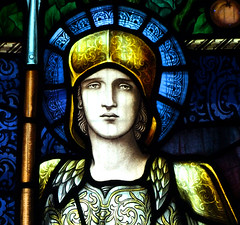
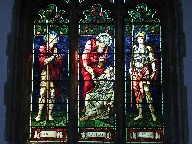
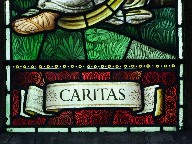
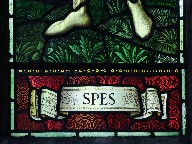
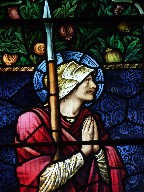
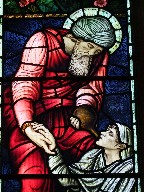
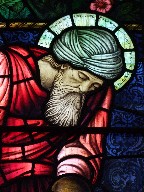
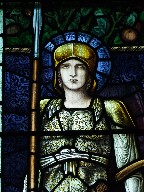
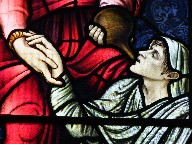
south aisle. The first window is by the William
Morris workshop, with the figures by Edward
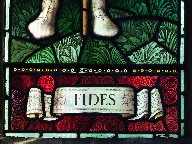
Burne-Jones of Faith Hope and Charity. All three
are shown, unusually, as men. Faith is the Roman
centurion at the foot of the cross, Hope is
Joshua and Charity is the Good Samaritan.
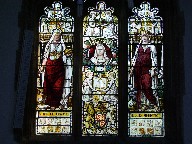
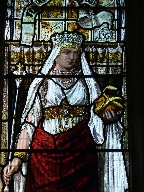
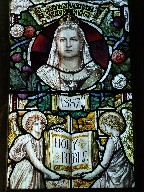
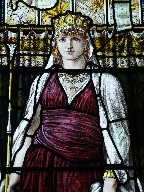
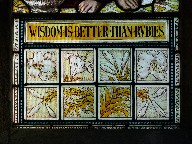
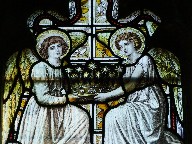
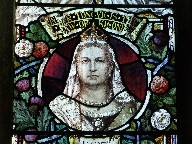
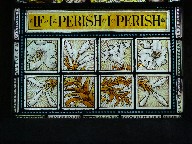
Beside
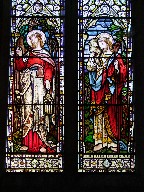
it is a window which is somewhat bizarre. A
number of Suffolk churches have windows to
commemorate the Golden Jubilee of Queen Victoria
in 1887, but none, I think, are quite like this
one. The stately queen sits with a look of
indigestion upon her face among angels carrying
her crown and the Bible. She is flanked by two
rather unlikely fellow monarchs, the Queen of
Sheba with a snake of temptation and her motto Wisdom
is better than rubies and a positively
louche Queen Esther with If I perish, I
perish. Above Victoria's head in a scroll is
inscribed In her tongue is the Law of
Kindness from the Book of Proverbs. All in
all, a remarkable piece.
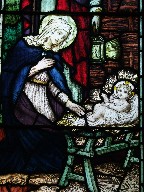
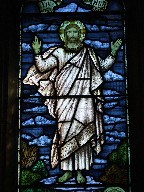
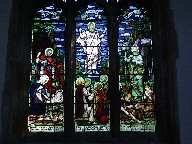
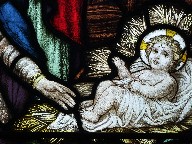
Ther
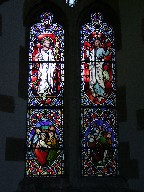
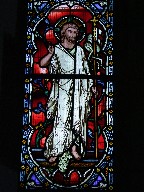
other window in the aisle depicts the Ascension
flanked by the Nativity and the Resurrection. The
Nativity scene is particularly good. It is
unsigned, but I wondered if it was by AK
Nicholson.
But
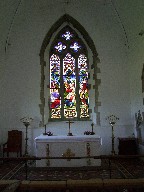
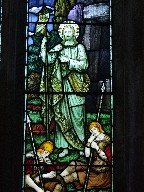
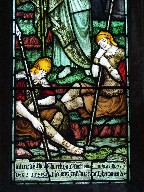
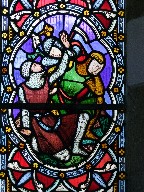
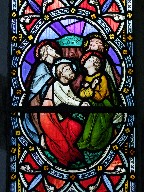
for the oddest window of all, you have to step up
into the chancel. Here, on the south side, is
another depiction of the Resurrection and the
Ascension. These appear in the upper part, and in
the lower part are the Disciples watching the
Ascension and the Roman soldiers asleep at the
Resurrection. However, these lower parts have
been put under the wrong upper parts, and the
sleeping soldiers are missing the Ascension and
the Disciples are watching the Resurrection! Such
a blunder can only have happened in the studio,
when the cartoons were being laid out before the
glass was made.
Holy Innocents is an
interesting dedication, and an unusual one for an
Anglican church, especially a medieval one. Bear
in mind that, in the Middle Ages, churches were
dedicated to feast days, especially of Saints,
and not the Saints themselves. Holy Innocents is
celebrated on December 28th, and remembers
Herod's massacre of the babies of Bethlehem. It
would have been a more common dedication in
medieval times. Here, it is probably a relic of
Anglo-catholic days, and the 19th century revival
of church dedications; but it may also be the
original dedication of the church. It is quite
clear that this church enjoys a High Church
character this day, and is one of the few village
churches in the Bury area where you can light a
candle when you say a prayer.
| Like all good High Church
parishes, Great Barton keeps Holy
Innocents open every day, and there is
even a Fair Trade shop where you can make
your purchases and perform a work of
mercy at the same time, a fine
opportunity. Back
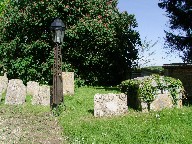
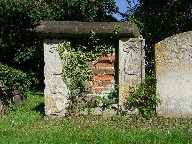
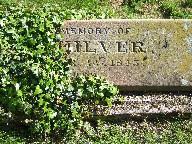
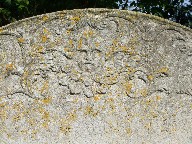
outside, the churchyard is one of the
best in Suffolk to potter about in. It is
vast, with a good 300 years-worth of
headstones. While exploring, you might
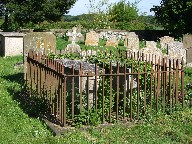
notice that the very north-east corner of
the churchyard is cordoned off by a low
brick wall, and contains but a small
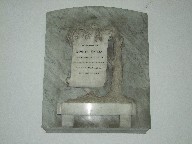
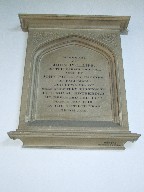
number of graves. They are to the Bunbury
family, who are also remembered with
mural monuments in the chancel of the
church. The
Bunburys had lived at Barton Hall, but it
was destroyed by fire in 1914. Sir Henry
Bunbury achieved a place in popular
history in the early 19th century when he
was the foreign office official who had
the job of breaking the news to Napoleon
that he was to be exiled to St Helena.
The school history books that speak of
the defeat of Napoleon have long since
been consigned to the skips. Now, all
that remains is the light summer breeze
in the corner of a Suffolk churchyard.
|
|
 |
|
|
|