| |
|
 |
|
2009: Just
as I finished visiting all the medieval
churches of Suffolk in 2003, decent
digital cameras became cheap enough for
me to afford one - or, at least, not to
put too big a dent in my overdraft - and
so I went out and bought a Fuji S5000.
This was, of course, too late for
Suffolk. Instead, I went off to explore
Norfolk, but by the summer of 2007, when
I had got about 700 churches around
Norfolk, I decided that it was time to
start exploring Suffolk again. By now, I
had an S9000, and there was simply no
comparison with the dismal, blurred old
photographs of the first Suffolk site
entries. I took about eighty of the
entries down, but I really meant to redo
the lot, eventually. Back
in 2003, Tom Muckley had nagged me
constantly about going to Gipping. Tom,
an enthusiast of East Anglian churches
living in Hampshire, was far better than
me at seeing both the strengths and
weaknesses of the Suffolk site. It was
he, when my energy and enthusiasm were
flagging in the spring of 2001, who had
first contacted me with convincing
threats of his own mortality, something
along the lines of if you don't get
on with this, I'm not going to be alive
to see you finish it! As it turned
out, Gipping was one of the very last
Suffolk churches which I visited. And
when Suffolk was complete, Tom, of
course, was not satisfied. He bullied and
cajoled me into finally agreeing on a
great adventure - visiting every Anglican
and Catholic church in Norfolk.
|
What
with medieval ones, and Victorian ones, and
modern ones, and ruins, and places where churches
had once been, and even a sprinkling of
non-conformist ones, we came up with a total of
about a thousand Norfolk churches, with which Tom
seemed satisfied. And so it was, in the summer of
2004, that the Great Norfolk Adventure began. It
still continues - I estimate I'm about
three-quarters of the way through, although I
must confess that many of those left to do are
distant from each other, each an island in a sea
of already-visited churches.
But
coming back to Suffolk, I had the privilege of
being able to decide exactly where I'd like to go
back first. There's no great hurry this time.
Inevitably, it was churches with medieval glass
that enthused me, and I went around Suffolk with
the satisfying task of putting right what I knew
I had not done well before. But Tom noticed one
great omission. When on earth was I going to get
off my backside and revisit Gipping? The threats
of mortality were brought to bear, and in reality
Tom knew what he was talking about. Around the
turn of the Millennium, he had been given six
months to live, which, as he pointed out to me,
concentrates the mind wonderfully. Here we were,
almost ten years on, and Tom had the satisfaction
of knowing that his threats were real, but that
he was successfully reaping the harvest he was
sowing.
I
came back to Gipping in March 2009. I had plans
to meet up with Tom in Norfolk a couple of weeks
later, but on this bright early spring day I
cycled out of Stowmarket up the Old Newton road,
and then off into the countryside. I hadn't told
him I was planning to pass this way. I found the
beautiful church open - I won't go into details,
you can read the original 2003 entry below - and
took photographs of those wonderful windows in
digital, at last, at last.
I
hurried home. I don't usually unpack the
photographs I have taken straight away, but I
really wanted Tom to see these Gipping windows,
and so I downloaded them off the camera and sent
them that evening over to Hampshire. Well, he
went into raptures. Tom's expertise in all areas
of the medieval never failed to impress me, but
he was always the most passionate about glass. He
knew well how enthusiasm, when it is bolstered
with love and knowledge, can be one of the most
satisfying of emotions.
The
following afternoon, he sent me a brief e-mail
postponing the Norfolk visit, because he was
being rushed into hospital to have abdominal
pains investigated. And there it was that he
died, on Tuesday the 24th of March 2009. The last
words of his final e-mail to me, expressing
disappointment that he wouldn't be making it,
were Damn! Damn! Damn!
I
was glad that he had seen those photos.
2003:
Just when I think Ive seen it all, Suffolk
surprises me. Out of all the countys
churches, this was the one that people most often
wrote to me about, urging me to go and visit it.
There are very few churches in the county that
dont have an entry on this site now, but I
identified a skein of them, stretching from the
northern outskirts of Ipswich out to Diss, where I could
catch a train back to Ipswich. Gipping
wasnt one of them, but things didnt
quite go according to plan.
It
was a gloomy day as I cycled out along the Henley
road, the low clouds glowering over the damp air.
A puncture at Coddenham didnt help matters
much, and once the enthusiasm of the churchwarden
at Pettaugh had detained me for longer
than Id planned, a thin continual drizzle
was penetrating my clothes, hair and face with
its icy fingers. This made my photographs of the
wrecked church at Mickfield more atmospheric, but it
also loosened all the mud on the road left by the
ploughing of the previous week. My bike wheels
threw it up around me; I reassured myself that Mendlesham would be open, as it
always is, since I was now in such a state that I
was sure no keyholder would grant me access,
looking as I did like a tramp who might make up a
bed on the altar.
There
was another thing too I had found the
climb out of Stonham Aspal a hard one, and I knew
that it wasnt the bikes fault. There
was the beginning of a dull ache in my head, and
a burning in my throat. My chest felt like
someone was standing on it. In fact, it was the
start of the flu that would keep me in bed for
the next four days. After Mendlesham, I had
planned to head north, for Finningham, Westhorpe and all points to Diss,
but as I stood in the high street holding my
bike, I knew I wasnt well enough.
I
decided to head south-west to Stowmarket, through the threads of
lanes that wind around the Gipping valley. I
could catch a train there. And so it was that I
came within a shout of St Nicholas Chapel, and
could not resist it.
Youll
notice that St Nicholas is styled a chapel. This
is because it is not a parish church, and never
has been. The history of Englands medieval
parish churches is complex enough, but suffice to
say that they were built as Catholic parish
churches before the Reformation, and translated
directly into the new Church of England in the
middle years of the 16th century. The imagery,
style and iconography of St Nicholas will clearly
demonstrate it to be pre-Reformation, but it was
actually the private chapel of a Big House,
Gipping Hall, home of the Tyrrells.
Gipping
Hall once stood immediately to the east of the St
Nicholas chapel, but it was demolished in the
1850s, and all that remains today is the wide
pond, and a couple of outbuildings. You approach
the tiny village along the narrow road to Old
Newton, and then turn off along a farm track for
about 100 metres. Not far from here, a spring
rises, and the parish shares its name with the
river that it makes. Two lovely farmhouses stand
to the left of the track, but already your eyes
and breath will be caught by the stunning
building to their right.
It
is like a finely-crafted jewel. Forget the glum
little tower at the west end this was an
unfortunate addition of the 17th century,
presumably by a Tyrrell of the time. The rest is
a superb example of late Perpendicular
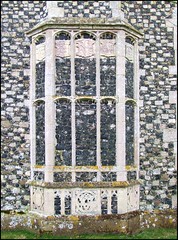
architecture; the flint-becrusted walls soar to
heaven, and great expanses of glass shimmer in
the late afternoon light. Once, the windows were
full of stained glass images of Saints, but they
were all destroyed, probably by 17th century
puritans. Not the iconoclast William
Dowsing,
who never came here; but he was vicious in his
treatment of the Tyrrell chapel at Stowmarket,
and the fact that he never came here suggests
that he knew it had already been dealt with. At
the time, it was still a private chapel (although
he investigated these elsewhere) and the Tyrrells
were still tainted by their recusancy, so it is a
mystery.
Because
the windows are so vast, there is a kind of
greenhouse effect; from the outside, you can see
right through the building, and within can be
lighter than outside. I wandered around. The
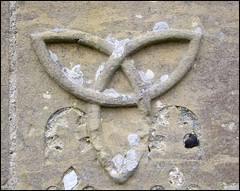
flintwork is superb; the buttresses are
punctuated with the iconography of the Tyrrell
family, some of which has still not been
certainly decoded. Most notable is the Tyrrell
knot, a three-bowed interlacing that looks like
the kind of thing I used to make with my
spirograph set when I was little. There is the
interlocking heart of the Arundell family, into
which the Tyrrells married, and the letters AMLA,
almost certainly Ave Maria, Laetare,
Alleluia! ('Hail Mary, rejoice, alleluia!')
from the May anthem. Also on the north side is
the extraordinary chaplain's quarters, like a
15th century house red brick grafted on. Above
the door is written Pray for Sir Jamys
Tirrell. Dame Anne his wyf. It was in 1743
that St Nicholas became a public chapel, and an
outstation within Old Newton parish.
The
church is open, and it is so every day, although
be aware that the south door is rather stiff. You
step directly into the nave - there is no porch.
If the exterior of the building speaks of late
medieval glory, you will be delighted to find an
interior that still retains much of its
prayerbook atmosphere, from the time before the
Oxford Movement resacramentalised the Church of
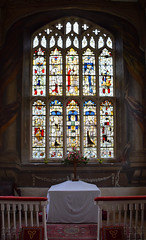
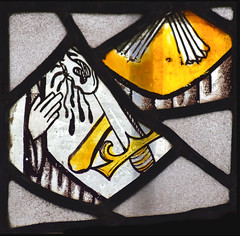
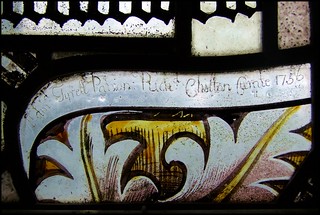
England. The glory of the inside is the awesome
east window, where surviving glass from other
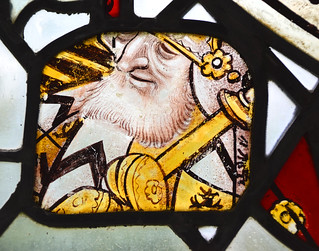
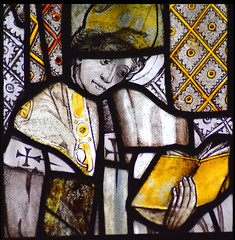
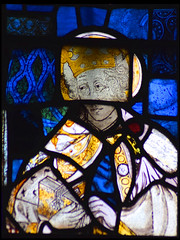
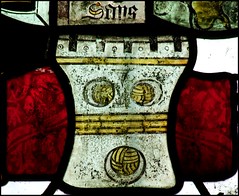
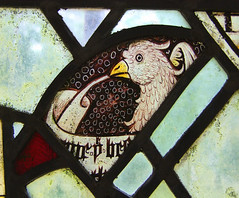
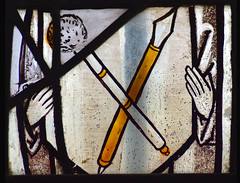
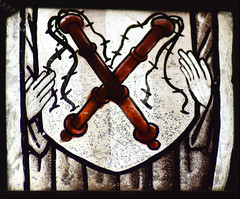
windows is collected. There is much to see,
including fragments of Saints and their emblems;
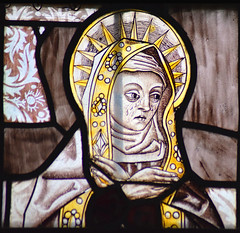
but the best are the grieving figures of St John
and Mary the Mother of God, reset in their
original position. The rood that once separated
them has gone, but the glass between is
sensitively arranged to suggest a cross. For my
money, they are the best stained glass figures in
Suffolk.
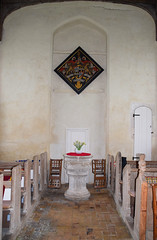
The
furnishings are a simple, late 18th century
affair, painted in a seemly manner in recent
years. On either side of the east window are
theatrical decorations, draped pillars that rise
to the 15th century ceiling. They would seem
curious in most medieval buildings, but in the
18th century they were common enough. The
Victorians hated them, of course, and so few
survive. The font is easily dismissed, but its
shape, on the eve of the Reformation, already
speaks of the rumblings on the continent that
would flower as the Renaissance; a flowering to
which the Tyrrels would have an access unusual in
this county.
There
are no memorials; in fact, the Tyrrells are
mostly remembered at Stowmarket, three miles away, where
the Parish church contains some of Suffolk's
best, including some intriguing 17th century
survivals. It is possible that the benches in the
north-west corner, which a re decorated by the
Tyrrell knot, were brought here from Stowmarket
when that church was restored in the 19th
century. But perhaps the most remarkable thing of
all about Gipping is the sense of constant care,
that there has always been a community here to
look after it. It has always been a tiny one;
even at the time of the 1851 census of religious
observance, when churchgoing in England was at
its height, the congregation here only numbered
20. The officiating minister was the headmaster
of Needham Market Grammar School.
| St
Nicholas lifted my spirits, and I cycled
off buoyed up by it, not realising that I
had left my copy of Mortlock behind.
Fortunately, the kind people in the house
opposite rescued it for me, and looked
after it until I could collect it.
Fighting the rising aches in my body, I
headed on down the tiny lane which
follows the infant River Gipping into Stowmarket. Rooks fluttered
upwards to land as I passed. For three
miles, the lane wove its way along the
side of the brook, crossing it once. I
didnt see a single other human
being, let alone a car. I had forgotten
how hilly it was around here, but the
water led me onwards, cutting a path down
through the woods and fields. Beyond
Stowmarket, it would leave me behind to
catch my train. But onwards it would
flow; it would open out into the wide
water meadows above Ipswich, before
cutting into the industrial heart of the
great town, becoming tidal, becoming the
Orwell, and emptying its broad and
majestic expanse into the grey North Sea. But by then I would
be too dosed with aspirin and whisky to
think of it.
|
 |
|
|
|
|