Holy Trinity, Gisleham

www.suffolkchurches.co.uk - a journey through the churches of Suffolk
|
Holy Trinity, Gisleham |
|
|
||
www.suffolkchurches.co.uk - a journey through the churches of Suffolk |
||


Follow these journeys as they happen at Last Of England Twitter.
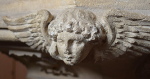
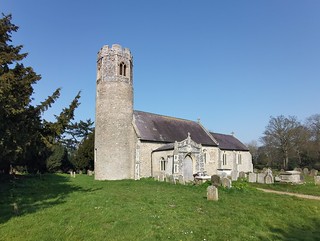
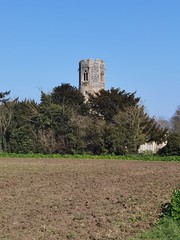
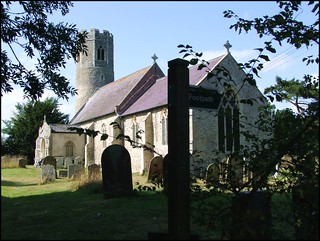
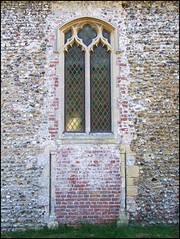
Gisleham, pronounced gizz-l'm, is an attractive village out in north-east Suffolk, with a lovely little round-towered church. Suffolk has few greater delights in spring than cycling around these narrow lanes between Lowestoft and Halesworth. If you avoid the main roads, you wallow in a lost land of scattered farms, little hamlets and mainly round-towered churches. There is hardly ever a car. When spring comes I cannot resist breaking out of the noise of my everyday urban existence and into the high-hedged lanes. In spring, the verges are high in alexanders and wild angelica, a vivid light green found nowhere else in nature. The birds sing, the hedgerows are alive with rosehip and hawthorn flowers, and there's hardly anywhere I'd rather be. Because the hedgerows still survive around here to a greater or lesser extent, large vistas are rare, and churches may appear as a surprise, suddenly, around the next bend. An Ordnance Survey map is essential for church-exploring out here, for they are often away from their villages, and sometimes the villages no longer even exist. However, Holy Trinity sits in its village not very far from the edge of Kessingland, and the first sight of it on this day in March 2022 was delightful, its tower tree-surrounded across the fields. This is one of north east Suffolk's many churches with a round tower, a late Saxon/early Norman base surmounted by an early 14th Century octagonal brick crown, similar to those at nearby Mutford and Ashby. This appears to be the story of the church too, a Norman structure elaborated in the early 14th Century, but on a quiet scale, making the mid-15th Century porch with its knapped flintwork more imposing than it would be against a larger or more demonstrative church. Above the porch entrance are the remains of a niche flanked by censing angels. This was probably defaced by iconoclasts in the 16th and 17th Centuries, but the major damage occured when a sundial, now removed, was fitted in the 18th Century, slicing the angels in half. It is a grand, spacious porch, and the door from within it into the nave is most curious, hinged up the middle so that only half of it opens. And it is curious for another reason, which we will come to in a moment. I first visited
Gisleham about twenty-five years ago, and I have a strong
memory of that occasion. Church exploring was not such a
popular activity in those days as it is now, and as a
harmless eccentric I was used to being followed into
churches after about five minutes by suspicious locals,
who usually pretended to be putting up a notice, or
rearranging the flowers, when clearly they'd just come in
to keep an eye on me. I'd been pleased to find this
lovely church open, and I was wandering around taking it
all in when a very jolly fellow popped his head around
the door. "Halt!" he cried. "I've come to
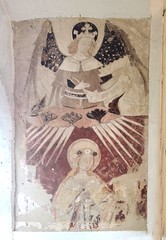
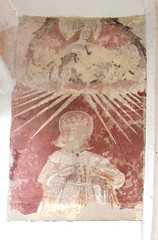
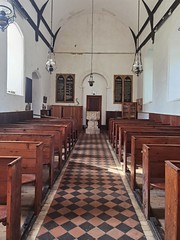
make sure you're not stealing anything!" The church we stood in is all of its restorations of the 1860s (structure and nave furnishings), 1880s (roofs and tower) and 1900s (chancel). But there is one unusual survival, or , more precisely, two, for it the eastern splay of the two windows on the north side of the nave are two exquisite wall paintings. They show female saints standing under canopies from which angels send down rays, and are reminiscent of figures on screens. One holds a sprig of flowers, and is likely to be St Dorothy. The other indicates a pot of lilies, and is thus the Blessed Virgin at the Annunciation.
There is a grand roll of honour on boards recording the names of all the local boys who went to fight in the First World War, indicating those who did not come back. It is much in the style of those at neighbouring Rushmere and Mutford. A moving little tablet to the two Pugh brothers, who died in a Far Eastern Prisoner of War camp during the Second World War, is nearby. Their graves lie among the forests of Siam, it notes, but their memorial is the praise we offer in this house - Sursum Corda ('Lift up your hearts'). There is a late 16th Century brass to Adam Bland of the City of London Esq and Serjeant to Majestye, which is to say Queen Elizabeth I. The east window is credited to the Kempe workshop, although the smaller figures are so much in the style of the work of former Kempe assistant Ernest Heaseman that I wondered if it might more likely be his work. Back in the 1990s I
had remarked to Mr Scollard how pleased I was to find the
church open, as it is in a rare area of Suffolk where
some are not. "Well, we like to keep the church
open", he replied. "We think it's important,
and it's an act of witness. But the main reason we keep
it open is that the door hasn't got a lock on it."
And he was right, the lock had been removed at some time
in the distant past, possibly during the 1860s
restoration, and it was never replaced. "The
insurance company says it's alright, because there's
nothing worth stealing", he grinned. Everything
moveable is locked away, all furniture bolted securely to
the floor. It is safe, secure and sensible, protected by
the houses around it, and consequently Holy Trinity can
be as welcoming as it is possible for any church to be.
And of course unlocked churches where local people feel a
sense of ownership are statistically less likely to
suffer vandalism, break-ins and thefts than locked ones. Simon Knott, April 2022 Follow these journeys as they happen at Last Of England Twitter. |




|
||||||||||||||||||||||||||||||||||||||||||||||||||||||