| |
|
I always get a frisson out
of visiting Gislingham, because it is one of the
few East Anglian churches with Knotts lying in
the churchyard. Here, the large, deeply incised
headstones to the west of the tower speak of
solid mid-Victorian respectability, and although
none of these Knotts have any connections to me,
I find this strangely comforting. When my son was
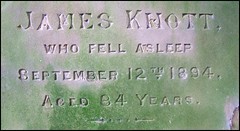
a teenager he especially liked the one which
begins James Knott fell asleep, because
that is his name, and he had a large photographic
reproduction of that headstone up above his bed.
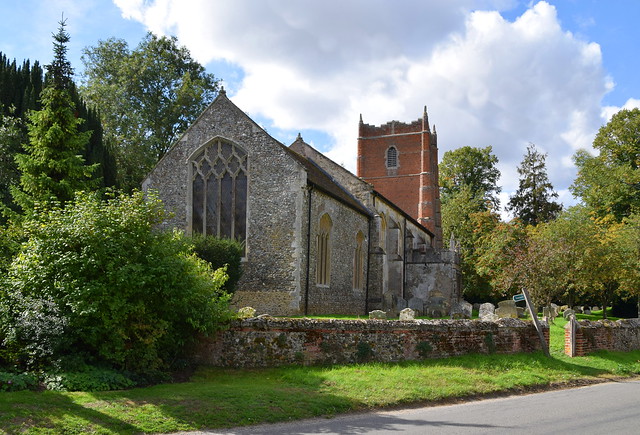
One of my favourite sights of the red brick tower
of St Mary is that from the walks on the Thornham
Estate of the Hennikers. One can imagine the 18th
Century squires treating it as a 'view' and
planting their copses accordingly. Closer to, the
tower dominates the local countryside, grand, yet
mellow, one of the best red brick towers in
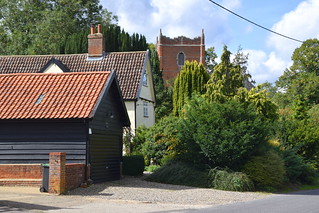
Suffolk. Within the village itself the church is
set rather tightly against the northern side of
its churchyard, but the tower is a pleasing
counterpoint to the surrounding houses.
And the tower is unusual, because it was built as
a replacement for a medieval tower in the years
after the Reformation. The neglect that set in
the Church of England in the later part of the
16th Century would cause more than a few Suffolk
church towers to collapse during the course of
the next two hundred and fifty years, before the
Victorians stepped in to rescue them.
Gislingham's was one of the first to fall,
hitting the ground in the winter of 1598. Robert
Petto paid for the replacement in 1639, so it was
probably an act of Laudian piety, and one that
would have seemed heartily pointless through the
twenty years of the Commonwealth period that
followed. Come the Restoration, however, and John
Darbye of Ipswich would cast two bells for the
tower - he may be the same John Darbie who had
given £100 for its construction thirty years
earlier. Because of the early date, there are
ecclesiological features which would be lost to
brick towers for the next couple of centuries.
Unusually, St Mary presents its north face to the
village street, with the grand porch and busy
graveyard belying any popular modern notion that
the north side of graveyards were in some way
unconsecrated. The tower was rebuilt flush with
this side, not centrally as before. St Mary is a
big church, and looks all of its forty metres
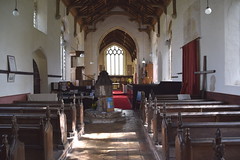
long. You enter through the long north porch and
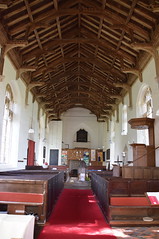
the church you step into feels wide and open,
with a sense of age not scoured by the 19th
Century restoration. There is a fine
double-hammerbeam roof which allows the great
width of the church without any need for arcades.
Sam Mortlock spotted pulleys on several beams,
which were probably used for pulling up candle
lights.
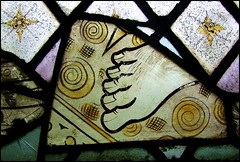
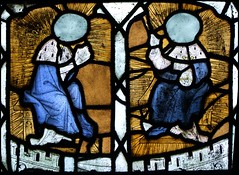
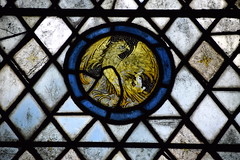
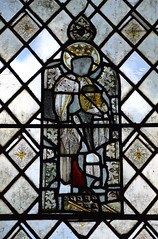
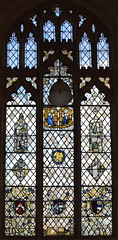
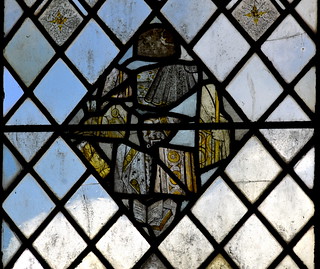
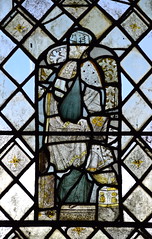
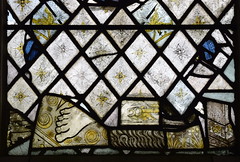
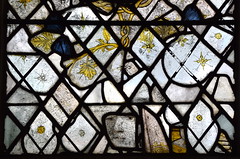
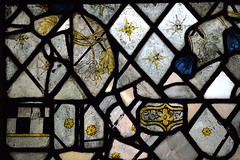
St Mary has a good collection of fragments of
medieval glass. The most significant scene is a
Coronation of the Blessed Virgin, which is more
commonly found in Norfolk. More beautiful are the
fragmentary collections set below it, including
one composite figure carrying the wheel symbol of
St Catherine, and elsewhere a face, a foot,
flowers and foliage and an exquisite roundel of
the eagle symbol of St John the Evangelist.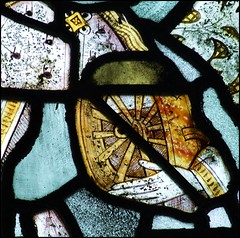 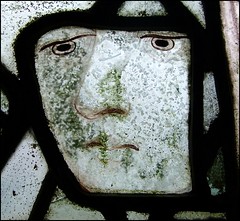 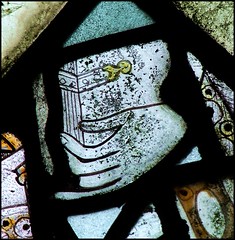
The church has undergone a
lot of repairs in recent years, and for anyone
who has visited it over that time it has looked
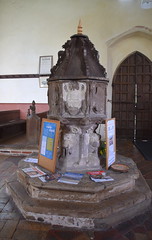
increasingly fine. The font has suffered the
knocks and indignities of the centuries, but
bears a dedicatory inscription to the Chapman
family, who also gave the porch outside. The
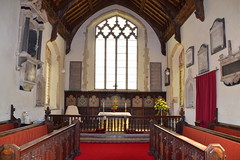
sanctuary, with its dark wood rails and
panelling, is beautiful in this ancient space.
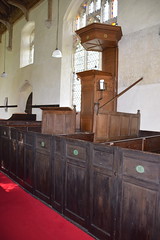
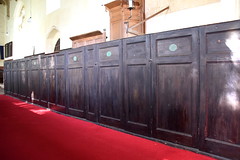
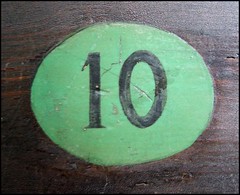
There are some box pews retaining their numbers,
and the position of the three-decker pulpit
halfway down the nave reminds us of the
importance of preaching of the time. It is a
reminder that, for a couple of centuries, it was
the pulpit rather than the altar which was the
focus of worship in an Anglican church. Of
course, the Oxford Movement put a stop to that,
and in any case I think the pulpit part of the
structure is a modern replacement.
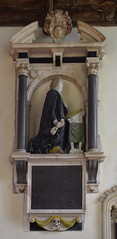
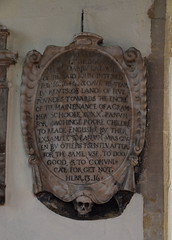
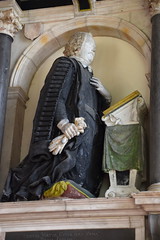
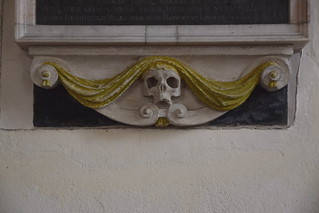
Gloomy skulls peep from beneath drapery on the
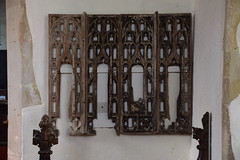
wall monuments. Elaborate tracery from the
medieval rood screen is set on the north chancel
wall. Sam Mortlock bemoaned its absence in 1987,
when he described the condition of the inside of
the church as being one of filth and decay.
How very different things are today!
|
|
|