We are close
enough to Ipswich to sense its orbit, but remote enough
for Gosbeck not to be a place that many of the county
town's residents will have heard of. The lanes out here
meander nowhere in particular, and it is possible to
cycle a long way without seeing a car. The villages are
generally away from their churches, and both Gosbeck and
nearby Crowfield are almost a mile from theirs. St Mary
sits in its graveyard surrounded by fields, one big house
beside it, the air full of birdsong and the rustle of
leaves.The solid 14th century tower is one of those south
ones you frequently find in the Ipswich area.
Externally, the church cannot have changed a great deal
in appearance since the 14th Century, but a crisp 19th
Century restoration has left a building with an
endearingly rustic feel, and a flavour of the dominant
enthusiasms of the Church of England in the last years of
that century, and the early decades of the one which
followed.
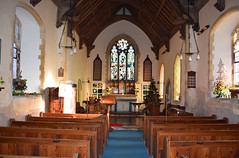
You step inside to a curiosity, for the body of the nave
is screened off from the back part, forming a kind of
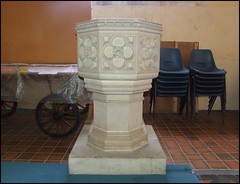
baptistery. The screen is probably contemporary with the
font, as the 19th Century becomes the 20th, but the most
interesting feature at this end is the iron-bound door to
the tower, which may very well also date from as early as
the 14th Century. You step through the gap into the body
of a well-kept, trim Victorian church, the work of
diocesan architect Herbert Green, who managed to keep his
frequent enthusiasm for neo-Norman under check here.
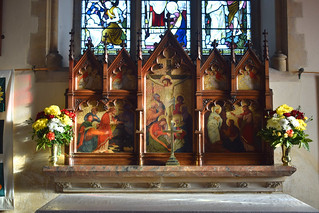
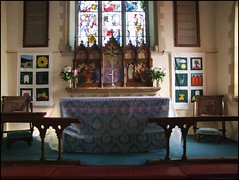
The best feature of the church is Green's reredos, at
once grand and sentimental. It was not installed until
the early years of the new century, some time after his
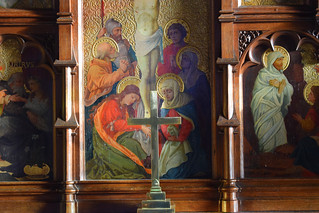
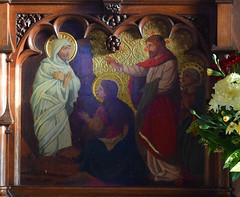
restoration. Either side of the Resurrection are the
raising of Lazarus and the raising of Jairus's daughter,
and perhaps the designers anticipated a less-enlightened
age, when people might not know what was going on, by
labelling them. The same two outer scenes can also be
found flanking the Resurrection in the east window at
neighbouring Crowfield.
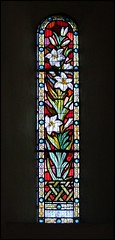
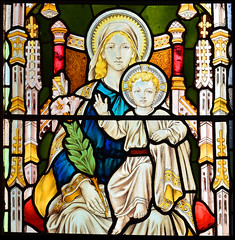
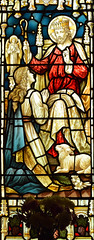
The other pleasing
feature is the glass, again turn of the century, suiting
the church well. William Worrall's Blessed Virgin and
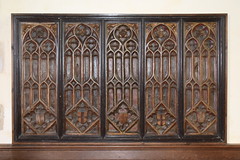
Child of 1902 in the chancel is striking. Some panels
from the former rood screen are attached to the north
wall. Unusually, they are traceried.
St Mary is a perfect example of all that is best about an
ordinary rural parish church: not historically or
artistically significant perhaps, but well-cared for,
obviously loved, opened to pilgrims and strangers, and a
vital heart of its community.
Back outside, the graveyard is an interesting place to
wander. To the south of the chancel is a headstone to
Caroline Attwood, the daughter of the composer Thomas
Attwood, better known in the early 19th Century than he
is today. He was a pupil of Mozart in Vienna, an unlikely
connection in this quiet spot. He wrote the anthem for
the Coronation of King William IV, and was hard at work
seven years later on an anthem for the Coronation of
Queen Victoria when he died. By the time of Caroline's
death in 1889 he would already have been unfashionable,
but his choral anthems are still sometimes performed,
particularly in cathedrals, and he himself is buried
under the organ of St Paul's Cathedral in London.
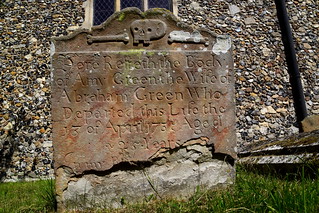
There are some unusual
brick anthropomorphic tombs to the west of the church,
probably the speciality of a local artisan, and a skull
and bones mark the place where resteth the body of
Amy Green, the wife of Abraham Green, who departed this
life in 1735, at the age of 25. Such a short life,
and so long ago, but still remembered. I made a mental
note to remind my family to put a headstone up for me,
possibly even with a skull and bones at the top, and
headed on towards Crowfield.