St Mary and St Lawrence, Great Bricett

www.suffolkchurches.co.uk - a journey through the churches of Suffolk
|
St Mary and St Lawrence, Great Bricett |
|
|
||
www.suffolkchurches.co.uk - a journey through the churches of Suffolk |
||



Follow these journeys as they happen at Last Of England Twitter.
| Great
Bricett must once have been a sleepy
hamlet lost in the gentle misty valleys between
Stowmarket and Hadleigh, but the 20th Century brought
great change to this area in the form of the Wattisham
airfield, one of the country's busiest army helicopter
bases. The village sits barely half a mile from it, the
mundane estate of base housing spilling over the hill and
merging into the village. A row of old houses conceals
its approach, and also concealed is Great Bricett's
church, set back from the road up a narrow lane, in a
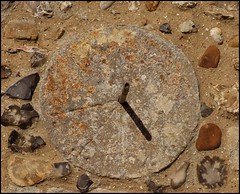
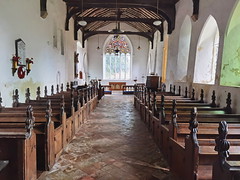
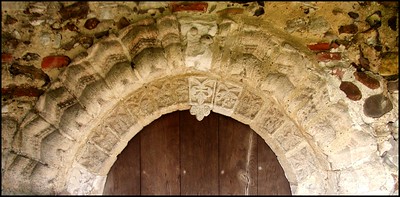
pretty square of fine houses. A first sight of this church inevitably elicits a reaction of what's going on here, then? for St Mary and St Lawrence is nothing if not unusual. It is extremely long and towerless, and has a nave and chancel all under the one roof. A 16th century house is built into the west end of it. The south side is like an encyclopedia of early medieval windows - few styles are unrepresented - and a curious arch at the east end reveals the site of a former transept chapel. The porch and the little bellcote are both modern. A huge Mass
dial is set to the east of the porch - it must be fully
40cm across, and easily the county's biggest. It is above
a blocked doorway, and the arch stones beneath it give it
a sense of scale.The porch itself also contains
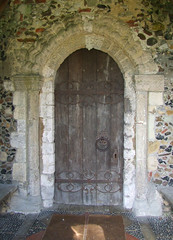
scratchings of interest. The Norman doorway has an
incised inscription on its columns. At some time it has
been rebuilt, and the letters are no longer in the right
order. You can just about make out the word Leonardus.
Now, why on earth should it say that? You step through
into a splendidly atmospheric space; long, low and full
of coloured light reflecting in the polished floor.
Again, you are struck by the strangeness of it, of
something not being quite normal, and you would be right,
for St Mary and St Lawrence was not built as a parish
church at all.
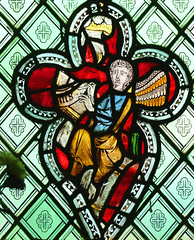
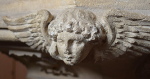
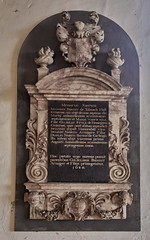
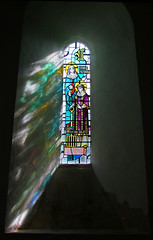
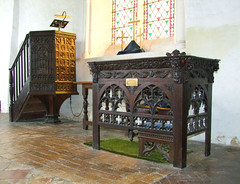
Further east on this side of the church is a quite different window, with 1970s glass by the Maile Studio of Canterbury showing the two current patrons of the church. And this is a church with good and interesting work from just about every century, for at the west end is one of Suffolk's best 12th Century fonts. The interlocking arches, jaunty and cartoonish, are so different from the elegant Decorated and serious Perpendicular tracery that future centuries would bring. They are survivals, not just of a craftsman's work, but of his imagination. When we see the artwork of the later medieval period it is as if we are able to understand what they were getting at. But Norman artwork like this is mysterious, as if produced by a culture with a quite different mindset. The sanctuary is simple and pleasing, its furnishings set against the plain whitewash of the walls. The light plays across the serious 1680s memorial to John Bright in the north wall, teasing it with a sense of the numinous. Despite the beginnings of a baroque fancy, the overall effect of the memorial is sombre, as if the shackles of puritanism had yet still to be fully shaken off. The gloomy little cherubs glow in the light. Across the church are the strikingly unusual pulpit and reading desk. The former is probably 19th Century, a grand staircase leading straight up into what is a far from conventional octagonal space, the forms undoubtedly gothic but in a different language. The reading desk beside it is bullishly baroque, the contrast between the two pieces adding to the thrill of both. Blind arches in the walls mark the locations of former chapels, and the east window upper tracery is filled with coloured glass, a balance to the white light beneath, the white walls around. All in all, a splendid atmosphere in a church quite unlike any other in Suffolk. What a contrast with the army base housing over the hill. |
Simon Knott, September 2020
Follow these journeys as they happen at Last Of England Twitter.







Amazon commission helps cover the running costs of this site