| |
|
 |
|
St Andrew is one of five
medieval churches in the Sudbury urban
area, and there are several more
separated from it by no more than a field
or two. But two of the Sudbury churches
are now redundant, and only St Gregory in
the town centre is open every day. When I
first came this way ten years ago I'd
found St Andrew locked without a
keyholder notice, but I'd been informed
by several people that there was now a
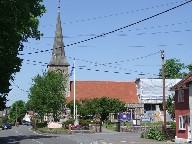
more enlightened attitude. Cornard is
Sudbury's busy southern suburb,
straggling along the road into Essex, and
its church speaks more of the southern
county than it does of Suffolk, the
wooden broach spire a near-twin of that
at lonely Great Henny a mile or two off
across the river. Image
niches at the west end would have
contained statues in late medieval times,
beneath which travellers might have
stopped for private devotions. The west
face of the tower sits hard against the
road, and so it wasn't until we reached
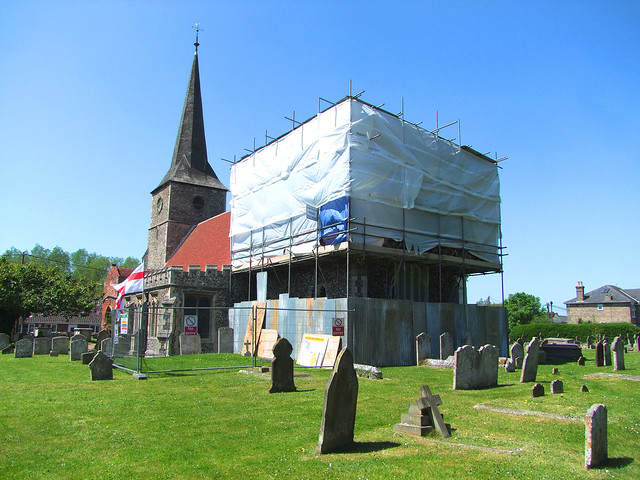
the churchyard that my heart sank. The
entire chancel was under scaffolding, and
that usually means an inaccessible
church.
|
Indeed,
the porch was locked, but a nice lady cutting
through the churchyard told us where the Rectory
was. The Rector was very pleased to see us and to
give us a go with the key, albeit warning us
about the work going on in the chancel. And so it
was that we hastened back along the high street.
From this side you can see that St Andrew was
substantially rebuilt during the 19th Century.
The south aisle, to which we were heading, dates
from the 1880s, and of course we could not see
the chancel, although I remembered that it is
largely still of the 14th Century. We unlocked
the porch and stepped inside St Andrew.
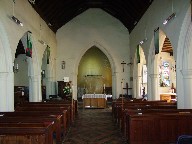
The
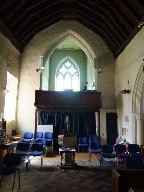
first impression on passing through the south
doorway is quite how little this church is. It
has the aisles and arcades you would expect of a
proud late medieval church, or a Victorian
imagining of one, but everything is done on a
small scale. My second impression was that this
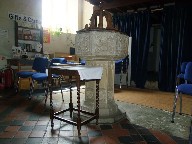
was a busy place which was well-used, giving a
cluttered feel which was not unattractive. And
then, turning towards the east, my eyes were
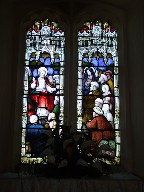
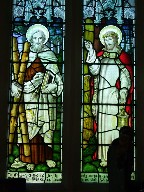
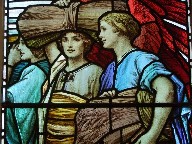
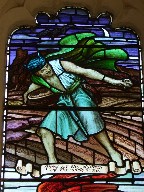
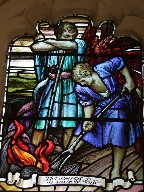
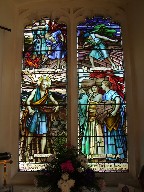
caught by this church's one great treasure, a
1920 window by AJ Dix. It is outstanding of its
kind, and compellingly modern. It illustrates the
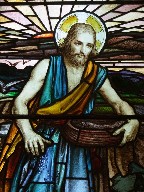
story of the sower who went forth to sow. The
lower left section depicts Christ sowing seed
broadcast from a basket ('A sower went forth to
sow his seed' reads the caption), and then two
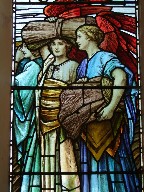
angels gather in the harvest ('Some fell on good
ground and sprang up and bare a hundredfold').
Only the traditional face of Christ betrays how
close we are to the 19th Century. The faces of
the muscular female angels carrying sheaths are
utterly contemporary, as if they might be
suffragettes. The story proceeds anticlockwise
into the upper lights, where a horned devil grins
wickedly as he sows tares ('Tares are the
children of the wicked one'), and then two male
angels burn the resulting weeds ('The harvest is
the end of the world').
The
subject seems to have been a popular one locally,
and there is another good window at Colne
Engaine, a few miles off in Essex, by Reginald
Bell. There are a couple of 19th Century windows
which are relatively mundane, but even with the
chancel blocked off there was plenty of light
inside the nave. I happened to know that the east
window is fairly large with five lights, and so I
expect this is never a gloomy place.
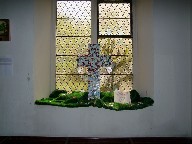
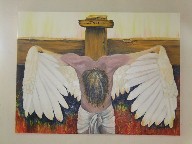
| Looking at the booklets and
posters, and an impressive if startling
painting of a crucified, winged Christ, I
got the impression that this is a fairly
radically evangelical community, and full
of life. And Great Cornard has a history
of radical action: this is one of just four
Suffolk parishes which stood up to the
puritan iconoclast William Dowsing. Dowsing arrived
here early in the morning of 20th
February 1644 - it was the first visit of
a series he would make to churches in the
Sudbury area over a period of four days.
He must have been full of energy. He took
up two brass inscriptions which asked for
prayers for the souls of the dead,
because the puritans considered these
superstitious. He gave orders for the
cross on the tower to be removed, and
also that the chancel steps, which had
been raised twenty years earlier during
the Laudian attempt to reintroduce
sacramental liturgy into the Church of
England, should be levelled again.
However, the churchwarden John Pain
refused to pay for this work, and so
Dowsing had him arrested. What happened
to John Pain is not known, but he must
have been a brave man.
|
|
 |
|
|
|