| |
|
 |
|
This is a church I
seem to revisit every five years or so,
and I'm always left wondering why I don't
come back more often. After the longest
winter I can remember, and a good five
months since my previous church exploring
bike ride, I set off from Bury St Edmunds
on a bright, cold Saturday morning
towards the end of February 2018, and
Great Saxham was my first port of call.
Nothing much had changed. A large oak
tree had fallen near to the fence of the
park in a recent storm, but otherwise it
was exactly as I remembered. It is always
reassuring to cycle off into rural
Suffolk to find that England has not
entirely succumbed to the 21st Century.
But Suffolk has changed in the
thirty-odd years I've been living here.
There is hardly a dairy farm left, and
not a single cattle market survives in
the county. Ipswich, Lowestoft, Bury, and
even the smaller places, are ringed by
out-of-town shopping experiences, and the
drifts of jerry-built houses wash against
the edges of nearly every village. But
the countryside has always been in a
state of perpetual change, a constant
metamorphosis, and often a painful one. I
had been struck by this before while
cycling across this parish, and the
memory added a frisson to the experience
of coming back. |
For many
modern historians, the Long 19th Century finished
on August 4th 1914, and you can see their point.
That was the day that the First World War began,
and the England that would emerge from the mud,
blood and chaos would be quite different. A new
spirit was abroad, and rural areas left behind
their previous patterns of ownership and
employment that were little more than feudalism.
Suffolk would never be the same again.
No more the Big House, no more the farm worker
going cap in hand to the hiring fair, or the
terrible grind to keep at bay the horrors of the
workhouse. I think of Leonard, remembering the
pre-war days in Ronald Blythe’s Akenfield,
that passionate account of a mid-20th century
Suffolk village, Charsfield: I want to say
this simply as a fact, that Suffolk people in my
day were worked to death. It literally happened.
It is not a figure of speech. I was worked
mercilessly. I am not complaining about it. It is
what happened to me. But the men coming home
from Flanders would demand a living wage. The new
world would not bring comfort and democracy
overnight, of course, and there are many parts of
Suffolk where poverty and patronage survive even
today, to a greater or lesser extent, but the old
world order had come to an end. The Age of
Empires was over, and the Age of Anxiety was
beginning.
The English have a love-hate relationship with
the countryside. As Carol Twinch argues in Tithe
Wars, it is only actually possible for
British agriculture to be fully profitable in war
time. In time of peace, only government
intervention can sustain it in its familiar
forms. Here, at the beginning of the 21st
century, British farmers are still demanding
levels of subsidy similar to that asked for by
the mining industry in the 1980s. With the UK's
exit from the European Union looming, the answer
from the state is ultimately likely to be the
same. British and European agriculture are still
supported by policies and subsidies that were
designed to prevent the widespread shortages that
followed the Second World War. They are half a
century out of date, and are unsustainable, and
must eventually come to an end.
But still sometimes in Suffolk, you find yourself
among surroundings that still speak of that
pre-WWI feudal time. Indeed, there are places
where it doesn’t take much of a leap of the
imagination to believe that the 20th century
hasn’t happened. Great Saxham is one such
place.
You travel out of Bury westwards, past wealthy
Westley and fat, comfortable Little Saxham with
its gorgeous round-towered church. The roads
narrow, and after another mile or so you turn up
through a straight lane of rural council houses
and bungalows. At the top of the lane, there is a
gateway. It is probably late 19th century, but
seems as archaic as if it was a survival of the
Roman occupation. The gate has gone, but the
solid stone posts that tower over the road narrow
it, so that only one car can pass in each
direction. It is the former main entrance to
Saxham Hall, and beyond the gate you enter the
park, cap in hand perhaps.
Looking back, you can see now that the lane
behind you is the former private drive to the Big
House, obviously bought and built on by the local
authority in the 1960s. It is easy to imagine it
as it had once been.
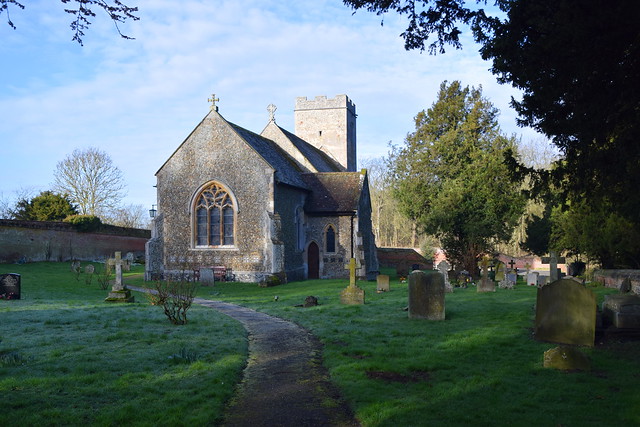
Beyond the gate is another world. The narrowed
road skirts the park in a wide arc, with woods
off to the right. Sheep turn to look once, then
resume their grazing. About a mile beyond the
gate, there is a cluster of 19th century estate
buildings, and among them, slightly set back from
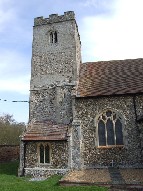
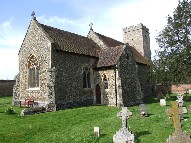
the road beyond an unusually high wall, was St
Andrew.
There was a lot of money here in the late 18th
and early 19th Centuries, so that you might even
think it a Victorian building in local materials.
But there is rather more to it than that. Farm
buildings sit immediately against the graveyard,
only yards from the church. When Mortlock came
this way, he found chickens pottering about among
the graves, and like me you may experience the
unnervingly close neighing of a horse in the
stables across from the porch.
The great restoration of this church was at a
most unusual date, 1798, fully fifty years before
the great wave of sacramentalism rolled out of
Oxford and swept across the Church of England.
Because of this, it appears rather plain,
although quite in keeping with its Perpendicular
origins - no attempt was made to introduce the
popular mock-classical features of the day. The
patron of the parish at the time was Thomas
Mills, more familiar from his ancestors at
Framlingham than here. There was another makeover
in the 1820s.
I've always found this church open, and so it
should be, for it has a great treasure which
cannot be stolen, but might easily be vandalised
if the church was kept locked (I wish that
someone would explain this to the churchwardens
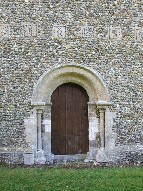
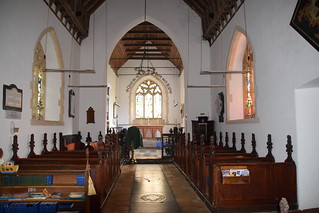
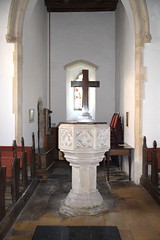
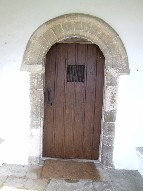
at Nowton). The careful restoration
preserved the Norman doorways and 15th century
font, and the church would be indistinguishable
from hundreds of other neat, clean 19th century
refurbishments if it were not for the fact that
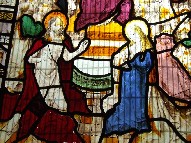
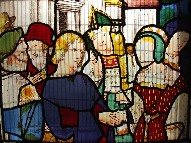
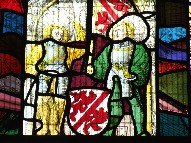
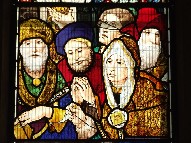
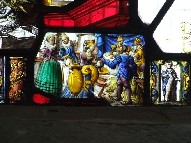
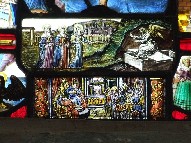
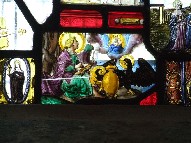
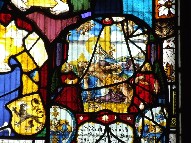
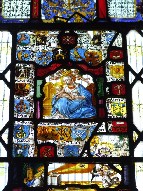
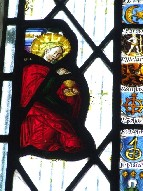
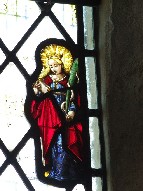
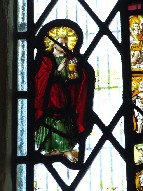
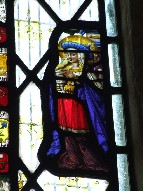
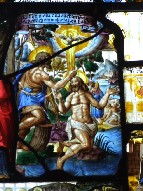
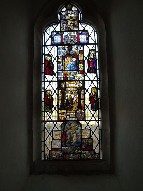
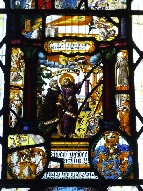
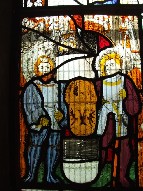
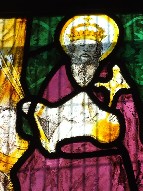
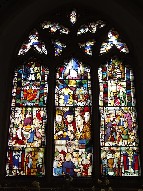
it contains some most unusual glass. It was
collected by Thomas Mills' son, William, and
fills the east and west windows. It is mostly
17th century (you can see a date on one piece)
and much of it is Swiss in origin. As at Nowton,
it probably came from continental monasteries.
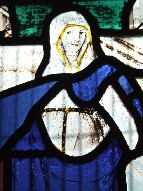
The best is probably the small scale collection
in the west window. This includes figures of St
Mary Magdalene, St John the Baptist and the
Blessed Virgin, as well as scenes of the
Annunciation, the Coronation of the Queen of
Heaven, the Vision of St John, and much more. The
work in the east window is on a larger scale,
some of it Flemish in origin.
There are several simple and tasteful Mills
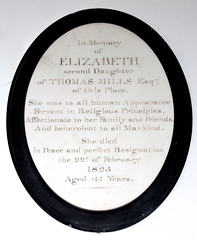
memorials - but the Mills family was not the
first famous dynasty to hold the Hall here. Back
in the 16th and 17th centuries, it was the home
of the Eldred family, famous explorers and
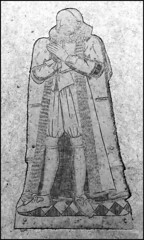
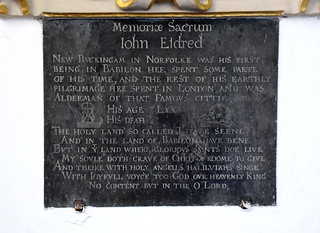
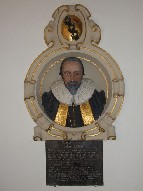
circumnavigators of the globe. John Eldred died
in 1632, and has one wall-mounted bust memorial
on the south sanctuary wall, as well as a figure
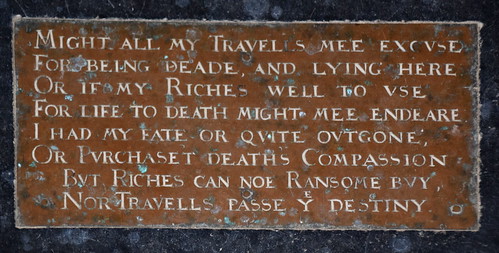
brass reset in the chancel floor from a lost
table tomb. Both are gloriously flamboyant, and
might seem quite out of kilter with that time, on
the eve of the long Puritan night. Compare them,
for instance, with the Boggas memorial at
Flowton, barely ten years later. But, although
the bust is of an elderly Elizabethan, I think
that there is a 17th Century knowingness about
them.
The
inscription beneath the bust reads in
part The Holy Land so called I have
seene and in the land of Babilone have
bene, but in thy land where glorious
saints doe live my soule doth crave of
Christ a room to give - curiously,
the carver missed out the S in Christ,
and had to add it in above. It might have
been done in a hurry, but perhaps it is
rather a Puritan sentiment after all,
don't you think?
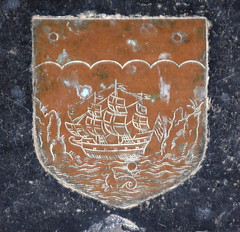
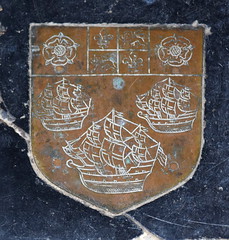
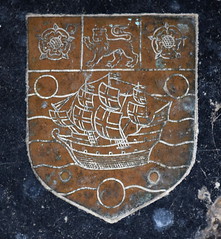
The brass has little shields with
merchant ships on, one scurrying between
cliffs and featuring a sea monster. The
inscription here is more reflective,
asking for our tolerance: Might all
my travells mee excuse for being deade,
and lying here, for, as it
concludes, but riches can noe ransome
buy nor travells passe the destiny.
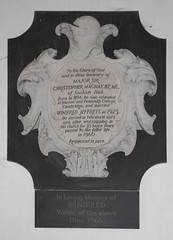
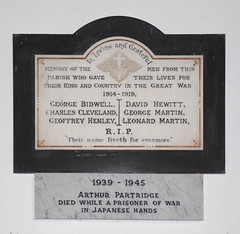
The First World War memorial remembers
names of men who were estate workers
here. And, after all, here is the English
Church as it was on the eve of the First
World War, triumphant, apparently
eternal, at the very heart of the Age of
Empires. Now, it is only to be found in
backwaters like this, and the very fact
that they are backwaters tells us that,
really, it has not survived at all.
|
|
 |
|
|
|