| |
|
Great
Wratting is the most southerly of the prettier
villages that line the Newmarket to Haverhill
road that winds down along the Cambridgeshire
border. Beyond here it starts to get a bit busy
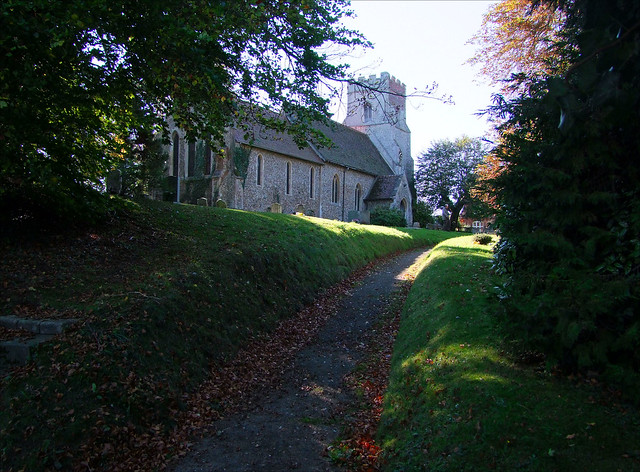
and industrial, but the church here sits on a
rise with the Hall and farm across the road and
the village street threading eastwards. The view
from the lychgate is memorable, as is the climb
up to the north porch, for this is a handsome
church if not a large one. Its story unfolds
westwards from the Early English chancel, the
14th Century nave and tower and the final
addition of the porch in the following century,
suggesting that there was no great amount of
money available here towards the end of the
medieval period for the aisles and clerestories
you find a few miles further south-east in the
Stour Valley. The crispness is the result of
restorations of the 1870s and 1880s, and these
decades are overwhelmingly responsible for the
feel of the building you step into. The west
end of the nave was screened off in the 1980s to
form a fairly large meeting room. The effect of
this in a church without aisles is rather
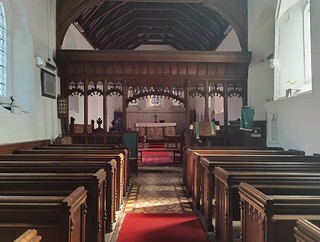
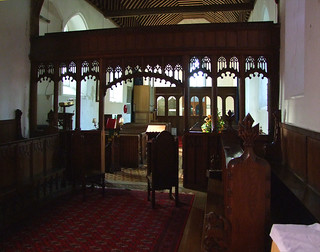
imposing. Equally imposing is the screen of a
century earlier beyond the benching, separating
nave and chancel under a wooden chancel arch. Its
elegant tracery under the solid coving of a
faux-roodloft is most effective. In comparison
with the nave, the chancel beyond is a richly
furnished intimate space, perfect for the
occasionally incense-led worship of the late 19th
Century High Church tradition. There are some
survivals of the earlier life of this place, but
not many. The two corbel heads westward of the
screen supported the medieval rood beam. The
curve of the former roodloft stairs is
discernable as an alcove behind the pulpit. Below
this to the west is a piscina to a former altar,
and, further east, the sedilia with another
piscina beyond them, which both must be recut I
think.
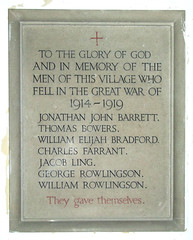
The
war memorial is a twin to that across the rolling
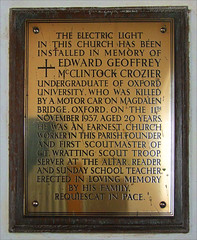
fields at Little Wratting. On the north wall of
the nave is the brass plate memorial to Edward
Geoffrey McLintock Crozier, who was killed by
a motor car on Magdalen Bridge, Oxford in
1937. to the east, Captain Robert Drake of the
Lincolnshire Regiment who, in 1914 was mortally
wounded during a successful attempt made by the
Regiment to capture a German battery, in the
Battle of the Marne. More of these memories
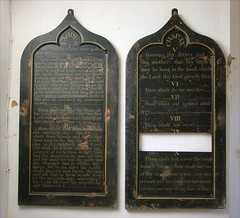
of the past are preserved back in the meeting
room. The early 19th Century decalogue boards
have lost the ninth commandment, giving the
unfortunate impression that the parishioners of
Great Wratting needed no longer refrain from
bearing false witness. A charity board remembers
James Vernon's bequest of a portion of the
weather cock charity amounting to ten pounds per
annum and a house for a widow. Also proudly
displayed is the certificate awarded to Great
Wratting when it came third equal in the 1995
Suffolk Village of the Year competition.
|
|
|