| |
|
This
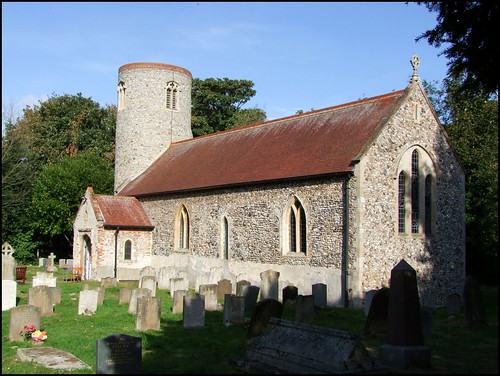
pretty little round-towered church is tucked away
in the pleasantly domestic northern suburbs of
Lowestoft, and has been for years. The parish
name is just a courtesy title really, and there
probably never was a village centre, for this was
the Hall church. The Hall itself is now a holiday
village, and the former grounds the home of the
Pleasurewood Hills American theme park, East
Anglia's biggest single tourist attraction. To
really appreciate the historic setting of this
church, you could do worse than leave your car in
their car park. You can then walk the quarter of
a mile along the footpath through the woods to
the church. Despite the
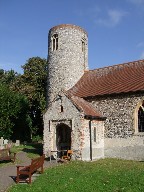
urban setting, St Peter is a truly rural church,
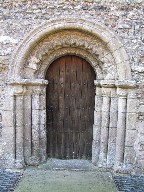
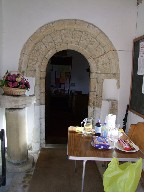
with a pretty round tower, and magnificent Norman
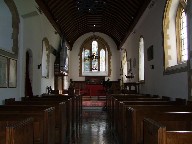
north and south doorways. The body of the church
was pretty well completely rebuilt in the 1890s,
although something of its earlier medieval
integrity has been preserved. Now, however, the
chancel and nave run under a single roof, and
there is no chancel arch anymore. The people of
the parish probably think that no one is
interested in seeing inside, because ordinarily
they keep this church locked, without a keyholder
notice.
| This is a sad reflection on
the people of Lowestoft, because in a
county where virtually all medieval
churches are open every day, or at least
accessible with a nearby key, the
churches of Lowestoft still lock us all
out. I have no doubt that this makes them
prey to vandalism, because, as the
Churchwatch charity have pointed out,
churches which are kept locked all of the
time are far more likely to be vandalised
than those which are regularly open, they
are twice as likely to be broken into,
and are even slightly more likely to have
something stolen from them. The irony is,
of course, that if parishes like this
suffer such a loss it tends to make them
even less likely to keep the church open,
and so the spiral of decline continues. However,
if you can, you step into a pleasantly
neat and trim late 19th century interior,
albeit rather gloomy from the tinted
glass. The building is obviously still
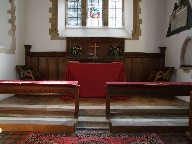
well-used and cared for. At the east end,
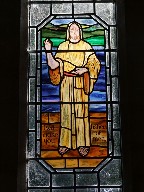
the rather awkward late Victorian triple
lancet window contains panels of simple
1960s glass depicting Christ and the
parable figures of a fisherman, a sower
and a reaper, a nice reference to the
main occupations of this part of Suffolk,
even if the design itself is not
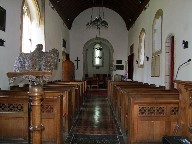
particularly exciting. More pleasing is
the view back to the west, down the
church to the tower, with good late
Victorian furnishings set in a sea of
shiny tiles.
|
|
 |
|
|
|