| |
|
Hadleigh is a
pleasant, self-important little town. It is one of those
places remote enough to be a microcosm of bigger towns -
the factories, shops and housing estates all to scale.
Its centrality in this part of Suffolk gave it the
headquarters of Babergh District Council in 1974, despite
the fact that the greater part of the population of the
district lives in the Sudbury conurbation and the
southern suburbs of Ipswich. Having said that, Hadleigh
has expanded greatly in recent years, with characterless
new estates now lining the bypass, and in any case
Babergh District Council has since merged with
Mid-Suffolk District Council and the councillors have all
toddled off to Stowmarket. But the heart of the town is
still probably the loveliest of any in East Anglia.
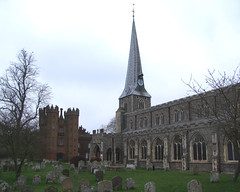
If Hadleigh is small, however, St Mary is not. This is
one of the grand Suffolk churches, the only big one with
a medieval spire which is also the only proper wood and
lead spire in the county. There are echoes of
Chesterfield in Derbyshire, only without the twist. It
was built in the 14th century, and the exterior bell, a
1280 clock bell doubling as a sanctus bell, is Suffolk's
oldest. The aisles, clerestory and chancel head eastwards
of it, equalling Lavenham in their sense of the
substantial. It is one of the longest churches in
Suffolk.
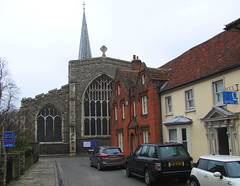
To the south west of the church stands the famous
Hadleigh Deanery, more properly the gorgeous red brick
Tudor gateway to the now demolished medieval Deanery. It
was at this Deanery gateway in July 1833 that the meeting
was held which gave birth to the Oxford Movement, and
went on to change the face of Anglican churches forever.
It is no exaggeration to say that the modern Church of
England was born in this building. The rector here, in
one of those anachronisms so beloved of the CofE, is
styled 'Dean of Bocking'. Bocking is a large village in
Essex, and the living is in the gift of the Archbishop of
Canterbury, so Hadleigh Rectors are installed in
Canterbury Cathedral.
The south side of the graveyard is taken up by the former
guild hall, and on the fourth side there is a scattering
of excellent 18th and 19th century municipal and
commercial buildings. With the possible exception of the
Bury churches, it is the best setting of any urban church
in Suffolk. Hadleigh was one of the great cloth towns, a
centre for merchants rather than factories (most of the
work was farmed out to self-employed weavers in nearby
villages, quite literally a cottage industry). The wealth
of those days rebuilt the church, particularly the fine
15th century clerestory and aisles.This is a big church,
since it needed to contain the chantry altars of at least
five medieval guilds. And it has always been an urban
church, as you can tell from the way buildings on the
north side cut into it. The east window was clearly
always intended to be seen up the gap to the busy High
Street.
The magnificent south doorway retains its original 15th
century doors. It is interesting to compare it with
Cotton, barely 50 years older, but from a quite different
generation of architecture. Gone are the delicate
fleurons, the articulate details that speak of an
internal sense of mystery. Here, we enter the realms of
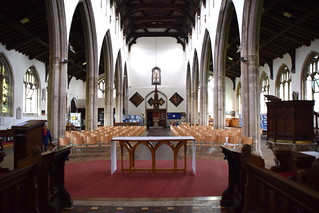
self-confident rationalism for the first time. You step
into a space that is light and airy, so vast that at once
it swallows sound, a feeling accentuated by the sheer
width of the chancel arch. Trees close by on the north
side gently wave shadows into the nave. It feels that the
church is organically part of the town and has been so
down the long centuries, although perhaps it is hard at
first to see this building as anything other than the
rather polite CofE parish church it has become.
If you'd been here some ten years or so ago, you might
have though that this was a very strange church, for
there was the surreal sight of a snooker table and a pool
table in the north aisle. They were part of what was
called the Hadleigh Porch Project, an attempt to provide
something to do for teenagers in the town who had been
causing a nuisance in the churchyard and porch. The
parish galvanised itself and attracted funding, and the
building became used by young people for secular
activities, one idea being that the sense of ownership
conveyed would give them a sense of responsibility.
Coming here in Lent of 2013, I was struck by the Stations
of the Cross lining the arcades, each created by a local
youth group or organisation. They were radically
different from anything I'd seen before, and I'm sure
that Maggi Hambling's Christ, looking on from the north
aisle, would have approved.
Coming back in 2019, the snooker and pool tables have now
gone, and so have the run of the mill Victorian benches
that filled the nave. Regular users of this site will
know that I am an enthusiast of replacing 19th Century
pews with modern chairs in medieval churches, but here
you can't help feeling that it hasn't really been done
very well. The chairs themselves are not the problem so
much as the floor, which has been left with expanses of
floor boards between the lines of poor encaustic tiles.
Perhaps there are plans to replace all of this with a
polished wood and pamment floor (Oundle in
Northamptonshire is a good example on a similar scale). I
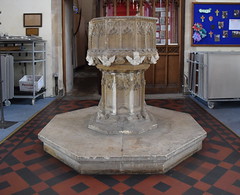
hope so. At the west end of the nave is a very curious
font, a typical 15th Century example but it has been
augmented by terrible 19th Century angels moulded on
around the base of the bowl. The cover above is by the
Anglo-Catholic craftsman Charles Spooner, part of a 1920s
refurbishment which also brought his war memorial and a
tower screen by Munro Cautley. The slightly later
memorial to Dean Carter has tablets by Eric Gill.
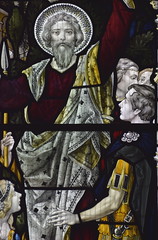
The sheer size of the nave and its aisles stops the
stained glass overwhelming it, which is a relief because
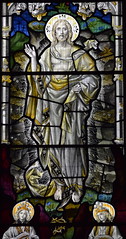
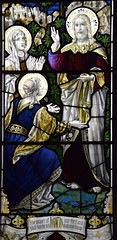
there is a lot of it and it is by no means all good. To
start with the best, there is a 1988 window by John
O'Connor for Chapel Studios beside Maggi Hambling's
painting, a memorial to John Betton, a former rector. But
the glass in the south aisle is mostly by Ward &
Hughes, and some of it very poor indeed, from the height
of that period when Thomas Curtis was trashing the brand.
George Hedgeland's painterly window at the east end of
the south aisle is half a century earlier, and appears
more at home.
Of course, there is much here that is older and more
traditional. In the south chancel chapel is what has
become known as the St Edmund bench end, attached to a
modern bench. It appears to shows a wolf, with the
Saint's head in its jaws. But a closer look shows that
the beast has cloven hooves, and what are either wings
and a collar or possibly eucharistic vestments. It is
more likely related to those bench ends more common in
east Norfolk depicting a mythical beast holding the head
of St John the Baptist. There are squints through to the
high altar from this chapel, so this was probably the
site of a guild altar.
There are recent memories of the High Church past of St
Mary. In the high sanctuary are not one but two plaques
to former Dean Hugh Rose, one commemorating his
conference that led to the Oxford Movement, and the other
the centenary of that movement, laid by the Archbishop of
Canterbury in 1935. One of the plaques quotes Pusey's
eulogy to Rose, that when hearts were failing, he
bade us stir up the gift that was in us, and betake
ourselves to our true mother. Another religious
figure associated with Hadleigh is the puritan preacher
Rowland Taylor, who was burned at the stake on nearby
Aldham Common in the brief but unhappy reign of Mary I.
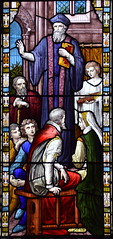
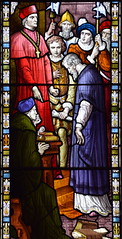
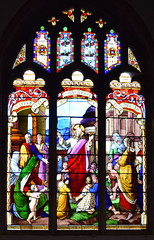
One of the Ward & Hughes windows in the south aisle
tells his story.
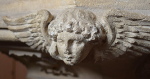
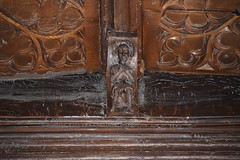
Up in the chancel, grinning figures peer down from the
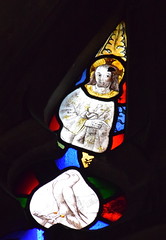
roof, and in the east window of the north chancel aisle
is a small collection of old glass, including heraldic
shields, a Tudor royal arms and haunting fragments of
15th Century English glass, all that survives of what
must once have been one of the largest expanses in
England, a sobering thought. Several of the shields are
for Archbishops of Canterbury, reflecting Hadleigh's
significance in the ecclesiastical firmament, and yet the
church has surprisingly few grand memorials for a market
town church. But Hadleigh was not a particularly strongly
non-conformist town. At the time of the 1851 Census
Religious Worship there were a little over 3700 people
living in the parish, and 680 of them attended morning
worship at the church, roughly one in five, although this
did include 220 scholars who perhaps had little choice in
the matter. Meanwhile up the road at the Congregational
chapel there were slightly more than 1000, but of course
as a gathered congregation this would have included
people who had travelled into Hadleigh from outside.
There were also two Primitive Methodist chapels and a
Baptist chapel, and all in all the people of Hadleigh
seem to have been enthusiastic churchgoers when compared
with many other East Anglian towns.
Simon
Knott, December 2019
Follow these journeys as they happen at Last Of England
Twitter.
    
  


Amazon commission helps cover the running
costs of this site
|
|
|