St Mary, Halesworth

www.suffolkchurches.co.uk - a journey through the churches of Suffolk
|
St Mary, Halesworth |
|
|
||
www.suffolkchurches.co.uk - a journey through the churches of Suffolk |
||

Follow these journeys as they happen at Last Of England Twitter.
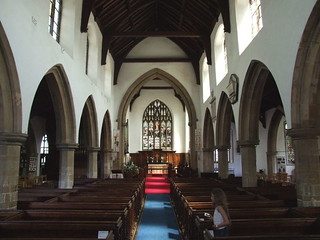
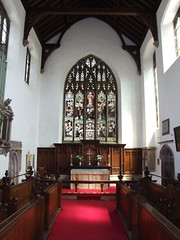
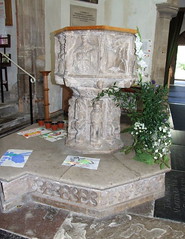
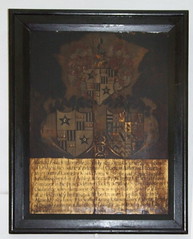
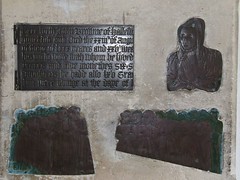
Halesworth's main street, the Thoroughfare, is one of the prettiest and most interesting main streets of any of East Anglia's smaller towns, and just around the corner to that is St Mary, the kind of decent, central medieval parish church which makes a town, as if Halesworth wasn't a delight already. A remarkable number of medieval wills survive for Halesworth's church, giving us a picture of its reconstruction in the 15th Century. We know that the tower was complete by 1426, when it was cited as a model in the contract for the new tower at Walberswick. Remains of the round tower that it replaced are apparently under the floor near to the font, so the church was lengthened at this time. In 1438 Thomas Clement left 20s to the reparation of Halesworth church. This was probably towards the new chancel, for as we shall see inside his dedicatory inscription asking for prayers for his soul and that of his wife Margaret survives there. From the 1470s onwards bequests were being made towards a new bell and to furnishings, so it is safe to assume that the church was pretty well complete by then. Interestingly, a number of these bequests tell us that the medieval dedication of the church was to the Assumption of the Blessed Virgin, that great festival day on August 15th at the height of the harvest when the whole of East Anglia seems to have ground to a halt, in those days before the Reformation. As often in small town churches, the 19th Century restoration here was vigorous and not terribly kind, despite a number of interesting survivals. The aisles were rebuilt in the 1860s by FJ & H Francis, as were the chancel and tower arches. Given the exquisite detailing on the 15th Century arch into the north aisle chapel, we may have lost some rather lovely things. The font is one of typical East Anglian examples of the 15th Century, and is probably contemporary with the completion of the tower. Lions and woodwoses guard the base, while around the bowl are the symbols of the four Evangelists, and angels holding shields including a Holy Trinity symbol and the Instruments of the Passion. On the walls flanking the tower arch are reset some odd fragments of a 1580s brass - an inscription, a woman's head and shoulders, two groups of children. They are all that is left of the figure brass to John Browne and his family, which were apparently recovered from the Waveney in the 1820s. There is no reason why 17th Century puritan iconoclasts would have thought ill of it, so most likely it was stolen from the church by a collector and then later discarded. The 17th Century provides its own oddity with a wooden memorial panel of the 1640s to Richard Assheton. It's safe to assume that these things were once much more common, and perhaps it did well to escape the attention of the 19th Century restoration here. The nave has been
cleared of its 19th Century benches since I took the
photographs below in 2007, which helps remove some of the
gloom that the dour Ward & Hughes glass casts. Up in
the sanctuary there are a couple of curious survivals.
The relief below the south piscina depicting hands
gripping foliage was found under the floorboards,
presumably mislaid and forgotten at some time of
reconstruction. It is claimed as Saxon, although James
Bettley revising the Pevsner for East Suffolk thought it
likely to be 12th Century. The piscina has an aumbry set
within it, an odd Victorian nod towards the revival of
sacramental practice. Across the chancel, the doorway to
the vestry has a pretty Perpendicular arch and above it
the 1438 dedicatory inscription asking us in Latin to
pray for the souls of Thomas Clement and his wife
Margaret. |
Simon Knott, April 2021
Follow these journeys as they happen at Last Of England Twitter.





|
||||||||||||||||||||||||||||||||||||||||||||||||||||||
Amazon commission helps cover the running costs of this site