St Edmund, Hargrave

www.suffolkchurches.co.uk - a journey through the churches of Suffolk
|
St Edmund, Hargrave |
|
|
||
www.suffolkchurches.co.uk - a journey through the churches of Suffolk |
||



Follow these journeys as they happen at Last Of England Twitter.
| To say that St Edmund is off the
beaten track depends on how much beating you are prepared
to do, I suppose. A narrow back lane heads away from the
village on the Haverhill to Bury St Edmunds road towards
the Hall, and after half a mile or so there's a narrow
muddy bridleway leading off to the right past the old
rectory. You might easily miss it. It leads, after a
couple of hundred yards or so, to a small clearing, the
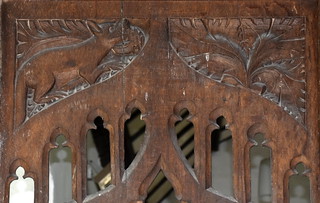
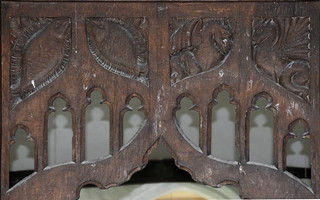
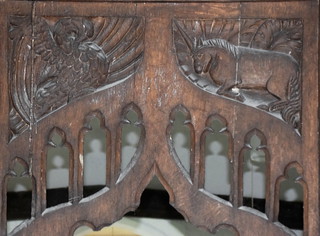
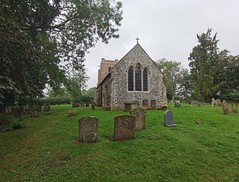
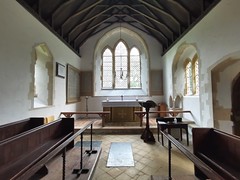
churchyard of St Edmund. This is a small church which appears to be mostly of the 13th Century, but there is more to it than meets the eye. The red brick tower must be of the 16th Century, but a bequest of 1401 survives towards the fabric of the tower. So if it was ever built what we see today must be a replacement. Did the old one fall, perhaps? The rector in the late 19th Century was Samuel Chamberlain, and his wife was the patron of the living. The architect of the considerable 1860s restoration, which included the building of a wide north aisle which Pevsner rightly called humble, was at the hands of one Ralph Chamberlain, presumably a relation. He doesn't seem to have been responsible for any other work in Suffolk. The south doorway is simple, without a porch, though there was one until it was wrecked during the Second World War by a German bomber dropping off its spare bombs before attempting the hazardous crossing back across the North Sea. You step into an inevitably low, square interior. The chancel is in the south-east corner and is boxed in by a late 15th Century screen. If you walk through the screen and turn to look at the east side of it there is the surprise of a sequence of carvings in the spandrels of the upper part above the lights - that is to say, they are on the side of the screen facing the altar and east window, not on the west side facing the parishioners.
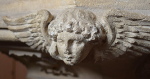
At the top, in the spandrels above the arches, are carved in relief a fox carrying a hen, a unicorn, an eagle, a saracen's head, several wyverns and curiously a pair of flat fish. The carving is delightful but rustic, presumably carried out by a local, and can have been done for no other reason but decoration. It is not impossible I suppose that the screen has been reset the wrong way around in more recent years, but looking at the west side of it that doesn't seem to be the case. Above, the rood beam survives with decorative carvings. Justin Rabett, churchwarden at Hargrave, tells me that the survival of this church is something of a miracle. In 2014 cracks began to open in the east wall of the chancel, widening dramatically over the next few years. The problem was traced to the the fact that the wall, which lacked proper foundations, was sinking into the wet ground, not only parting the wall from its adjoining neighbours to south and north but seriously disrupting the window tracery above. The wall certainly would have collapsed if ignored, but thanks to a massive fundraising effort and the awarding of grants, work was carried out over 2020 and the church was returned to use in time for Christmas that year,a heartwarming story. To stand in the chancel now you wouldn't know that there had ever been a problem. At the time of the 1851 Census of Religious Worship the rector here was John White. He was also rector of Chevington, one of the last examples of plurality in Suffolk. The annual income from the two was almost £700, which is roughly £140,000 in today's money. His successor was Samuel Chamberlain, who can only have been in his late twenties at the time, and who oversaw the major restoration of the 1860s. He died in 1896 at the age of sixty, and his memorial in the nave remembers the sincere affection and lasting respect of the parishioners. The church we see today is certainly one that he would still recognise, a simple interior made more special perhaps by the setting of the church. One to remember. |
Simon Knott, September 2021
Follow these journeys as they happen at Last Of England Twitter.




|
||||||||||||||||||||||||||||||||||||||||||||||||||||||