| |
|
 |
|
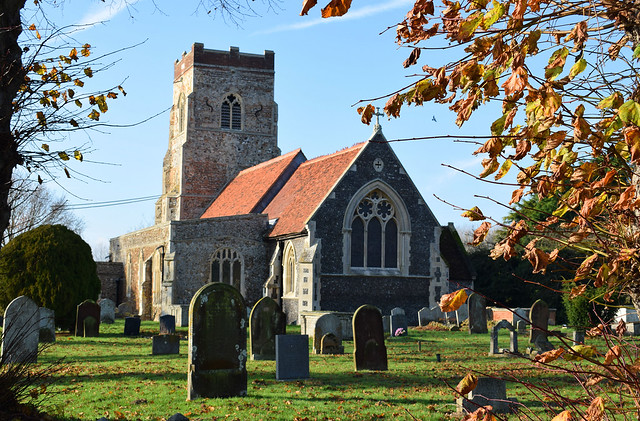
Not far from the
Stour estuary and within sight of the
modern world that is Essex, this sleepy
church raises its head above the trees
and looks out across the rolling fields.
Harkstead is a lovely village, more a
scattering of settlements really, like so
many on the Peninsula. Away from the
village centre, the church is in a quiet
lane, surrounded by woodland and meadows,
in as lovely a setting as any in Suffolk.
The warm colours of the tower betray the
fact that, as with many along this coast,
the tower is largely built of septaria,
the hardened mud found in the estuary
mouths of the Suffolk rivers.
Unfortunately septaria becomes friable as
the centuries pass, but Harkstead tower
still stands, a mark that this is a more
sheltered spot than Bawdsey and Alderton
not far off, where the towers succumbed
to the elements in the 18th and 19th
centuries. |
In midsummer the lanes here
are wildly hedged, and if you catch a breeze from
the river it is a pleasant relief from the high
sun. In autumn, the land begins to turn in on
itself; back in 2008 I had cycled from Erwarton
through the busy harvest being gathered, and ten
years after my previous visit as a young man I
had felt a sense of something passing, of Suffolk
beginning to relax and ready itself for winter.
And now another eight years had passed, and it
was winter again. Towards the end of November
2016, a beautiful Saturday morning dawned crisp
and bright, and so I set off out of Ipswich for a
bike ride around the Shotley peninsula. First
Woolverstone, and then across to the winding
lanes across the ploughed fields, a weasel
chattering at me angrily as it ran across the
road in front of me, and then I came to Harkstead
and its church. The tall graveyard trees were
almost bereft of their leaves, just a few hanging
on now in the breeze from the Stour estuary. At
the heart of it the church, looking all of its
19th Century restoration.
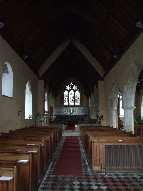
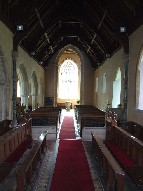
In fact, St Mary was almost entirely reinvented
during the 1860s. At this time the chancel was
rebuilt, and the fixtures and furnishings
replaced with a good example of a Victorian High
Church interior. Almost nothing medieval survives
inside, but still the feeling is of a pleasing
combination of the rustic and the triumphant. How
wide-eyed the villagers must have been when they
saw what their little church had become! Below
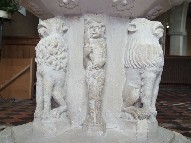
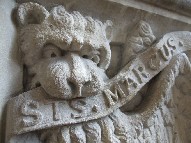
the remarkably tall tower arch, the font was
completely recarved with the typical East Anglian
design of Evangelistic symbols and angels
alternating on the bowl, and lions and woodwoses
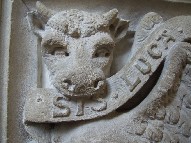
alternating on the stem. The Evangelistic symbols
hold scrolls with their Saints' names in Latin, a
nice High Church touch.
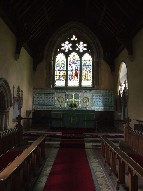
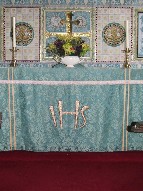
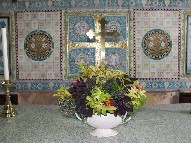
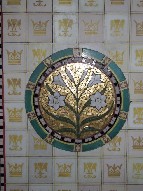
Matching it at the east end is the fabulous
reredos and tiled sanctuary, the work of Powell
and Sons. A lady I met inside joked that it
reminded her of the tiles of a public lavatory,
but I thought it was better than that, recalling
more the high Victorian decoration of those great
urban public houses you still find in big cities,
with which it is almost exactly contemporary. In
2008 it was still dressed in a flamboyant High
Church style, but not today. There is an intimacy
in seeing this kind of work on such a small scale
which gives you a frisson, a sense of
the seriousness and ecstasy of the Anglican
catholic revival in outposts like this. As the
tide of Anglo-catholicism recedes, places like
this become a touchstone to our not-so-distant
ancestors, and what prayer and worship meant to
them.
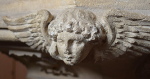
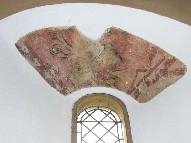
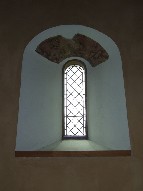
A single medieval survival is the fragment of
wallpainting opposite. A batwinged figure appears
to extend a ball in its left hand, and for one
moment I mused that this might be the medieval
occasion on which Ipswich Town Football Club sold
their souls to become more successful than they
ever had a right to - but then, I'm a Cambridge
United fan. Perhaps it is really part of a 15th
Century Warning against Gossip.
Thirty years ago I had friends who lived in
Harkstead, but over the years we had lost touch.
As I was exploring St Mary in 2008, an old lady
came in. She stood down by the west end, leafing
through the visitors book, apparently reading the
comments. I went and asked her if she was from
Harkstead. "Oh yes, dear, I'm from
Harkstead!" she replied fervently. I asked
her if she knew my friends, and if they were
still living in the village. She thought for a
moment, and then said "sorry, dear,
but..." It turned out that she had left the
village in 1939 to go and work in Ipswich, where
she now lived, and had never moved back. But she
still came to visit Harkstead at least once a
month, and always visited the church, and knew
that one day she would be buried in the soft
ground around St Mary. I thought that this was
beautiful, and it told me pretty much everything
I needed to know about the parish of Harkstead.
Coming this way in the late 1990s, I arrived a
few months after Harkstead had lost its village
shop and its post office. Local people were
fighting to keep their pub. I wondered then if
villages like this were in danger of becoming
rather pretty ghost dormitory villages, for
professionals working in Ipswich. Would their
churches lose their central role in the lives of
the villages, I wondered?
Coming back, it is
good to see that the Bakers Arms is still
thriving, although it now seems
extraordinary that Harkstead had ever had
a village shop or a post office. But the
church is still open, and there is still
a feeling that St Mary is at the heart of
a living community.
It is easy to indulge yourself with the
adjective timeless when you
stand in a church like that of Harkstead.
But it wouldn't be true of course, and change
and decay in all around I see, but
after all, part of the beauty of our
ancient churches is their sense
of continuity and change. And how will
our communities survive without change?
Harkstead may not. But I like to think
that there is something timeless about
this gorgeous setting, and that the
pattern of summers, flickering again
across its high trees, and the winters
with their skeletal trees, ploughed
fields and weasels, is one that would be
recognised by the ghosts of passing
generations. |
|
 |
|
|
|