The Assumption, Haughley

www.suffolkchurches.co.uk - a journey through the churches of Suffolk
|
The Assumption, Haughley |
|
|
||
www.suffolkchurches.co.uk - a journey through the churches of Suffolk |
||


Follow these journeys as they happen at Last Of England Twitter.
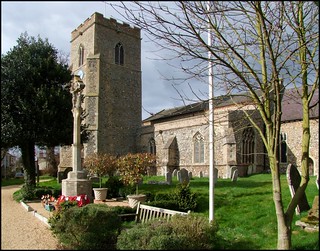
| Haughley is a fairly large and
busy village to the north of Stowmarket, but it benefits
from a lovely main street of cottages along a narrow
green. The church is set in a knot of little roads, and
presents itself in an unusual way. This is one of East
Anglia's thirty-odd south towered churches, but as you
approach, the tower and nave appeared to be quite
separate, as if they had been built without regard to
each other, and a south aisle built between them, joining
the two together. The nave is tall and the aisle low, so
the effect is unusual. There is still a sanctus bell
turret on the nave gable, which may well be original. The
dedication may also seem unusual. In fact, it was
probably once the most common church dedication in
Suffolk. The Feast of the Assumption is on August 15th at
the height of the harvest, and in a strongly Marian
county like Suffolk it was always a popular feast. A fair
was held on August 15th in the village until well into
the 19th Century, but Simon Cotton urges caution,
pointing out that no medieval wills refer to the
dedication of the church here as the Assumption of the
Blessed Virgin. The war memorial in the form of a rood
group to the south of the church may provide a clue, for
it suggests an Anglo-Catholic enthusiasm here at the tie,
which may well also have led to the adoption of the
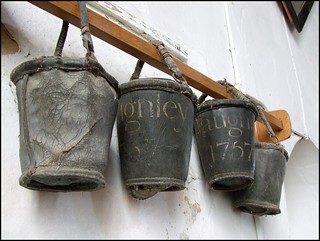
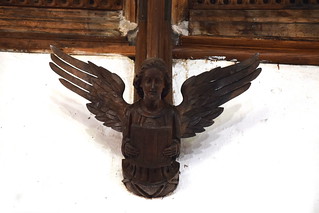
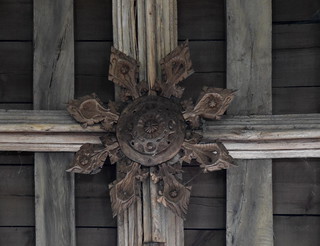
dedication. The tracery of the south aisle is all Decorated, that of east and west windows and chancel an enthusiastic Perpendicular, so presumably replacements. Pevsner thought that the church was pretty well complete by the middle of the 14th Century, but if that is the case there was certainly plenty going on in the later medieval period. Peter Northeast and Simon Cotton transcribed wills from the 1460s onwards which, among other things, left bequests for the reparation of Haughley church, the new glass in the window of the chapel of St Mary, and the reparation of the candlebeam (ie rood screen) of the said church. Things get even more interesting as the Reformation approaches, for in 1517 Robert Hall left 6s 8d to the reparation of the aisle in Haughley church, while in 1520 and 1521 Thomas Austin and Thomas Halle both left money to the making of the aisle. This clearly cannot refer to the current south aisle, and there is no north aisle. Was one planned and then not built? As is usual in churches arranged like this, you enter beneath the tower which serves double duty as a porch, although in this case there are no bell ropes because the bell ringing chamber is above. I remember that back in the 1990s, the first time I stepped into the porch, it was with some expectation, because there is a photograph taken here by Munro Cautley in the 1930s which shows an array of 18th Century leather fire buckets suspended from the ceiling. In fact, by then the buckets had been moved inside, but the hooks are still there. Also, there are several beams which have a regular sequence of rebates in. They are clearly former uprights of the late medieval roodscreen pressed into service to support the ringing chamber floor. You step into the aisle and then into the nave beyond, which opens upwards, tall and wide, full of light. It is impressive if somewhat stark and barn-like. The late medieval roof is splendid, a sequence of tie beams and arched braces, the whole thing studded with bosses. A new extension beyond the former north doorway is now home to the buckets which hang from the roof.
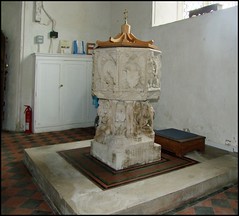
The ceiling of the chancel is barrel-vaulted, which is practical and pleasing. I'm told it was built to improve the acoustics after the organ was installed in the organ chamber in the late 19th Century, and that there is a medieval scissor-braced roof underneath it. The choir stalls below were still used by a traditional robed choir when I came here in the 1990s, an unusual survival in rural Suffolk. In the 17th Century, Haughley was in the curious situation of having a recusant Lord of the Manor, and a puritan minister. The iconoclast William Dowsing didn't come here, and perhaps he didn't think he needed to, although he must have actually passed the church on the day he dealt with Wetherden. The Sulyards of Haughley Park were recusant Catholics, but their house was closer to Wetherden church, and the Sulyards glorified the church there. Not far in the other direction is Gipping, home of the equally recusant Tyrrells, who were even more unpopular with the Puritans. Eventually, most such landed gentry paid the price for their beliefs, and by the start of the 19th Century the protestant Crawfords were in possession of Haughley Park and were putting up their hatchments and commemorating their dead in the south aisle here. From inside, the south aisle appears a substantial creation, but low roofed. Most aisles were built to enable liturgical processions, and had the added advantage of providing more space for gild and chantry altars. But the south aisle here may actually have been built as a chapel dedicated to the Holy Cross. The roof is a riot of angels, some of them playing musical instruments. At the west end of the aisle stands the font, an example of the typical 15th Century East Anglian design. Not a great deal else remains from that time. The rood beam mentioned in those 15th Century wills was still in existence in 1865, but no trace survives today. Simon Knott, April 2022 Follow these journeys as they happen at Last Of England Twitter. |




|
||||||||||||||||||||||||||||||||||||||||||||||||||||||